
By Orit Naomi, RTN staff writer - 8.8.2025
Fast-casual sandwich chain Potbelly is turning its investments in technology and store design into measurable growth, prompting the company to raise its same-store sales outlook for the year. The brand, known for its toasted subs and urban storefronts, is modernizing its infrastructure and shrinking its real estate footprint as part of an ambitious plan to reach 2,000 locations through franchising.
For the second quarter ending June 30, Potbelly reported a 3.6% increase in same-store sales, with traffic rising 1.1% year over year. Digital channels accounted for 41% of sales, up 200 basis points from the same quarter in 2024, thanks in part to a redesigned website and mobile app rolled out in June. The company also reported improved restaurant-level margins, up to 16.7% from 15.7%, and average weekly unit volumes of $27,040.
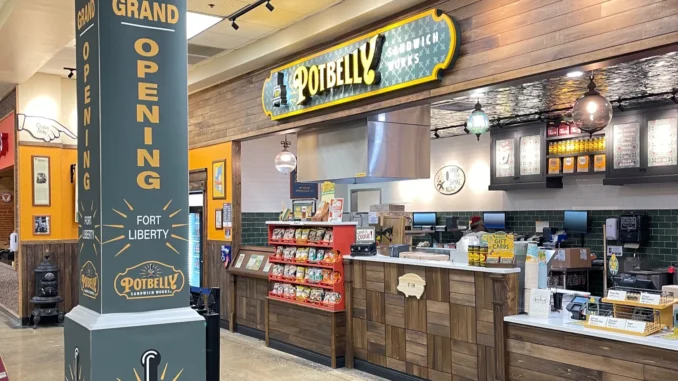
Beyond the numbers, Potbelly is transforming its restaurant model to be faster, more efficient, and easier to scale. That evolution starts with a new 1,800-square-foot prototype, about 500 square feet smaller than previous formats, that is designed to optimize digital transactions, streamline operations, and lower development costs. The updated layout includes a digitized kitchen backline, reoriented pickup shelves, a more efficient makeline, and seating tailored to today’s balance of dine-in and off-premise traffic.
The first franchised location featuring the prototype is expected to open in Arkansas this month, with more on the way. CEO Bob Wright noted the flexible design can be adapted to rectangular, square, or even triangular site footprints, avoiding the rigid build specs that once defined QSR development. That flexibility, along with aesthetic changes that don’t require permitting, is already helping bring development costs below the chain’s historical average of $650,000 per unit.
Technology is playing a central role in Potbelly’s evolution. The company’s Digital Kitchen platform, comprised of kitchen display systems, an upgraded POS, and back-of-house workflow tools, is now standard in all new locations and will be rolled out across the system by the end of 2026. Wright views these tools not as bells and whistles but as core infrastructure that can improve order accuracy, reduce throughput time, and deliver consistent guest experiences across a growing franchised footprint.
This modernized model is already supporting faster growth. During the second quarter, Potbelly opened eight new shops, exceeding expectations. It also added 54 new franchise commitments, bringing its development pipeline to 816 locations. The company now operates 447 units, including 340 company-owned and 107 franchised stores. Most of the 38 expected new openings this year will be franchised, part of a broader shift toward a more asset-light model.
To accelerate growth, Potbelly has been offering incentives such as reduced royalties and fees to franchisees who open stores ahead of target timelines. The goal is to convert demand into development more quickly, with a focus on underpenetrated markets where digital infrastructure, smaller real estate footprints, and lower buildout costs can translate to stronger returns.
In an increasingly competitive fast-casual market, where tech-driven convenience and efficient unit economics are becoming table stakes, Potbelly’s focus on flexible prototypes and digital-first operations puts it in a stronger position than in years past. Larger chains like Panera and Chipotle are investing in automation and AI-enabled back-of-house systems, while others like Subway are updating mobile platforms and streamlining store formats.
Potbelly’s more measured approach, focused on scalable digital tools and cost-efficient growth, may not grab as many headlines. However, it reflects a pragmatic view of what franchisees need and what customers expect. If the company can maintain this balance of innovation and discipline, it may well achieve its long-term goal of becoming a 2,000-unit national brand.

