By Jeff Zabin and Paulina Hubli, RTN staff writers - 5.13.2026
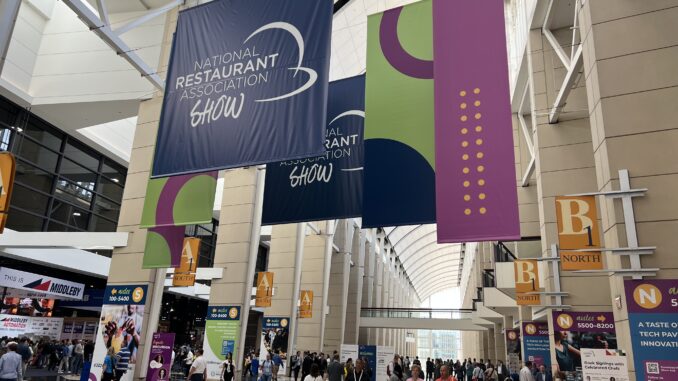
The 2026 National Restaurant Association Show arrives in Chicago this weekend at a pivotal moment for the industry. Restaurant operators are entering the second half of the year facing rising labor costs, continued pressure on margins, increasingly cautious consumers, and growing expectations around convenience, personalization, and operational speed. Against that backdrop, the annual event at McCormick Place has evolved beyond a traditional trade show into something closer to a strategic planning exercise for restaurant executives trying to determine which technologies, platforms, and operational models are actually worth investing in.
Running May 16-19, this year’s Show is expected to attract tens of thousands of foodservice and hospitality professionals from around the world, with more than 2,200 exhibitors spread across more than 700,000 square feet of exhibit space. Organizers say the floor will feature more than 900 product categories, ranging from AI-enabled equipment and restaurant automation systems to new loyalty, off-premises, kitchen efficiency, and back-office solutions.
The sheer scale of the event reflects how quickly the restaurant technology landscape continues to evolve. For many operators, the challenge is no longer simply finding new tools. It is figuring out which technologies can actually reduce complexity, improve throughput, lower labor dependency, and deliver measurable ROI in an environment where operating costs remain elevated and guest expectations continue to rise.
According to research cited by the National Restaurant Association Show, nearly 90 percent of operators expect food and labor costs to continue increasing this year, while 80 percent of consumers say overall value remains their top priority when dining out. Those competing pressures are helping fuel demand for technologies that can simultaneously improve efficiency and protect the guest experience.
Artificial intelligence will likely dominate many conversations on the show floor, though the discussion has become noticeably more practical compared to previous years. Rather than broad theoretical conversations about AI replacing restaurant workers, vendors are increasingly focused on targeted operational applications that can help solve specific pain points.
One area expected to draw significant attention is AI-powered voice automation. SoundHound AI, for example, plans to showcase its conversational AI platform designed to support restaurant ordering and guest interactions. “The National Restaurant Association Show is an opportunity for us to not only demonstrate how AI voice is changing restaurant operations, but to gather critical insights from the industry community,” said Ben Belletini, SVP of Sales at SoundHound AI.
Voice AI, however, is only one piece of a much broader automation movement taking place across the industry. Kitchen automation, predictive inventory management, labor optimization platforms, smart equipment, and AI-assisted drive-thru technologies are all expected to feature prominently throughout the Show. Operators are increasingly seeking technologies that do not merely add features, but eliminate friction.
That operational focus also extends to loyalty and guest engagement. Restaurants are moving beyond generic points-based rewards programs toward more integrated engagement strategies that connect digital ordering, mobile apps, in-store experiences, personalization, and first-party data collection. As customer acquisition costs continue climbing, many brands are prioritizing technologies designed to improve repeat visitation and increase customer lifetime value.
The industry’s growing emphasis on unified commerce and guest data management is also expected to shape many discussions at this year’s event. Operators are trying to connect previously fragmented systems spanning POS, loyalty, online ordering, labor management, kitchen operations, payments, and marketing automation into more cohesive ecosystems. The ability to consolidate and operationalize data has become increasingly important as restaurant brands pursue more personalized marketing and AI-driven decision-making.
At the same time, cost control remains central to nearly every purchasing conversation. The Show’s Kitchen Innovations Awards, which recognize equipment focused on automation, efficiency, safety, and sustainability, reflect the growing industry focus on technologies capable of improving margins without sacrificing quality or consistency.
The continued expansion of grab-and-go, off-premises dining, and hybrid service models is also influencing investment priorities. Restaurant operators are increasingly evaluating technologies that support faster fulfillment, improved order accuracy, digital menu flexibility, and streamlined kitchen workflows. Many are also reassessing physical store layouts and equipment strategies to better support omnichannel ordering behavior that became normalized during the pandemic and has continued evolving since.
Meanwhile, beverage innovation and menu differentiation remain major priorities as operators search for new ways to drive traffic and increase average ticket sizes. The Show’s FABI Awards and beverage demonstrations will highlight emerging food and beverage trends, including functional ingredients, globally inspired flavors, and new beverage concepts designed to appeal to younger consumers seeking novelty and customization.
Networking and relationship-building also remain central to the Show’s value proposition. While restaurant technology vendors increasingly rely on digital sales and virtual demos throughout the year, the National Restaurant Association Show continues to provide one of the industry’s few opportunities for operators, suppliers, investors, and technology providers to meet face-to-face at scale. That dynamic becomes especially important in a fragmented technology environment where operators are often evaluating long-term platform relationships rather than one-off software purchases.
For emerging restaurant technology vendors, the event can also serve as a critical visibility opportunity. With more than 650 companies making their Show debut this year, competition for operator attention will be intense. Many smaller vendors are hoping to capitalize on growing operator appetite for specialized solutions that address narrow but persistent operational problems.
Ultimately, this year’s National Restaurant Association Show arrives at a moment when the restaurant industry is under pressure to modernize faster while simultaneously controlling costs more aggressively. The technologies and partnerships gaining traction at McCormick Place will likely provide an important preview of where restaurant operations, guest engagement, and foodservice innovation are headed over the next several years.
