
By Dustin Stone, RTN staff writer - 4.18.2026
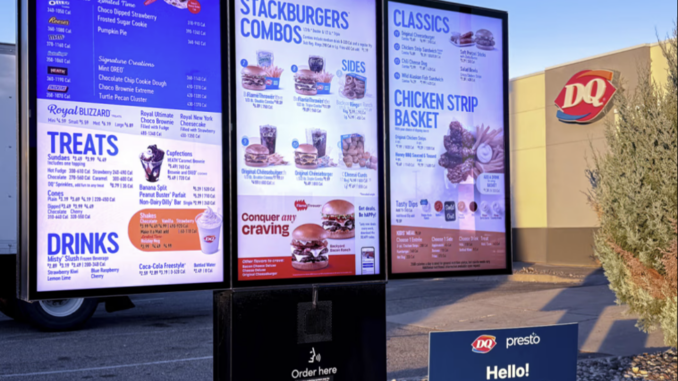
Dairy Queen is taking the next step in one of the restaurant industry’s most closely watched technology experiments: letting AI take the order. This week, the company announced it’s expanding its partnership with technology solution provider Presto to deploy voice AI in the drive-thru, moving beyond corporate testing into a broader pilot with select franchisees. The initiative follows earlier testing in corporate stores and positions Dairy Queen among a growing group of quick-service brands attempting to automate one of the most labor-intensive and operationally sensitive parts of the business.
The logic behind the move is relatively straightforward. The drive-thru remains the highest-volume ordering channel for most quick-service brands, but it is also one of the most difficult to staff and standardize. Turnover is high, training is inconsistent, and performance can vary widely depending on the individual taking the order. Voice AI is being positioned as a way to introduce more consistency while allowing staff to focus on food preparation, handoff, and guest interaction at the window.
Dairy Queen’s initial tests with Presto focused on whether the system could handle real-world ordering conditions, including menu complexity, background noise and variations in how customers speak. The expansion to several dozen franchised locations suggests the company sees enough stability in the technology to evaluate it in a broader operating environment.
At the same time, the rollout reflects a cautious approach. Rather than a systemwide deployment, Dairy Queen is extending the pilot in stages, working with franchisees to assess performance across different store formats and regions. That phased model has become typical for AI deployments in the sector, particularly in areas that directly affect the guest experience.
Presto, for its part, has become one of the better-known names in restaurant voice AI. The company did not begin in the drive-thru. It originally built restaurant technology tools for other parts of the operation before narrowing its focus to automation and voice ordering, a shift that mirrors the broader restaurant tech market’s move away from hardware-heavy platforms and toward software and AI. In recent years, Presto has concentrated increasingly on drive-thru voice applications, where the economic case is easier to articulate and the operational pain points are more visible.
That repositioning has given the company a meaningful foothold in a still-emerging market. Presto has already announced deployments or pilots with brands such as Carl’s Jr., Hardee’s, Taco John’s, and Fazoli’s, making it one of the more active players in the category. The company has tried to distinguish itself by focusing on the “last mile” of deployment, including menu complexity, integrations, voice quality, and the handoff between automated and human interaction.
The competitive landscape for drive-thru AI remains crowded but unsettled. SoundHound and other voice AI vendors are targeting restaurants with conversational ordering tools, while larger technology companies continue to explore adjacent opportunities in voice, automation, and customer interaction. At the same time, some restaurant brands have experimented with building or heavily customizing their own systems. No single approach has emerged as the standard, in part because drive-thru environments are unusually difficult settings for AI. They combine noisy audio, rapid-fire ordering, regional accents, menu substitutions, and high customer expectations, all in a transaction where speed is critical and mistakes are immediately visible.
The business case for voice AI is relatively consistent across providers. According to reporting, systems like Presto’s are designed not only to improve order accuracy and speed, but also to increase average check size through consistent upselling, an area where human employees tend to be inconsistent. For operators, even modest increases in average ticket size can have a meaningful impact at scale, particularly in a high-volume channel like the drive-thru.
Still, the technology raises practical and operational questions that go beyond the initial value proposition. One is how much of the interaction is actually handled by AI versus human assistance. Earlier reporting on comparable systems found that some deployments relied on remote human support to intervene when the technology struggled with accents, customizations, or unclear audio. While vendors describe this as part of a training and quality assurance process, it highlights the gap that can exist between a fully automated system and one that operates as a hybrid.
Another consideration is how the system performs under peak conditions. Drive-thru environments are unpredictable, with overlapping conversations, engine noise, and time pressure. Even small delays or misunderstandings can slow down throughput or create friction at the window. That is one reason many brands, including Dairy Queen, are expanding pilots gradually rather than moving directly to full deployment.
Customer perception is also an open question. Some early adopters of voice AI in drive-thrus have reported smoother interactions, while others have encountered issues with pacing, repetition, or limited flexibility when modifying orders. The extent to which customers notice or care about the presence of AI may vary by demographic and location, but consistency in the interaction will likely be a key factor in adoption.
From a labor perspective, the implications are more nuanced than simple replacement. While automation can reduce the need for staff at the order point, it also shifts responsibilities elsewhere in the operation. Employees may spend more time on food preparation, quality control, and customer interaction at pickup, areas where consistency and speed still depend heavily on human execution.
For franchisees, the decision to adopt voice AI will ultimately come down to performance. Improvements in order accuracy, throughput and check size need to offset the cost of implementation and integration. The ability to operate more consistently during peak hours, when staffing is often stretched, is another potential advantage.
Dairy Queen’s willingness to expand testing also reflects the brand’s longer history of operational adaptation. Founded in 1940, Dairy Queen built its identity around soft serve and frozen treats, but over time evolved into a broader quick-service concept with substantial drive-thru business and a significant franchised base. Its parent, International Dairy Queen, now oversees more than 7,700 restaurants in more than 20 countries, and the system has increasingly had to balance brand consistency with the demands of digital ordering, off-premise growth, and franchise technology adoption. The company is also part of Berkshire Hathaway, a detail that has historically reinforced a more measured, incremental approach to major operational changes.
Like many large chains, Dairy Queen has already been adapting its tech stack in quieter ways. Mobile ordering, app-based engagement, loyalty functionality and menu digitization have all become more important as consumer behavior has shifted toward convenience and off-premise access. In that sense, voice AI is less a dramatic break from the past than a continuation of a broader effort to modernize the ordering experience without disrupting the brand’s core operating model.
More broadly, Dairy Queen’s expansion reflects the current phase of AI adoption in the restaurant industry. Rather than large-scale transformations, most brands are running targeted pilots focused on specific pain points. Drive-thru automation is one of the most visible of these efforts, but it is also one of the most complex to execute reliably.
The company is expected to discuss its approach with Presto at the upcoming Restaurant Leadership Conference, where operators and technology providers will be looking for clearer signals on what is working and what still needs refinement. For now, the expansion suggests that voice AI has moved beyond early experimentation and into a phase of more structured evaluation. Whether it becomes a standard part of the drive-thru experience will depend less on the promise of automation and more on how well it performs under everyday conditions.
