
By Gavi Shohet, Jeff Zabin and Paulina Hubli, RTN staff writers - 5.13.2026
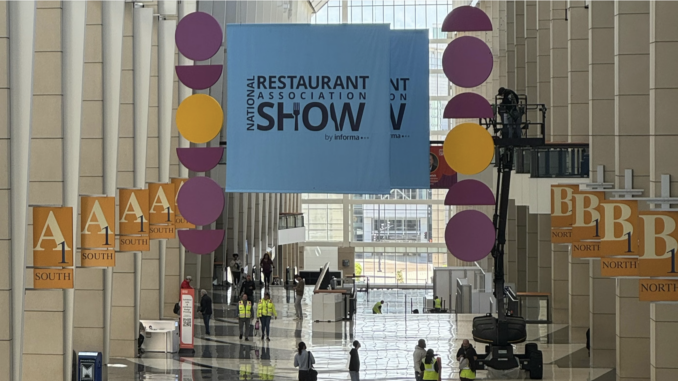
Every year, the National Restaurant Association Show arrives with the same promise: a glimpse into the future of the restaurant business. Thousands of exhibitors descend on McCormick Place in Chicago, unveiling everything from kitchen equipment and beverage concepts to AI-powered software platforms and robotic fry stations. There is always plenty of excitement, plenty of hype, and plenty of technology vendors insisting they have solved the industry’s biggest operational headaches.
This year, however, feels different. The restaurant technology conversation has matured considerably, shaped less by speculative innovation and more by financial necessity. Operators attending the show this weekend are not looking for futuristic novelty. They are looking for practical ways to stabilize margins, simplify operations, manage labor shortages, increase throughput, and create more predictable business performance in an industry that has become extraordinarily difficult to run.
That shift matters because, for much of the past decade, restaurant technology evolved in a highly fragmented way. Operators added systems incrementally as new challenges emerged. Online ordering platforms were layered onto legacy POS environments. Delivery integrations were added during the third-party delivery boom. Loyalty systems, digital marketing tools, labor management platforms, kitchen display systems, inventory software, scheduling applications, QR code menus, contactless payment tools, and mobile ordering systems were introduced one after another, often without any real interoperability strategy. The result was a patchwork of disconnected technologies that frequently created new inefficiencies while attempting to solve existing ones.
Many restaurant executives are arriving at this year’s NRA Show carrying the scars of those decisions. They have spent years dealing with overlapping vendor relationships, duplicate data entry, inconsistent reporting, integration failures, escalating SaaS costs, and operational environments where managers spend as much time navigating software platforms as they do running restaurants. That frustration is driving one of the most important themes emerging across this year’s show floor: simplification.
Technology vendors can still generate attention with AI buzzwords and automation demos, but operators are becoming far more disciplined buyers. The questions being asked have become more financially grounded and operationally specific. How quickly can this system be implemented? Does it integrate cleanly with the existing POS infrastructure? Will staff actually use it? Can it reduce labor friction during peak periods? Will it help improve ticket times, order accuracy, guest satisfaction scores, or inventory visibility? Most importantly, can it produce measurable financial improvement within a reasonable timeframe?
That change in mindset reflects the economic reality restaurants are facing in 2026. Food costs remain volatile. Labor costs continue climbing in many markets. Wage pressure has not eased. Traffic patterns remain inconsistent across several restaurant segments. Consumer expectations for convenience, personalization, and digital ordering continue rising even as guests become more price sensitive. Operators no longer have the luxury of investing in technology simply because it appears innovative or because competitors are experimenting with it. Technology spending increasingly requires the same scrutiny as any other capital investment.
That economic pressure is one reason handheld POS systems have become such a central storyline across the industry. A few years ago, handhelds were often framed as a convenience upgrade or a modernization initiative. Today they are increasingly viewed as operational infrastructure. Full-service restaurants that once resisted mobile tableside ordering because they feared disrupting the hospitality experience are now recognizing that handhelds can materially improve throughput, reduce payment friction, speed table turns, and help servers manage larger sections more effectively during labor shortages.
Importantly, the conversation around handhelds is no longer purely about speed. It is about operational resilience. Restaurants have discovered that even small improvements in ordering efficiency and payment processing can create significant financial impact when multiplied across hundreds of daily transactions and dozens or hundreds of locations. Faster payments improve table availability. Reduced ordering errors lower food waste and remake costs. Better integration between front-of-house and kitchen systems improves pacing during peak hours. Those operational gains translate directly into margin protection at a time when restaurants are fighting for every percentage point of profitability.
The same dynamic is driving the continued expansion of self-service kiosks. Kiosks are no longer viewed simply as pandemic-era solutions designed to reduce human interaction. In many quick-service and fast-casual environments, they have evolved into high-performing revenue optimization tools. Operators continue reporting higher average check sizes through automated upselling and recommendation prompts. Kiosks also create more predictable ordering workflows, reduce front-counter congestion, and allow restaurants to redeploy labor toward food production and guest engagement during high-volume periods.
What is particularly notable at this year’s show is how much the labor conversation itself has evolved. During the early phases of the labor shortage crisis, restaurant technology was often marketed aggressively as a replacement for human workers. That framing created understandable resistance throughout parts of the industry, especially among operators who viewed hospitality as fundamentally human. Over time, however, the conversation has become more nuanced. Most sophisticated operators now understand that automation works best when it removes repetitive, low-value tasks rather than attempting to eliminate hospitality altogether.
Restaurants are not factories. Guests do not visit restaurants merely to complete transactions as efficiently as possible. Hospitality still matters enormously. Service quality still matters. Brand personality still matters. Technology succeeds when it reduces friction in ways that allow employees to focus more attention on food quality, speed, consistency, and guest interaction. Systems that complicate workflows or create operational confusion tend to fail regardless of how impressive they appear in demonstrations.
That distinction is especially relevant when discussing artificial intelligence, which will dominate the marketing language throughout McCormick Place this weekend. Nearly every major software vendor now describes its platform as AI-powered in some capacity. Some of those claims are legitimate. Others are little more than rebranded analytics features wrapped in trendy terminology. Operators are becoming increasingly capable of distinguishing between the two.
The more meaningful AI developments happening in restaurants today are often invisible to guests. AI is increasingly being embedded into forecasting engines, labor scheduling systems, inventory management platforms, dynamic pricing models, kitchen analytics, and operational reporting tools. Restaurant managers are beginning to rely on predictive systems that help identify staffing needs, forecast sales patterns, reduce inventory waste, optimize prep schedules, and flag operational inconsistencies before they become larger problems.
In many respects, AI is quietly becoming embedded operational infrastructure rather than a flashy consumer-facing attraction. That transition is important because it reflects a broader maturation of restaurant technology itself. The industry is moving away from technology as spectacle and toward technology as integrated operational architecture.
That shift is also accelerating consolidation across the technology ecosystem. Operators are increasingly frustrated by fragmented software environments requiring multiple dashboards, disconnected reporting systems, and separate vendor management processes. Many are now prioritizing platforms capable of integrating payments, loyalty, online ordering, labor management, inventory tracking, guest engagement, and analytics into more unified systems.
This trend creates both opportunity and risk for technology vendors exhibiting at this year’s show. Larger platform providers with broad integration capabilities are well positioned to benefit as operators seek simplification. At the same time, smaller point-solution vendors face growing pressure to demonstrate not only product quality but also interoperability and long-term strategic value. Restaurants are becoming less interested in adding standalone tools that create additional operational complexity.
The irony is that the restaurant industry’s long-awaited digital transformation is finally happening just as operators are growing more skeptical of technology marketing itself. That skepticism is healthy. Restaurants learned difficult lessons over the last several years about the difference between innovation and operational improvement. They learned that adding more software does not automatically create a smarter business. In many cases, it simply created more systems to manage.
Walking the show floor this weekend, there will still be plenty of futuristic concepts competing for attention. Some will eventually reshape the industry. Others will disappear quietly within a few years. But beneath the marketing language and product launches, a more grounded reality is emerging across the restaurant sector.
Technology is no longer a secondary consideration inside restaurant operations. It increasingly sits at the center of how restaurants manage labor, drive profitability, engage guests, and scale efficiently. At the same time, operators are becoming far more selective about which technologies deserve investment and which merely add noise.
That tension between innovation and operational practicality may ultimately define this year’s National Restaurant Association Show more than any individual product category or technology trend. The industry is no longer searching for technology that simply looks impressive on a trade show floor. It is searching for technology capable of surviving the far more difficult test of daily restaurant operations.
The National Restaurant Association Restaurant Show returns to McCormick Place in Chicago, May 16-19 For more information and to register, visit nationalrestaurantshow.com.
