
10.21.2026
Following the post-COVID wave of digitalization, the hospitality industry is facing a second major turning point. Shifting customer behavior and the rapid rise of new technologies are playing mainly into the hands of large chains, but independent venues are now getting a new weapon to keep pace with the giants. European startup Choice is transforming its restaurant platform into an AI operating system that can replace the marketing, finance, and technology departments of a small business. Backed by a €6 million ($7.1 million) investment secured earlier this year, Choice aims to accelerate its European expansion and plans to reach 10% of the entire European food service sector within five years.
“Hospitality happens in real time. That is exactly why the traditional model, which relies on external marketers, analysts, developers, or agencies, so often fails smaller restaurants. Expertise is fragmented and frequently arrives too late. Solutions like ours can help reverse the gradual takeover of the market by large chains, which have the resources to carry out AI-driven digitalization. Even the smallest venues stand to benefit. They cannot afford to build their own solutions and are often run by people who do it out of pure love for the craft, yet in today’s changing environment their operations can look unsustainable,” says Alex Ilyash, CEO of Choice.
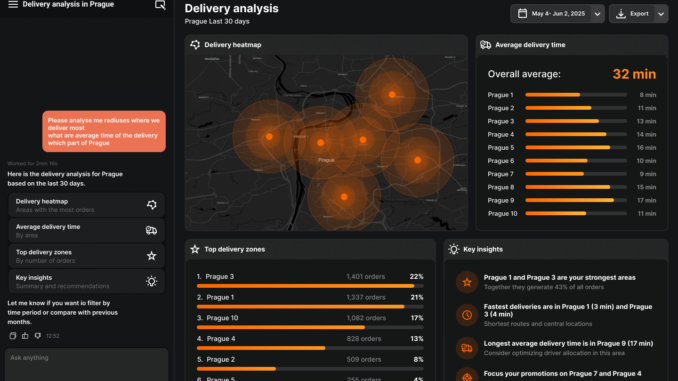
Choice AI is a system that does not merely analyze restaurant operations but also puts its proposed solutions into practice on its own. Restaurateurs simply state what they want to achieve, and the AI proposes and carries out the best course of action. Within minutes, it can build a new website, launch a marketing campaign, respond to guest reviews, or adjust the menu based on real demand. The team of IT developers, marketers, and analysts that only large chains can keep on staff is out of reach for a typical restaurant. With Choice AI, however, they get one in a single digital colleague.
AI steps in as your marketer, operations lead, and developer
Choice is moving away from the traditional restaurant software model, in which operators constantly have to switch between separate systems for orders, marketing, loyalty programs, reservations, or analytics.
Its proprietary AI layer is built directly across the existing Choice ecosystem. As a result, it works with the restaurant’s complete data and makes changes directly in the systems through which the business is run. A single request in plain language can trigger a series of follow-up steps, and the same interface instantly answers questions that previously required laborious digging through reports.
“Owners should be thinking about what their business needs, not about where a particular setting is hidden. Choice can increasingly act as a manager who takes ownership of a task, rather than yet another assistant that merely tells someone else what needs to be done,” explains Ilyash.
For example, a restaurateur can ask Choice to raise burger prices by 5% and prepare a weekend promotion. Instead of manually updating each sales channel separately, Choice can identify the relevant items on its own, update the menus on supported platforms and on the website, and launch the campaign right away.
The same principle applies to marketing, technology, and business analysis: from identifying key or inactive customers and preparing campaigns, to adjusting system settings or explaining why revenue, delivery efficiency, or guest behavior has changed.
The race to lead Europe’s restaurant AI starts now
Artificial intelligence is rapidly shifting from a subject of experimentation to an investment priority across the hospitality industry. Deloitte’s global survey State of AI in Restaurants found that 82% of restaurant executives expect to increase their AI spending, with improved customer experience cited most often as the expected benefit. According to Hospitality Technology, 71% of restaurants already use generative AI for marketing content. At the same time, 48% of them name integration as the biggest obstacle to effective adoption.
It is precisely this gap, strong demand but difficult integration, that Choice wants to fill. “Hospitality AI is becoming a market of its own. Europe can still keep pace with the U.S., where AI is quickly becoming the standard in restaurant technology,” says Ilyash. “But the American model cannot simply be copied here. The European market is highly fragmented: every country has its own language, payment methods, POS systems, tax rules, and different consumer behavior. Building a European restaurant operating platform therefore means solving complex local integrations while offering a radically simple user experience. That is the infrastructure we have spent the past several years building.”
The next stage of Choice’s development is its evolution from a passive AI assistant into a proactive, autonomous manager. The new generation of the system will take the initiative in marketing and customer care: it will continuously segment guests, automatically launch retention email and push campaigns to win back dormant customers, and independently create and publish social media content. Choice AI thus becomes a full-fledged member of the restaurant team, one that constantly looks for ways to increase revenue and guest satisfaction and puts its proposed steps straight into action.
“For the first time in a long while, AI gives European hospitality something that can bring immediate change. We want Choice to be one of the companies that turns this opportunity into reality. Over the next five years, we plan to capture 10% of the European food service market, which represents roughly 150,000 venues and brings our annual serviceable available market (SAM) to approximately €6 billion (about $6.7 billion),” adds Ilyash.
