By Dustin Stone and Lea Mira, RTN staff writers - 7.16.2026
Restaurant technology does not always arrive as a new app, kiosk or guest-facing platform. Some of the most useful operational gains come from the systems that help teams label food correctly, record temperatures, manage prep, support food safety training, print accurate order pads and keep branded materials consistent across locations. Those tools may not draw the same attention as ordering or payments, but they sit close to daily execution. NCCO, also known as National Checking Company, has built its business around that part of foodservice. The company manufactures and supplies restaurant and foodservice products including GuestCheck order pads, register rolls, food rotation labels, tamper-evident labels, custom labels, first aid kits and tech-enabled systems such as DateCodeGenie, Task Manager, RightBytes and food safety training through Always Food Safe.
NCCO brought that mix of foodservice essentials and newer technology to the National Restaurant Association Show, where the company showcased tools for fast-paced kitchens, including DateCodeGenie automated food labeling, RightBytes kitchen intelligence, Always Food Safe training, custom labels and Task Manager digital food safety and HACCP compliance. For restaurant operators walking the show floor, NCCO presented a practical message: food safety, labeling, compliance and kitchen execution can be improved without separating the digital tools from the supplies teams already use every day.
The company has been tied to restaurant operations for more than a century. NCCO traces its history to 1905, when Carl Raschick and Frank Minea founded National Checking Company in St. Paul, Minnesota, as a printer of coupon books, meal tickets and other paper products. The company was formally incorporated in 1909 and later began producing early versions of the restaurant café check, which evolved into the GuestCheck format associated with NCCO today. That history gives NCCO an unusual position in restaurant technology. The company is not entering foodservice from a purely software background. It started with printed tools used in restaurants, then expanded into food rotation labels, register rolls, custom print, brand fulfillment and digital labeling systems. Its current portfolio reflects that progression from paper-based operational products to more connected back-of-house workflows.
The clearest example is DateCodeGenie, NCCO’s automated food labeling system. The system is designed for commercial foodservice kitchens that need to reduce handwritten errors, automate expiration dates and improve consistency across locations. Operators can use DateCodeGenie to create and print prep labels, use-by labels, sell-by labels, MRD labels, ingredient labels, allergen information, nutrition facts, barcodes, QR codes and branded grab-and-go labels.
Labeling is a high-volume task in many restaurants, and small errors can carry outsized consequences. A handwritten date may be hard to read. A use-by label may be calculated incorrectly. A grab-and-go item may need nutrition information, pricing, allergens or a barcode. A team member may use masking tape because the right label is not available. Those breakdowns can create waste, compliance risk and confusion during service. DateCodeGenie is built to reduce that variation. NCCO says the platform can auto-calculate expiration dates, centralize label management and allow teams to create consistent templates across one or multiple locations. The system includes labeling software, single and dual thermal food label printer options, customizable labels and support for Android or Apple iOS tablets through the DateCodeGenie app. For operators, the goal is to make label accuracy easier to maintain even when kitchens are busy and staff turnover is high.
The system also supports front-of-house and packaged-food use cases. Restaurants, cafes, convenience stores, commissaries, bakeries and grab-and-go programs often need labels that include ingredients, nutrition facts, allergen information, prices, logos and product details. NCCO’s DateCodeGenie materials emphasize drag-and-drop label design, bulk printing and branded templates, giving operators a way to produce more polished labels without relying only on preprinted inventory or manual handwriting.
For restaurants expanding packaged food, takeout, catering, delivery or retail-style items, the label becomes part of the product experience. It communicates freshness, safety, brand identity and product information. A consistent labeling system can help restaurants maintain that standard across dayparts and locations.
NCCO’s traditional food safety products remain part of the same operating story. The company offers DateIt food rotation labels in dissolving, reusable, removable and permanent adhesive styles, along with tamper-evident labels, portion bags, label kits and dispensers. These products support basic kitchen routines: knowing what to use first, reducing spoilage and helping teams maintain food safety standards. Tamper-evident labels have also become more relevant as takeout and delivery remain important parts of restaurant sales. NCCO offers SecureIt tamper-evident labels, including options for food packaging and alcohol to-go. For restaurants, tamper-evident packaging can help reassure guests that an order has not been opened between the kitchen and the point of handoff. It also gives operators a simple way to strengthen the presentation and perceived safety of off-premise orders.
NCCO has moved deeper into digital food safety management through Task Manager. The platform is designed to digitize food safety and HACCP compliance through checklists, forms, reporting and automated temperature monitoring. Operators can access standard HACCP forms or digitize their own, schedule recurring forms, use review and approval features, and gain visibility across multiple locations. Task Manager addresses a familiar restaurant problem: many food safety tasks still depend on paper logs, clipboards and manager follow-up. Paper records can be incomplete, illegible or hard to retrieve when needed. Digital forms and checklists give teams clearer tasks and give managers a better record of what was completed. The platform can support opening and closing procedures, temperature checks, cleaning routines, audit preparation and other food safety workflows.
The temperature monitoring component adds another layer. NCCO says Task Manager supports remote monitoring of refrigerator and freezer temperatures through integrated sensors, real-time data transmission and alert notifications when temperatures move outside a safe range. In restaurant operations, temperature problems can create inventory loss, food safety risk and service disruption. Earlier visibility gives managers a better chance to respond before a problem becomes more expensive.
Task Manager also connects with DateCodeGenie. The integration allows teams to print food prep labels, including use-by, defrost and batch labels, using label and ingredient data already available in the DateCodeGenie portal. Labeling and food safety records are often linked in daily kitchen work. A prep task, temperature check or production workflow may also require an accurate label. Bringing those workflows closer together can reduce repeated data entry and support more consistent execution.
RightBytes extends NCCO’s platform into broader foodservice operations management. NCCO describes RightBytes as an AI-powered platform that connects compliance, prep planning, inventory, traceability, forecasting, online ordering, reporting and performance tracking. The platform includes Max Profit, a digital assistant designed to interpret operational data, surface recommendations and help teams prioritize decisions. RightBytes is positioned for multi-location foodservice environments where operators may be managing POS data, spreadsheets, paper checklists, delivery tools and inventory processes across many stores. The platform’s modules include predictive analytics and sales forecasting, inventory management and traceability, online ordering, digital checklists, temperature monitoring, food production planning and waste tracking.
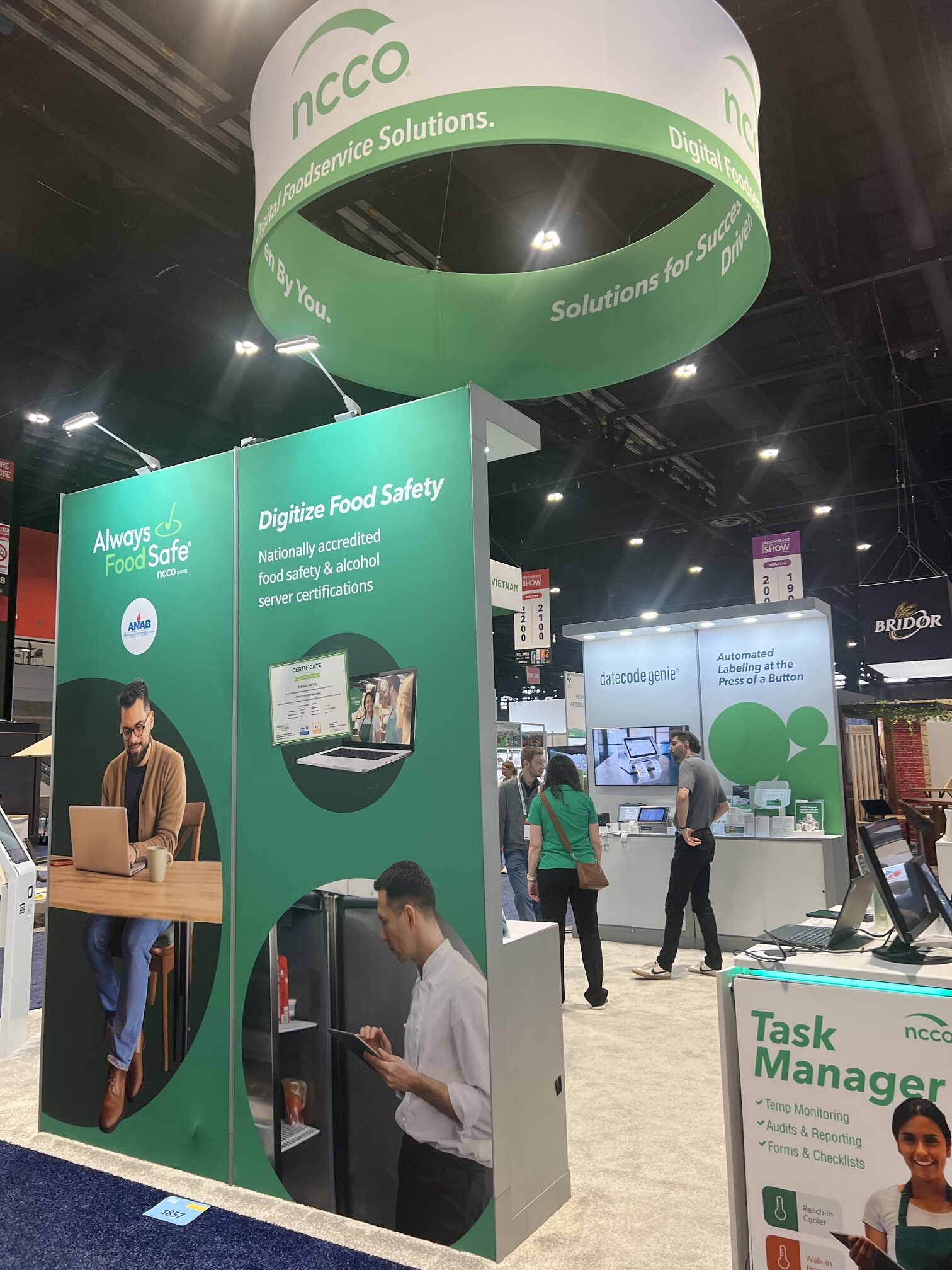 For restaurants, the most relevant shift is the move from isolated tools toward connected back-of-house data. A kitchen may know what it made, what it wasted, what sold and what needs to be prepped, but those details often live in different systems or on paper. RightBytes is designed to pull more of that information into one operating environment so teams can make better decisions about production, prep, inventory and compliance. The connection to DateCodeGenie gives RightBytes another practical use case. NCCO says RightBytes can connect with DateCodeGenie to support food labeling and traceability, including QR-code labels, ingredient details, barcodes and made/wasted product tracking. For operators managing prepared foods, grab-and-go items or commissary-style production, that can support better visibility from production through service.
Food safety training rounds out the portfolio. NCCO’s show materials highlighted Always Food Safe, which provides online food protection manager, food handler and allergen awareness training. NCCO’s history page notes that it acquired The Always Food Safe Company in 2016, adding training to its broader food safety and compliance offering. Training is a natural extension of the company’s back-of-house focus. Labels, checklists, temperature monitoring and task management can help standardize execution, but employees still need to understand the principles behind food safety and compliance. By connecting training, labeling and digital task workflows under the same broader foodservice umbrella, NCCO can support both the tools and the knowledge required to use them properly.
NCCO’s brand fulfillment portals and custom print services address another pain point for growing restaurant groups. Multi-location brands often need stores to order approved materials, localize certain fields, maintain brand standards and receive products without creating one-off requests for corporate teams. NCCO’s fulfillment portals include features such as a variable editor, print-on-demand, multi-location shipping, saved templates, product reorder, analytics and reporting. That capability fits restaurant operations where brand consistency depends on physical materials as well as digital systems. Labels, LTO kits, printed collateral, guest-facing materials and store supplies all need to arrive accurately and on time. A centralized storefront can help corporate teams preserve brand control while giving local operators a practical way to order what they need.
NCCO’s original restaurant products remain part of the company’s identity. GuestChecks are available in different sizes, colors, styles and packaging options, including carbon and carbonless formats. NCCO says the checks contain EarthSafe recycled material and include seating diagrams and menu prompts designed to help servers record orders and remember upsell opportunities. Even in a POS-driven market, guest checks remain useful in certain service environments, as backups, training tools, kitchen workflows or formats where handwritten order capture still fits the operation.
The company also supplies register rolls and ribbons, including phenol-free thermal, sticky thermal, Blue4est thermal, one-ply and two-ply bond options. These consumable products are not flashy, but restaurants still depend on them every day. A receipt roll, food rotation label or guest check may seem small until it is missing during service. NCCO’s value has long been tied to supplying these workflow-critical products reliably through foodservice distribution channels.
NCCO entered a new growth phase in 2026 when Gallant Capital Partners acquired a majority position in the company. The announcement described NCCO as a manufacturer of workflow-critical foodservice consumables and tech-enabled labeling solutions, with offerings that include GuestCheck order pads, register rolls, food rotation and tamper-evident labels, DateCodeGenie, digital food safety certification and management systems, and AI-driven foodservice solutions. Gallant said it would support continued investment in NCCO’s people, products, technology platforms and commercial capabilities. For restaurant operators, the transaction reinforces NCCO’s evolution from a legacy supplier of paper and labels into a broader foodservice solutions provider. The company now combines consumables, digital labeling, food safety management, training and operations intelligence, with Gallant’s investment adding support for continued expansion of the technology-enabled side of the business.
NCCO’s strengths begin with its foodservice focus. The company has served restaurants and foodservice distributors for more than 100 years, and its products are built around the practical details of kitchen and service execution. Restaurant operations are full of small routines that have to be easy, repeatable and durable. A tool that looks good in a demo but does not fit the pace of a kitchen will not last. A second strength is the connection between physical and digital workflows. Restaurants still use labels, paper, packaging, receipt rolls, printed collateral and training materials. NCCO has not abandoned those categories. Instead, it has layered digital systems such as DateCodeGenie, Task Manager and RightBytes around them. That combination can make the transition from paper to digital feel more operationally grounded.
A third strength is relevance across different foodservice segments. NCCO serves restaurants, convenience stores, hospitality, contract foodservice, healthcare, education and ghost kitchens. Those segments have different service models, but they share a need for accurate labels, clean records, reliable supplies, consistent training and practical tools for execution. NCCO’s portfolio gives it several ways to support those needs.
Operators still need to match the tools to the workflow. Automated labeling requires accurate menu data, expiration rules, allergen information and label templates. Digital food safety tools require staff training and management follow-up. AI-supported operations platforms require clean data and clear processes. Brand fulfillment portals require governance around who can order, edit and approve materials. The value comes when the system is configured around how the restaurant actually works.
Hardware and consumable choices also need attention. Operators need to select the right label adhesive, label size, printer setup, tamper-evident format, guest check style or register roll for the environment. A dissolving label may make sense for one surface, while a removable, permanent or tamper-evident label may be better for another. NCCO’s broad product assortment gives operators options, but those choices still need to be matched to the use case.
The strongest NCCO use cases are likely to be restaurants and foodservice operators where food safety, labeling accuracy, grab-and-go packaging, multi-location consistency and operational documentation are recurring challenges. Quick-service restaurants, fast casual brands, commissaries, convenience-store foodservice, cafes, ghost kitchens and institutional foodservice operations can all benefit from clearer labeling and more structured back-of-house workflows.
NCCO stands out because it approaches restaurant operations from the ground level. The company understands the label, the guest check, the receipt roll, the prep station, the cooler, the food safety log and the branded store kit. Its newer technology tools build on those operational touchpoints rather than replacing them with a detached software layer. For restaurants trying to improve execution without adding unnecessary complexity, that combination has appeal. DateCodeGenie can make labeling faster and more accurate. Task Manager can digitize checklists and temperature records. RightBytes can connect prep, inventory, waste and operational insights. Always Food Safe can support training. Custom labels and brand portals can help growing brands maintain consistency. GuestChecks, register rolls and food safety supplies continue to support the everyday mechanics of service.
Restaurant operators often look for big technology changes, but many operational improvements come from making routine tasks more reliable. Accurate labels, better prep planning, clearer checklists, cleaner records and consistent supplies all help kitchens run with less friction. NCCO brings those pieces together in a portfolio that reflects both its long foodservice history and its push into more connected, tech-enabled operations.
