
By Lea Mira, RTN staff writer - 10.7.2026
Kutlerri.ai has announced $4 million in funding from Houston-based Narahari Investments to expand a restaurant AI business that combines automation with managed sales and operational services. Its first commercial product handles catering prospecting and inquiries, with fees tied to the orders it generates. Additional agents targeting delivery sales, advertising expenses, food and labor costs, and waste are at earlier stages of development.
Founded by Kiran Rana and Payal Tripathy, the Houston-based company is addressing a familiar staffing problem. Restaurants may have systems for tracking customers and orders but limited time to find prospective catering buyers, prepare quotes and follow up consistently. Kutlerri takes on that work as a managed service, allowing operators to develop the channel without hiring a dedicated salesperson.
The company developed its catering service through a paid engagement with RASA, the fast-casual restaurant group serving the Washington, D.C., area. According to Kutlerri, it spent 10 months building and refining the service inside the group before selling it to other operators. That development process gave the company experience with the conversations, approvals and administrative work involved in turning a catering inquiry into a completed order.
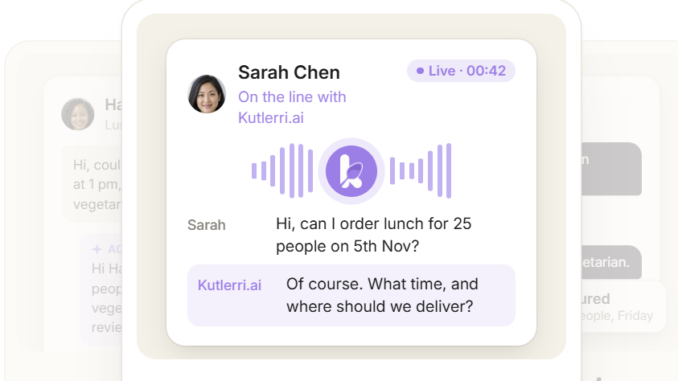
The Catering Sales Agent handles incoming inquiries through channels including phone, email, text and web forms. It gathers details such as headcount, timing, budget and dietary requirements, then helps prepare a quote. On the outbound side, the service identifies nearby businesses, finds relevant contacts, conducts outreach and follows up with prospects and past customers.
Human sales staff remain involved. In its RASA case study, Kutlerri describes its team making outbound calls and checking AI-drafted quotes before RASA approved them. Customers could also be transferred to a person when requested. Operators considering the service are therefore buying a combination of software and sales execution, with restaurant approval retained at the quoting stage.
Kutlerri reports that the engagement generated $450,000 in new catering revenue over 10 months without an additional hire by RASA. The company says that revenue exceeded 10 times RASA’s spending on the service. Those are company-reported sales figures, rather than a measure of net profit or an independently verified return on investment. Food, preparation labor, packaging, delivery and service fees all affect how much of that revenue the restaurant retains.
The appeal of expanding sales with existing resources is clear in an industry facing persistent margin pressure. The National Restaurant Association forecasts $1.55 trillion in U.S. restaurant and foodservice sales for 2026, yet 42% of operators surveyed reported that their restaurant was not profitable in 2025. A managed sales service could be useful to an operator with spare production capacity and insufficient staff time to pursue additional business.
Catering also offers the possibility of repeat business from a relatively small number of accounts. An office that orders lunch regularly can justify sustained follow-up and relationship management, especially when its requirements become familiar. For a restaurant team occupied with daily service, keeping track of those opportunities can be difficult even when the customer information is already available.
The quality of those accounts matters as much as their number. A large order that fits a restaurant’s preparation schedule and delivery area may contribute more profit than one requiring overtime, discounts or a difficult delivery. An effective sales service needs accurate menus, minimum-order requirements, lead times and capacity limits so that its recommendations reflect what the kitchen can fulfill profitably.
Kutlerri faces established competitors across catering management and restaurant AI. MONKEY offers catering technology alongside Sadie AI, a voice agent that handles catering calls, captures new orders and changes to existing orders, and routes summaries to restaurant teams. Its offering demonstrates that AI-assisted catering intake is already available from providers with broader catering operations platforms.
Tripleseat supports catering and event sales through inquiry management, proposals, contracts, payments and online booking requests. Slang AI adds another approach through automated phone handling and integrations. At Rosa Mexicano, the companies’ integrated workflow captures private-event inquiries by phone and sends the details into Tripleseat for the events team to pursue.
ezCater competes for catering business through its marketplace and tools supporting restaurants’ own ordering, management and delivery needs. Operators can use such services to reach buyers as well as process orders. The choice between a marketplace, a managed sales service and an internally operated platform depends on customer acquisition costs, staffing requirements, fees and the value of repeat business.
Kutlerri’s competitive pitch centers on combining outbound prospecting, inbound handling and follow-up with a team that runs the service for the restaurant. That could appeal to operators who need someone to manage the sales process alongside the technology. Restaurants with established catering departments may place greater value on software their own staff can operate, while smaller groups may prefer to outsource more of the work.
Fees tied to results can reduce the risk of paying for an unused subscription, although operators still need clear terms for attributing sales. Kutlerri says pricing varies with the size of the business and the scope of the engagement. A restaurant should know how the agreement treats existing customers, repeat orders, cancellations and refunds, and whether fees apply to booked revenue or completed sales.
The wider product lineup remains under development. Kutlerri identifies three agents as being in beta: a Third-Party Sales Agent, a Third-Party Marketing Spend Optimization Agent and a Prime Cost Optimization Agent. An Online Sales Agent and a Daily Prep and Waste Control Agent are in development, while a mobile-first self-service app is planned. These products would extend the business beyond catering into delivery performance, advertising efficiency and operating costs.
Tripathy, the company’s co-founder and chief operating officer, has described a goal of helping restaurants increase revenue by 20% and reduce costs by 10% through the combined work of multiple agents. Those figures are targets for the broader offering, rather than established results across its customers. Each additional service will need its own method for measuring improvements, particularly when sales volume, supplier prices or staffing changes affect the comparison.
Expanding the managed model will also require Kutlerri to balance automation with the human work that helped support its initial engagement. More customers mean more menus, approval rules, service areas and exceptions for its team to understand. The $4 million financing gives the company capital to expand deployments and develop additional agents, but profitable repeat orders will be the most useful measure for restaurant buyers. A service that keeps finding suitable accounts, follows through on inquiries and fits the kitchen’s capacity can earn an ongoing place in the operation.
