
By Dustin Stone, RTN staff writer - 4.9.2026
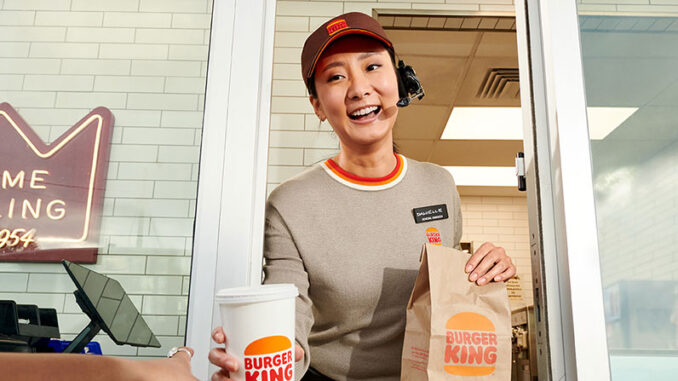
Burger King’s plan to hire up to 60,000 team members across its nearly 6,500 U.S. restaurants, announced earlier this week, might sound like a straightforward labor story. It’s not. It’s a reflection of what happens when a large quick-service brand invests heavily in modernizing operations and starts to see the payoff.
Over the past couple of years, Burger King has been quietly rebuilding its operational foundation. That includes redesigned restaurant formats, upgraded kitchen layouts and a more consistent technology stack across franchise locations. In February, the company began testing AI headsets with the goal is to provide employees and managers with faster access to operational information while helping streamline workflows during busy shifts. These changes are now driving increased guest traffic, which in turn is creating immediate pressure on staffing.
The common assumption is that more technology means fewer people. In practice, the opposite is often true, especially in high-volume quick-service environments.
Modern Burger King locations are increasingly built around digital ordering channels, including mobile apps, web ordering, kiosks and third-party delivery integrations. Each of these channels feeds directly into the point-of-sale system and downstream into kitchen display systems (KDS), where orders are sequenced and routed for preparation. This creates a more structured and data-driven workflow in the kitchen, but it also increases order volume and complexity.
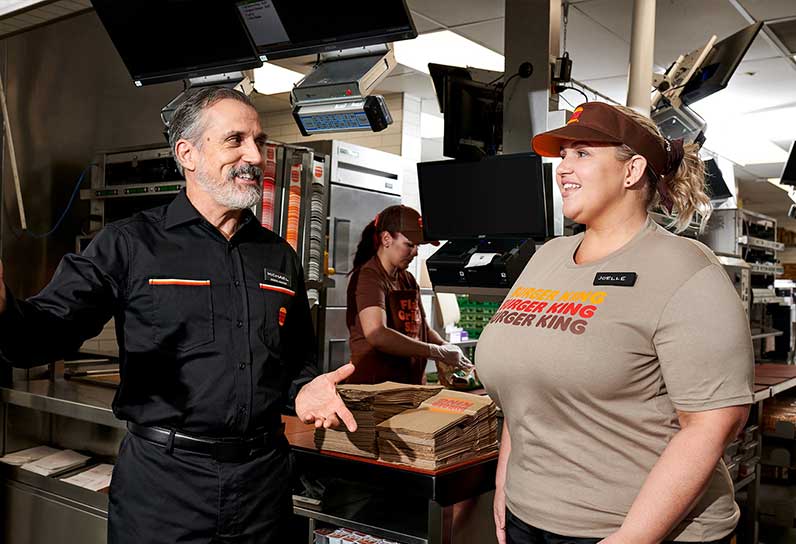
Instead of a single line of guests ordering at the counter, restaurants are now managing multiple demand streams simultaneously. A single location might be handling in-store orders, drive-thru traffic, mobile pickup and delivery orders at the same time. Technology helps orchestrate that flow, but it doesn’t remove the need for people to execute it.
That’s where the hiring push comes in. As throughput improves and order accuracy increases, restaurants can serve more guests per hour. But higher throughput requires adequate staffing across stations, from order assembly and expediting to drive-thru coordination and guest interaction. Without that balance, the benefits of digital systems quickly erode into longer wait times and inconsistent service.
There’s also a growing need for a different kind of frontline employee. Today’s restaurant teams are expected to interact with POS systems, manage digital order queues, troubleshoot kiosk issues, and coordinate with delivery drivers all while maintaining speed and hospitality standards. Even entry-level roles increasingly require a level of digital fluency that wasn’t necessary a decade ago.
For managers, the shift is even more pronounced. Modern restaurant operations generate a constant stream of data, from ticket times and order accuracy to labor productivity and sales mix. Many operators are now using integrated platforms to forecast demand, optimize staffing schedules, and monitor performance in real time. That requires managers who can interpret dashboards, adjust staffing dynamically, and keep operations aligned with demand patterns throughout the day.
Burger King’s franchise model adds another layer of complexity. With the vast majority of U.S. locations owned by independent operators, consistency depends on both standardized technology and disciplined execution at the store level. The hiring push reflects not just brand momentum, but a coordinated effort across franchisees to support higher volumes and more structured operations.
What’s notable is that this hiring effort comes after significant work has already been done to improve the system. The brand has focused on simplifying menus, upgrading equipment, and incorporating guest feedback into product and experience decisions. These changes, combined with more modern ordering and kitchen systems, are making restaurants more efficient and more capable of handling increased demand. The result is a familiar pattern across the restaurant industry right now. Technology is making operations more efficient and scalable, but it is not eliminating the need for labor. Instead, it is raising the bar for how labor is deployed.
Restaurants are becoming more like coordinated production environments, where timing, sequencing, and accuracy are tightly managed through software. But the last mile—the part that guests actually experience—still depends on people. Speed of service, order handoff, problem resolution and overall hospitality remain human-driven (at least for now).
Burger King’s messaging around friendliness and career growth speaks to that reality. The brand is not just filling positions; it is reinforcing the idea that frontline roles are still central to the experience, even as the underlying systems become more sophisticated. In many ways, this is the next phase of restaurant technology adoption. The early focus was on digitizing ordering and payments. Now the emphasis is on operational consistency, data quality, and throughput optimization. And increasingly, success depends on how well those systems are supported by trained, engaged teams.
The takeaway is straightforward. Technology can make restaurants faster, more accurate and more scalable. But when it works, it drives demand. And when demand increases, the need for people becomes more important than ever. Burger King’s hiring push is what that looks like in practice.
