

By Dustin Stone and Lea Mira, RTN staff writers - 7.16.2026
Restaurant technology is often discussed in terms of software, ordering platforms, POS systems, payments, loyalty programs and artificial intelligence. But many of the most important operational improvements still happen much closer to the food itself. Before a guest receives a salad, sandwich, soup, sauce, side dish, entrée, frozen meal, packaged item or prepared ingredient, someone has to cut, slice, dice, shred, mill, puree or otherwise prepare products with consistency and speed.
That work affects more than kitchen workflow. A tomato dice affects presentation and portion control. A lettuce shred affects texture, shelf life and throughput. A potato cut affects cooking consistency and waste. A cheese shred affects melt, yield and labor. A vegetable puree can support soups, sauces, fillings or plant-forward menu development. In high-volume foodservice environments, cutting is part of quality control, food safety, labor management and margin protection.
Urschel Laboratories has spent more than a century focused on that part of the food production process. The company manufactures industrial food cutting equipment used for slicing, dicing, shredding, milling, granulating, strip cutting and pureeing across a wide range of applications. Its machines support processors and foodservice operations working with fruits, vegetables, potatoes, meat, poultry, seafood, cheese, bakery products, plant-based ingredients, pet food and other products that require reliable size reduction.
At the National Restaurant Association Show, Urschel showcased equipment that speaks directly to those production needs. Featured machines included the Little Gem Aspire Dicer, Sprint 2 Dicer, KRONEN GS 10-2 Slicer, KRONEN KS-100 PLUS Centrifuge/Dryer and other manual and automatic KRONEN machines. For operators, commissaries, foodservice manufacturers and suppliers walking the show floor, the draw was practical: equipment that can help increase throughput, reduce repetitive manual prep and produce more consistent results.
That need has become more pressing as restaurants and foodservice companies try to do more with fewer labor hours. Central kitchens and commissaries are preparing more ingredients for multiple locations. Suppliers are being asked to deliver products that meet tighter specifications. Multi-unit restaurant groups need consistency across markets and dayparts. Guests may never see the processing equipment behind a menu item, but they notice when fries cook unevenly, lettuce lacks texture, diced vegetables vary from plate to plate or prepared ingredients do not match expectations.
Urschel was founded in 1910 in Valparaiso, Indiana, by William E. Urschel, an inventor whose early food processing equipment helped set the direction for the company. Urschel began with the Gooseberry Snipper and continued expanding its engineering capabilities across generations of the Urschel family. Today, the company is headquartered in Chesterton, Indiana, and remains closely associated with industrial food cutting technology.
Its long history is tied to a remarkably consistent focus. Urschel has stayed close to food cutting and size reduction rather than moving into unrelated equipment categories. The company’s own history notes that its product line has remained focused primarily on food cutting equipment, along with the parts and knives that support those applications. In 2016, Urschel became a 100% employee-owned company, giving employees a direct stake in the business and reinforcing the company’s long-term manufacturing culture.
That continuity has real value in food equipment. Restaurants, commissaries and processors often invest in machines that need to perform reliably for years. Equipment has to fit production lines, withstand repeated use, meet sanitation requirements, produce the right cut specifications and be supported with parts, service and technical expertise. Urschel’s employee-owned structure, manufacturing base and engineering history give the company a strong foundation in a category where reliability, support and application knowledge matter.
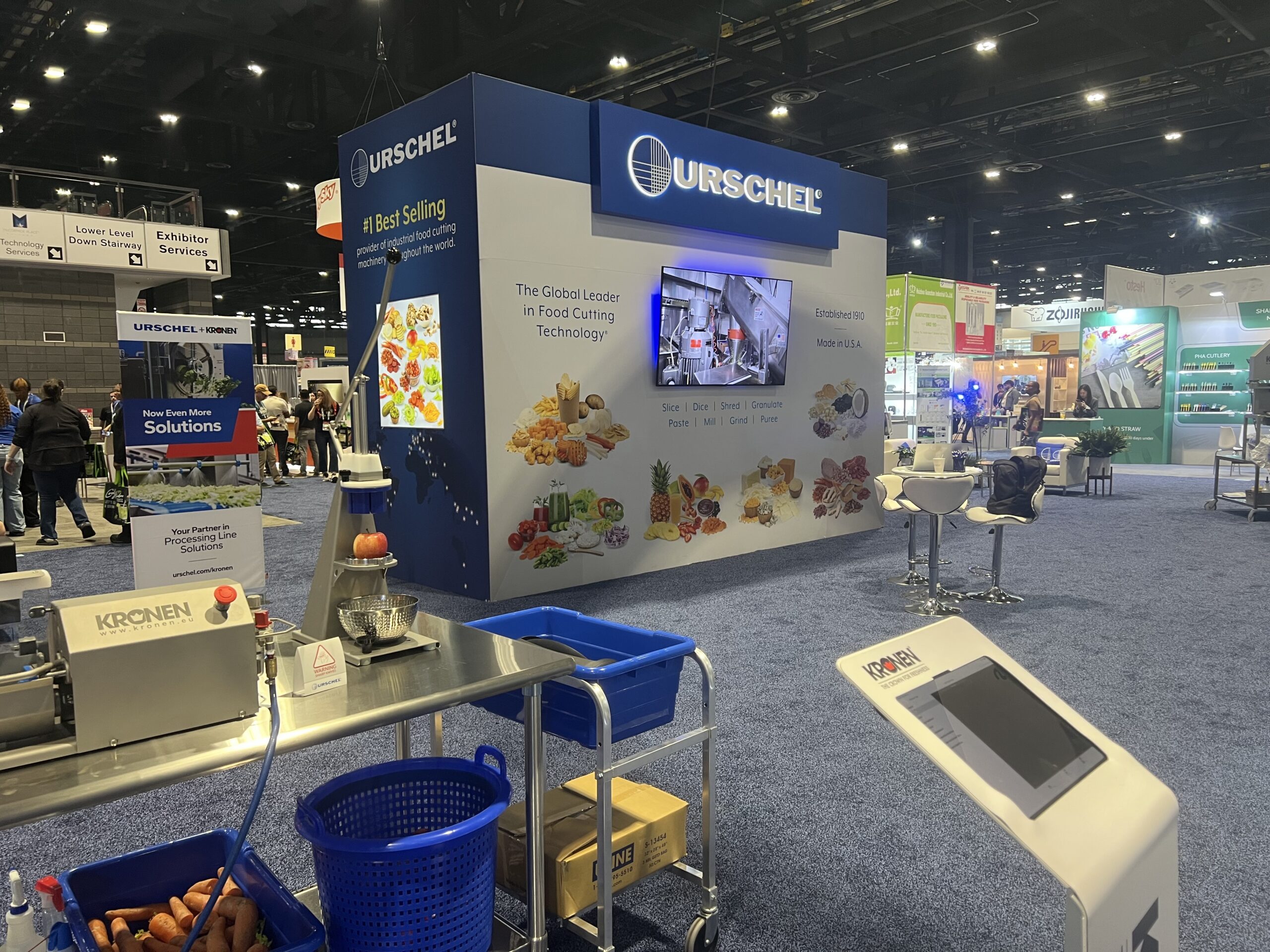
Urschel describes itself as a global leader in food cutting technology, serving customers in more than 130 countries. Its equipment is used in applications that include potato slicing, bacon crumbling, nut milk pureeing, lettuce shredding, nut butter milling, cheese shredding, vegetable pureeing, potato strip cutting, meat shredding, fruit slicing and pureeing, tomato dicing, and poultry dicing and slicing. That range makes the company relevant not only to processors, but also to the broader restaurant and foodservice supply chain.
For a single independent restaurant, industrial cutting equipment may not be part of the daily operation. For a commissary, central kitchen, foodservice manufacturer or multi-unit restaurant group, the connection can be direct. Even when the machine sits upstream, the products it helps create still show up in restaurant kitchens through fresh-cut produce, frozen vegetables, prepared sauces, cheese products, potato items, soups, ready meals, bakery components, meat and poultry ingredients, and other foodservice products.
The central benefit is consistency. Manual prep can vary by employee, shift and location. A diced vegetable may differ in size depending on who is holding the knife. A product that is cut inconsistently can cook unevenly, portion poorly or look different from one plate to the next. In high-volume operations, that variation can create waste, slow production and affect the guest experience. Urschel equipment is designed to help operators and processors produce uniform cuts at scale.
Uniform cuts also affect the economics of the business. They can improve portion control, support predictable cooking times, reduce rework and help maintain product presentation. They can also help foodservice manufacturers meet the specifications required by restaurant customers. A restaurant group buying diced tomatoes, sliced onions, shredded lettuce or potato products needs those items to arrive within agreed specifications. Consistency at the processing stage supports consistency at the restaurant level.
Urschel’s cutting machine portfolio includes dicers, slicers, shredders, milling equipment and specialty machines engineered for different products, textures and production needs. The company emphasizes precision-engineered designs, high-capacity output, hygienic stainless-steel construction, flexible setups and global service support. Those attributes affect uptime, sanitation, product quality, staff efficiency and throughput.
The Little Gem Aspire Dicer, one of the featured products at the National Restaurant Association Show, reflects Urschel’s newer development work. The company describes it as a new cutting concept in fruit and vegetable processing, developed by its Innovation & Development team and featuring patent-pending cutting methods. The machine is designed for fresh produce applications such as apples, beets, butternut squash, carrots, mangoes, onions, pineapple, potatoes, strawberries, sweet potatoes, tomatoes and zucchini. It can produce flat slices, strips and dices in a compact format with a focus on ease of use and lower total cost of ownership.
The Little Gem Aspire is particularly relevant for operations working with fresh produce. Produce prep is labor-intensive and highly visible to guests. A rough cut can affect texture, appearance and yield. A clean, consistent dice can support salads, bowls, soups, toppings, sides, sauces, salsas, meal kits and ready-to-eat items. As restaurants add more fresh, vegetable-forward and globally inspired items, equipment that can handle a range of produce with precision becomes more valuable.
The machine’s StatiCut™ Knife Assembly also shows how Urschel approaches equipment design. The system replaces a traditional circular knife assembly and is designed to provide flexibility across different cut sizes and patterns. For processors, that can reduce parts complexity and make it easier to adapt to changing product needs. A more flexible cutting platform can help support new menu formats, seasonal ingredients and customer specifications without adding unnecessary work to the production process.
The Sprint 2 Dicer addresses a different set of needs. Urschel describes it as a compact, high-performance food dicer with a cutting zone designed to deliver precision cuts. The machine is available with built-in conveyor discharge to facilitate dispensing into totes and can produce dices, strips, slices, granulations and shreds. It also supports continuous operation.
That versatility is useful in foodservice production. The same operation may need different cuts depending on the menu, customer specification or production run. A machine that can support multiple formats can help processors maintain productivity while meeting changing requirements. For restaurants and foodservice brands, the result is a more consistent ingredient supply and a better chance of matching product quality across locations.
The DiversaCut 2110A Dicer illustrates the company’s high-capacity side. It is the largest dicer in the DiversaCut series and is designed for continuous operation across a wide range of products. Urschel describes models that can accept products up to 10 inches in any dimension, with a large-product-input version that can accept products as large as 14 inches in diameter. The system is used for vegetables, fruits, bakery ingredients, dairy inclusions, meat, poultry, seafood, pet food and alternative plant-based products.
That kind of capacity can be valuable for processors and commissaries trying to reduce pre-cutting and product handling. Every additional manual step creates labor cost, variability and the potential for product damage. Larger input capability can reduce the need to pre-cut products before they enter the machine, helping preserve quality and improve line efficiency. For restaurant groups relying on centralized production, those gains can translate into more consistent output at the unit level.
Urschel’s slicers and shredders serve similar needs in different applications. Slicing equipment can support potatoes, vegetables, meats, cheeses and other products where thickness and surface quality affect cooking, presentation or downstream processing. Shredding equipment can help produce uniform cheese, lettuce, vegetables and protein-based ingredients. Milling and Comitrol processing equipment support purees, pastes, sauces, nut butters, condiments and other products where particle size and texture need to be controlled.
These capabilities fit a larger shift in foodservice. As menus become more complex and labor remains tight, restaurants are relying more on prepared and semi-prepared ingredients, central kitchens and supplier partnerships. That does not necessarily mean removing craft from the kitchen. In many cases, it means moving repetitive, high-volume prep into a more controlled environment so restaurant teams can focus on cooking, finishing, plating and hospitality.
Food cutting equipment also plays a role in waste reduction. Better cut consistency can improve yield. Reduced product damage can help limit waste. More accurate portioning can help restaurants control cost and avoid overproduction. Equipment that is easier to clean and maintain can support sanitation while reducing downtime. For operators managing high food costs and tight margins, those details can make a difference.
Sanitation is especially important because cutting equipment comes into direct contact with food. Urschel’s machine descriptions emphasize stainless-steel construction, separated food and mechanical zones, hinged access panels, sloped surfaces and designs intended to support cleaning and maintenance. For processors and commissaries, cleanability, access and maintenance are not secondary features. They are part of the purchase decision.
Service and support also matter. Urschel’s support resources include sales and service assistance, product test cutting, technical machine operating manuals, safety publications, parts ordering and global service support. The company offers product test-cutting analysis for prospective customers, allowing processors to evaluate machine fit before making a purchase. That can be useful because the right cutting solution depends on product texture, temperature, desired cut size, throughput, sanitation requirements and line design.
Test cutting helps operators and processors understand how equipment will handle their actual products. A carrot, onion, cooked meat, cheese block, frozen item, leafy vegetable or bakery product may behave differently under cutting pressure. Testing can help identify the right machine, cutting head, knife setup and production approach before capital is committed.
Urschel’s relationship with KRONEN expands its reach beyond cutting into adjacent food processing steps. This year, Urschel expanded access to KRONEN commercial processing systems throughout Asia through Urschel Asia Pacific Pte. Ltd. and throughout Italy through Urschel International Ltd. Italy, adding to availability through Urschel in the United States, Mexico, Pakistan and China. KRONEN systems include equipment for washing, dicing, slicing, drying and conveying fresh foods.
That relationship was visible at the National Restaurant Association Show, where Urschel showcased both Urschel and KRONEN solutions. The KRONEN GS 10-2 Slicer and KRONEN KS-100 PLUS Centrifuge/Dryer pointed to a common production challenge: cutting is often only one step in the line. Washing, drying, conveying, slicing, dicing and staging all have to work together for production to run efficiently.
For restaurant operators, commissaries and foodservice manufacturers, that full-line view is important. A central kitchen may need to process produce for multiple brands or locations. A foodservice manufacturer may need to supply prepared vegetables, fruit, cheese, proteins or inclusions to restaurant customers. A commissary may need to support menu consistency across a growing footprint. In each case, cutting equipment has to fit into a larger system that includes labor, sanitation, packaging, inventory and distribution.
Urschel’s engineering depth is one of its clearest advantages. The company has spent more than a century focused on food cutting, and its product line reflects a detailed understanding of how different products behave. Food is not uniform like metal or plastic. It bruises, deforms, crumbles, shreds, sticks, separates, oxidizes and changes with temperature. Cutting equipment has to account for those differences while still delivering speed, sanitation and repeatability.
The company’s manufacturing continuity is another strength. Urschel’s long history, employee-owned structure and Indiana manufacturing base give it a clear identity in a category where customers value durability and support. Food processing equipment is not purchased casually. Operators want confidence that parts, service, engineering expertise and technical support will be available long after installation.
Application range is also important. Urschel machines are used across fruits, vegetables, potatoes, meat, poultry, seafood, cheese, bakery ingredients, plant-based products and other applications. That breadth allows the company to support different parts of the restaurant and foodservice supply chain, from fresh-cut produce and prepared sides to proteins, sauces, snack components and frozen items. For customers with varied product needs, that application knowledge can be as valuable as the equipment itself.
Industrial cutting equipment needs to match the production environment. A machine built for a high-volume processor may not make sense for a lower-volume kitchen. Operators need to evaluate throughput, available space, cleaning routines, labor skills, desired cuts, ingredient variability, upstream and downstream line requirements, and service access. The strongest deployments are usually the ones built around a specific production need.
Training and process discipline are also part of the equation. A precision cutting machine can deliver strong results, but the operation still needs proper setup, maintenance, cleaning and product handling. Knives need to be selected and maintained correctly. Staff need to understand safe operation. Production schedules need to account for cleaning and changeovers. The benefits come when equipment, process and people work together.
For restaurant and foodservice operators facing labor pressure, the value of that work is becoming clearer. Manual prep is expensive, inconsistent and difficult to scale. Centralized production can improve consistency, but only if the equipment delivers the right quality at the right volume. Prepared and fresh-cut ingredients can support unit-level efficiency, but suppliers need reliable processing systems behind the scenes. Urschel provides the precision cutting layer that helps make those models work.
The company’s story also shows that not every important restaurant technology trend is digital. Automation, efficiency and consistency can come from mechanical engineering as much as software. A better cut can improve yield. A more sanitary design can reduce downtime. A compact machine can fit into a tighter production line. A more flexible knife assembly can support more product formats. These improvements may not show up on a dashboard, but they can affect labor, quality and cost every day.
That is why Urschel remains relevant to the restaurant industry even though much of its work happens upstream from the dining room. The guest may never see the machine that diced the tomato, shredded the lettuce, sliced the potato or milled the sauce ingredient. The restaurant still depends on that consistency. In a foodservice market where operators are trying to produce more with fewer labor hours while maintaining quality across channels, precision cutting technology has become an important part of the operating foundation.
Urschel addresses that need with a portfolio built around durability, precision, sanitation, service and application expertise. Its newer developments, including the Little Gem Aspire Dicer and expanded KRONEN offering, show a company continuing to evolve while staying close to its core purpose. For restaurants, commissaries, processors and foodservice suppliers, that focus gives Urschel a strong role in the production systems that help turn ingredients into consistent, scalable menu items.
