
By Dustin Stone, RTN staff writer - 8.9.2026
In the current rush to automate restaurant operations, it takes some discipline to admit when a promising technology is not earning its place in the operation. Starbucks appears to have reached that point with Automated Counting, the computer vision inventory system it rolled out across North America last September and retired only nine months later.
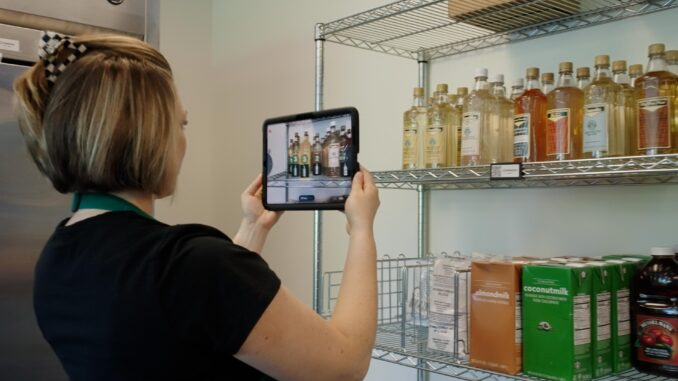
The system was developed by NomadGo and used computer vision, 3D spatial intelligence and augmented reality to count products with a smartphone or tablet. NomadGo said at launch that its technology was being deployed in more than 11,000 Starbucks locations and could complete inventory counts up to eight times faster than manual methods with 99% accuracy. Those were NomadGo’s performance claims, and the potential benefits were easy to understand. Inventory counting is tedious, better visibility can help prevent stockouts, and every minute an employee does not spend counting cartons of milk is a minute that can potentially be spent serving customers.
The reality inside Starbucks coffeehouses was apparently less tidy. Reuters reported that the application frequently miscounted and mislabeled products, sometimes confusing similar milk varieties or missing products altogether. Starbucks did not confirm that those errors were the reason it ended the program, saying instead that it was standardizing inventory counting across coffeehouses as it focused on consistency and execution at scale.
The reaction from some employees was revealing. Starbucks shared internal comments in which employees welcomed the change, including one who expressed gratitude that concerns about the AI count had been heard and another who preferred relying on store partners rather than what the employee called unreliable spatial recognition. Employees who work with a system every day are usually in a better position than anyone else to know whether it is saving time or merely moving work around.
That becomes particularly important with computer vision because restaurants are difficult physical environments to interpret consistently. Products get moved, boxes obscure other boxes, shelves are arranged differently, packaging changes and visually similar products can mean very different things operationally. A system that performs extremely well under predictable conditions can face an entirely different challenge when deployed across thousands of locations, each with its own layouts, storage habits and daily improvisations.
Inventory automation also loses much of its advantage if employees have to verify what the technology has counted. If a barista scans a refrigerator, notices that the system has confused two milk varieties, fixes the count and then checks the rest of the inventory because the first result was wrong, automation has not eliminated the manual process. It has added another step to it.
Starbucks still has to solve the problem that Automated Counting was intended to help address. CEO Brian Niccol has been unusually candid about product availability, telling investors earlier this year that customers should not have to wonder whether something displayed on the menu will actually be in stock. Starbucks is working toward daily replenishment by the end of calendar 2026 as it expands its food program and tries to improve availability across its coffeehouses.
More frequent replenishment could ultimately be more consequential than faster counting. Knowing exactly how many units are sitting on a shelf is valuable, but that information still has to work its way through forecasting, ordering, distribution and replenishment before a shortage is prevented. Improving one piece of the process does not necessarily fix weaknesses elsewhere in the supply chain.
Starbucks’ decision should not be mistaken for a retreat from artificial intelligence. The company continues to deploy Green Dot Assist, which provides employees with conversational answers about recipes, routines and service standards, and Smart Queue, which sequences orders coming from the café, drive-thru, mobile and delivery channels. Starbucks is also working on AI-enabled forecasting, data-driven scheduling and technology that could identify equipment problems before they cause downtime.
A pattern is emerging across the restaurant industry in which operators are becoming more willing to separate enthusiasm for AI from loyalty to any particular implementation. McDonald’s provided an early example when it ended an automated drive-thru ordering test with IBM in 2024 after deploying the technology in more than 100 restaurants. McDonald’s made clear at the time that it still believed voice ordering would eventually have a place in the drive-thru, even though it was ending that particular program.
Two years later, McDonald’s is trying again. The company introduced ArchIQ as part of its McDonald’s > NEXT technology strategy this summer and is testing a Google-powered AI ordering system at five U.S. restaurants. The new effort illustrates why ending an unsuccessful or unsatisfactory deployment should not be confused with abandoning the underlying technology.
Taco Bell’s experience has followed its own uneven course. The chain attracted attention when voice AI produced awkward customer interactions and executives acknowledged that automated ordering might not make sense in every restaurant or during every operating condition, but Taco Bell continued developing the technology rather than walking away from it. This July, Omilia announced that its voice AI system had reached more than 890 Taco Bell restaurants across 38 states and that the partnership would continue expanding.
Wendy’s has also continued expanding FreshAI after beginning with a much more limited deployment. Google Cloud reported last year that Wendy’s was expanding the drive-thru ordering system across 24 states, where it was handling roughly 50,000 orders a day with a reported 95% success rate. The figures come from Google, Wendy’s technology partner, but they suggest that voice automation can reach meaningful scale when an operator is satisfied with its performance.
Computer vision itself is hardly disappearing from restaurants. Culver’s announced this May that it was working with Berry AI to deploy vision technology across more than 1,000 restaurants, using cameras to measure service execution, vehicle flow, throughput and other operational activity. That is a different computer vision problem from identifying individual products on crowded storage shelves, and the comparison helps explain why broad judgments about whether restaurant AI “works” are increasingly meaningless.
The useful question is whether a particular application works well enough for the job it has been given. Restaurants can tolerate an occasional imperfect menu recommendation far more easily than inaccurate inventory data that feeds into replenishment decisions, just as they can tolerate an AI assistant giving an employee an answer that can be checked more easily than an automated ordering system repeatedly sending incorrect orders to the kitchen.
Restaurant companies also need to become more comfortable assigning different thresholds of acceptable error to different technologies. An AI application does not have to be perfect to be useful, but its mistakes have to occur infrequently enough, and be easy enough to detect and correct, that the system still creates a net operational benefit. A technology that saves 20 minutes and creates 30 minutes of checking, corrections and frustration is not automation in any meaningful sense.
This is one reason frontline employees deserve considerable influence over whether these systems survive beyond the pilot stage. Senior executives can see aggregate labor savings, transaction times and accuracy statistics, while restaurant employees see the exceptions that those averages conceal. They know when a workflow that looked elegant in a demonstration becomes cumbersome during a rush and when they have quietly developed workarounds because the official technology cannot be trusted.
There is considerable pressure on restaurant companies today to demonstrate that they have an AI strategy. That pressure can make shutting down a high-profile deployment look like failure, particularly after the company and vendor have publicly promoted the expected productivity gains. In practice, keeping a mediocre system alive because it carries an AI label is a much bigger failure of technology management.
Starbucks tested Automated Counting for years before its North American deployment and ultimately exposed the system to one of the largest real-world restaurant environments imaginable. When it decided this spring to retire the program, it returned milk and beverage components to the same counting process used for other inventory while continuing its broader investments in AI and supply-chain modernization.
There will be plenty more restaurant AI projects that work, plenty that need another few years of refinement and plenty that should be killed after operators discover that the promised benefit does not survive contact with a working restaurant. Companies that can tell the difference will probably get more value from artificial intelligence than those determined to turn every pilot into a permanent deployment.
Starbucks still needs to improve inventory visibility, replenishment and product availability, and another technology may eventually automate much of the counting work that employees are doing today. For now, the company decided that one heavily promoted AI tool had not earned a permanent place in its coffeehouses. Making that call after nine months looks less like a technology failure than a sensible way to run a technology program.
