
By Kyle Wilks, CEO and Co-Founder, Labl.it - 10.26.2026
Spend any time talking to hospitality operators and you’ll quickly discover that very few of them are asking for more regulation. Given everything the sector has faced over the last few years, that’s hardly surprising. Rising employment costs, higher food prices, tighter margins and continuing recruitment challenges mean most businesses already have more than enough to contend with.
Food safety regulation has never really evolved because operators wanted it to. More often, it changes because public expectations change. Natasha’s Law is a well-established example of this, fundamentally changing how pre-packed food for direct sale is labelled following a tragedy that shifted expectations around allergen information and consumer safety.
Looking at how commercial kitchens are changing today, I sometimes wonder whether we’re beginning to see the same pattern emerge elsewhere. Food preparation has become more complex, allergen management has become more demanding, and operators are expected to demonstrate increasing levels of traceability.
The conversation around digital food labeling often centers on whether it’s necessary. I think the more interesting question is whether manual systems can keep pace with the expectations now placed on commercial kitchens.
The humble food label has become one of the most important pieces of information in the food safety process. However, many of the systems supporting that process haven’t evolved at the same pace as the expectations placed upon them.
Handwritten labels have served commercial kitchens well for decades and, in many businesses, they continue to do so. But they rely on people remembering the right information, calculating dates correctly, writing legibly under pressure and repeating that accuracy hundreds of times every week. Most kitchen teams manage that, but as expectations continue to increase, it’s reasonable to ask whether manual systems will always be enough.
I’m not convinced legislation is about to force the issue. Hospitality continues to operate under significant financial pressure, and I suspect the government will be cautious about introducing additional compliance requirements unless there is a compelling reason to do so.
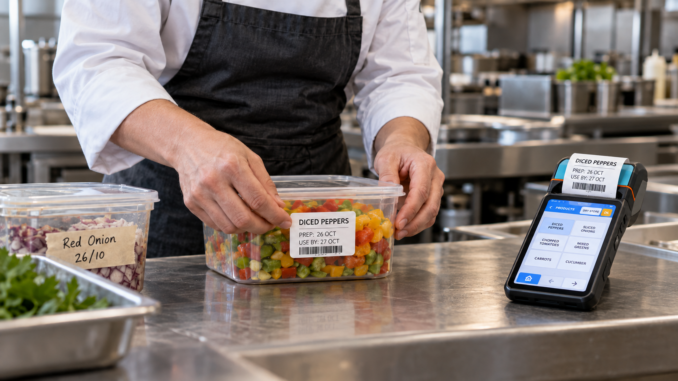
That doesn’t mean operators should ignore the direction of travel. Digital food labeling offers something handwritten systems will never be able to: complete consistency. Information can be standardized, traceability becomes easier, and operators can demonstrate far more easily that the correct processes have been followed if questions are ever asked by Environmental Health Officers or customers.
Whether digital food labeling ever becomes mandatory is impossible to know. Personally, I hope businesses adopt these systems because they recognize the operational benefits rather than because legislation leaves them with no alternative. That’s the approach we’ve always taken at Labl.it, focusing on solving practical kitchen challenges rather than simply helping operators meet compliance requirements.
 Kyle Wilks is CEO and Co-Founder of Labl.it, which provides digital food labelling and compliance technology to thousands of commercial kitchens across the UK. Having worked closely with hospitality operators, he regularly shares insights on food safety, operational efficiency and the role of technology in modern commercial kitchens. Since launching, businesses using Labl.it have printed over 47 million food labels, helping operators improve efficiency, strengthen compliance and reduce manual administration.
Are you an industry thought leader with a point of view on restaurant technology that you would like to share with our readers? If so, we invite you to review our editorial guidelines and submit your article for publishing consideration.
