
By Dustin Stone, RTN staff writer - 10.3.2026
A customer who pays more for lunch today may decide to eat somewhere else tomorrow. Restaurant operators investing in AI-assisted pricing need to account for that possibility alongside food costs, sales forecasts and competitor prices. The debate over McDonald’s pricing technology puts that challenge in practical terms. Estimating what customers will pay can help operators make informed decisions, but the best price for a restaurant also depends on visit frequency, perceived value and the profitability of serving those customers over time.
A September 29 Reuters investigation described a machine-learning engine that analyzes millions of daily transactions across nearly 14,000 U.S. McDonald’s restaurants to recommend menu prices. Screenshots reviewed by Reuters showed that the system considers local price sensitivity, estimated willingness to pay and publicly available competitor prices.
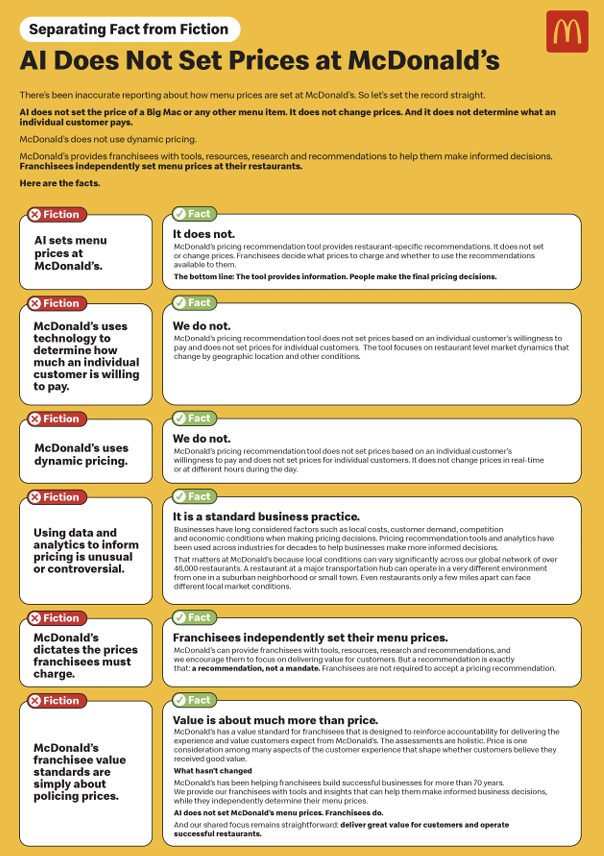
McDonald’s subsequently published a response stating that the tool provides recommendations and franchisees independently determine their prices. The company also said it does not use dynamic pricing, change prices in real time or at different hours during the day, or set prices for individual customers. The available reporting therefore does not support claims that McDonald’s charges each diner a personalized price based on what an algorithm believes that person can afford.
Reuters found a Big Mac priced at $5.69 at one company-operated restaurant in Fresno and $6.89 at another two miles away. It could not confirm whether the pricing engine caused that difference, so the example demonstrates a price gap without establishing how either price was determined.
Different prices can reflect legitimate differences in the cost of running a restaurant. Rent, wages, competition and operating conditions can vary within the same city, making a uniform price difficult to sustain. Better analysis could help operators adjust selected items while avoiding increases that unnecessarily discourage purchases.
Before acting on a recommendation, however, operators need to know what the software is trying to achieve. Maximizing revenue over the next month, improving restaurant profit and encouraging repeat visits are related objectives, but they can lead to different pricing decisions.
A promotion might attract additional transactions while adding food and labor costs that absorb much of the benefit. A price increase might lift the average check while gradually weakening customers’ habit of visiting. A recommendation deserves to be evaluated against the restaurant’s economics and customer relationships, rather than accepted because it carries an “optimal” label.
Willingness to pay also requires careful interpretation. A completed transaction establishes that a customer accepted a price on that occasion. It says much less about whether the customer considered the meal good value, would accept another increase or plans to return.
Someone buying lunch near a transportation hub may have limited time and few convenient alternatives. A family purchasing the same meal near home may be choosing among several restaurants. Both purchases produce useful data, but the circumstances behind them can lead to very different responses to a future price change.
Operators evaluating pricing software should ask how its analysis separates price effects from other influences on demand. A promotion, a competitor’s closure, faster service or a local event could affect sales independently of the menu price. The analysis should also account for customers who have stopped visiting, whose absence may be more revealing than the purchases of those who remain.
Public reporting does not provide enough detail to assess how McDonald’s handles every one of these issues. That uncertainty should encourage specific questions about the system’s methodology, rather than assumptions that its forecasts are either infallible or inherently exploitative.
Used well, pricing analysis could help a restaurant preserve an affordable entry point, identify items that can support an increase or find discounts that generate enough additional business to justify their cost. Reuters reported that McDonald’s recommendations have recently included some price decreases, showing that the technology can also support efforts to improve affordability.
The business case should include evidence of customer response over time. Transactions, contribution margin, repeat visits, menu mix and customer feedback should be reviewed together. A higher average check accompanied by fewer returning customers deserves investigation, even when the initial revenue result looks encouraging.
Franchise relationships introduce another concern about how recommendations are used. Five owners told Reuters they felt pressure to use McDonald’s pricing tools, while the company maintains that franchisees are not required to accept its recommendations. Those accounts describe a disagreement about the practical influence of the system, rather than establishing that it automatically controls prices.
Meaningful discretion requires an operator to understand a recommendation and have a workable way to challenge it. Local costs, service constraints or changes in customer behavior may make a suggested price unsuitable. Recording those reasons can improve subsequent analysis by bringing information from the restaurant into the decision process.
Other companies’ experiences show how quickly pricing technology can become a customer-relations problem. In 2024, Wendy’s faced a backlash after its CEO discussed plans to test dynamic pricing. The company clarified that it had no plans to raise prices during peak demand and said digital menu boards could make discounts easier to offer during slower periods.
Instacart faced criticism over a different practice. In December 2025, it ended item-price tests that had shown different prices for the same item at the same store. The company said those tests were not based on personal data or individual shopping behavior, but acknowledged that they had left some customers questioning the prices they saw.
Neither example establishes what McDonald’s is doing. Both suggest that customers’ expectations deserve attention before a pricing initiative launches. A technically accurate explanation of a system may offer little reassurance once customers believe they are being treated unfairly.
Restaurant brands should be able to explain their pricing practices in language customers understand. Store-level differences, temporary promotions and changes tied to local operating costs each have explanations that can be communicated plainly. Confusing those practices with individualized prices or demand-based surcharges can damage trust and obscure a useful discussion about value.
The information feeding a pricing system also warrants scrutiny. The Justice Department’s November 2025 proposed settlement with RealPage addressed allegations involving competitors’ nonpublic information and software features that aligned rental pricing. That case concerns a different industry and does not establish wrongdoing by McDonald’s, but it gives buyers a concrete reason to examine data sources and the independence of pricing decisions.
A restaurant evaluating pricing software should require a clear business objective, an explanation of the main factors behind each recommendation and information about forecast uncertainty. Operators should retain the ability to approve or reject changes, test them within a defined scope and reverse them when results disappoint. Reviews should assess whether the resulting prices support sustainable profit and give customers a reason to return.
AI can help restaurants make better-informed pricing decisions, including identifying when holding or lowering a price makes commercial sense. Its value should be judged by what happens after those decisions reach the menu. Selling a Big Mac at a higher price today is one result; keeping that customer’s business over the following months is the result worth protecting.
