
By Gavriel Shohet, RTN staff writer - 3.17.2026
Restaurant operators have more data than ever. That’s not the issue. If anything, the problem is that the industry has spent years chasing visibility without solving for what actually matters: the ability to act on that information in time to make a difference.
New research from Starfleet Research, based on responses from more than 350 restaurant owners and operators, underscores just how wide that gap has become. Only 18% say they feel very confident in their ability to forecast sales, labor needs, or guest traffic. Nearly a third say they’re not confident at all. For an industry that now runs on digital ordering, real-time payments, and multi-channel fulfillment, that level of uncertainty should raise eyebrows. It suggests that while restaurants have invested heavily in technology, many are still operating without the level of control those investments were supposed to deliver.
The issue isn’t a lack of information. It’s that most of it arrives too late to be useful.
Talk to operators and you hear the same questions repeated over and over. Why were sales down today? Why did labor spike on a shift that should have been predictable? Which menu items are actually eroding margins? These are not strategic questions. They’re operational questions that need answers in the moment, not hours later. Yet roughly two-thirds of operators say they’re still looking for faster answers to these kinds of issues on a daily basis. By the time most reporting surfaces the problem, the shift is over and the opportunity to correct it has already passed. In an environment where demand can swing based on weather, local events, or a single promotion, that delay isn’t just frustrating. It’s expensive.
That disconnect shows up clearly in the data. Seventy-nine percent of operators say real-time visibility is essential to running their business, yet far fewer feel like they actually have it. More than one in four cannot reliably track even basic metrics such as prep time, order duration, or upsell conversion. In other words, restaurants are generating more data than ever, but much of it still isn’t translating into usable insight. That’s the difference between having information and having control.
One of the more important shifts happening right now is where that control is starting to take shape. It’s not in the back office. It’s at the point of service, where every interaction with the guest now doubles as a data capture opportunity. Every order, modifier, and payment decision feeds into how well a restaurant can understand demand, deploy labor, and manage margins. The operators who are getting this right are treating the front line as an intelligence layer, not just a transaction layer.
Handheld POS devices illustrate this better than almost anything else. They were originally introduced as a way to speed up service, and they still do that. Seventy-two percent of operators now use handhelds for tableside or line-busting workflows, and nearly half extend them to curbside and drive-thru operations. The benefits are well documented. Eighty-two percent report faster service. Sixty-three percent see higher average check sizes. Seventy percent report improved guest satisfaction. But focusing only on speed misses the bigger story. These devices are now capturing real-time operational data that used to be invisible or delayed. Ticket size, prep times, upsell conversion, even inventory checks are being tracked continuously, giving operators a much clearer picture of what’s happening during service, not after it ends.
That shift matters because it directly addresses the industry’s forecasting problem. When confidence in predicting demand is low, real-time feedback becomes the next best thing. Operators can see changes as they happen and adjust staffing, pacing, or promotions before inefficiencies compound. It’s not perfect foresight, but it’s a meaningful step toward control in an unpredictable environment.
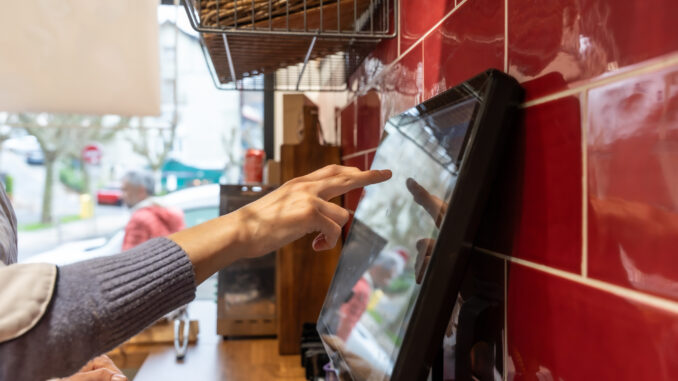
At the same time, control over the ordering process itself is changing in ways that are hard to ignore. Self-service kiosks and guest-directed ordering flows have moved well beyond their early role as labor-saving tools. More than half of operators now use kiosks in at least one location, and adoption continues to spread across formats that historically relied on full-service interaction. The reason is simple. They work. Seventy-six percent of operators report reduced wait times, 69% report improved order accuracy, and 67% report higher average check sizes.
That last number is particularly telling. When guests order on their own, they behave differently. They take more time, they engage with visual prompts, and they are more likely to add items that might not come up in a quick exchange with a staff member. The result is not just faster ordering, but more consistent revenue outcomes. Just as important, kiosks generate cleaner, more structured data. Operators can see exactly what guests are selecting, where they hesitate, and what they skip. Over time, that data exposes something many operators have long suspected but haven’t been able to quantify: the difference between what sells and what actually makes money.
Even with better data capture, however, there’s still a practical reality that technology alone doesn’t solve. Restaurant managers don’t have the luxury of sitting in front of dashboards all day. They’re managing shifts, handling issues, and keeping the operation moving. Expecting them to monitor dozens of metrics in real time isn’t realistic. This is why there’s growing demand for systems that shift from passive reporting to active guidance. More than three-quarters of operators say they want proactive alerts that flag when something is off, whether it’s a spike in labor costs, a slowdown in the kitchen, or a drop in conversion rates. The goal is not to review everything, but to focus attention where it matters most.
You see the same mindset in how operators are approaching AI. There’s clear interest, but it’s pragmatic. Nearly two-thirds say an AI assistant that can answer questions about sales, staffing, or customer trends would be highly valuable. At the same time, there’s little appetite for fully automated decision-making. Operators want support, not replacement. They want faster answers and better context so they can make informed decisions themselves. That distinction is important, and it reflects a broader shift toward technology that augments human judgment rather than overrides it.
All of this leads to a more fundamental change in how restaurant performance is measured. For years, growth was the primary benchmark. If revenue was increasing, the business was considered healthy. That assumption is becoming harder to sustain. Supplier price volatility remains a constant challenge, with 58% of operators saying it affects their business frequently. Labor costs are still elevated. Margins are tight, and in some cases, shrinking. Under those conditions, growth without visibility into costs can actually create more problems than it solves.
That’s why interest in margin-focused capabilities is rising. Seventy-two percent of operators say real-time ingredient price comparisons would be highly valuable. Nearly two-thirds say better plate costing would improve their ability to manage profitability. At the same time, a significant portion of operators are still spending hours each week manually updating costs and checking supplier pricing. It’s a process that’s both time-consuming and reactive, which is exactly what operators are trying to move away from.
Perhaps the clearest signal of this shift is the growing emphasis on profitability forecasting. Sixty-nine percent of operators say forecasting profitability is now very or extremely important. That’s a notable change. It suggests that operators are starting to look beyond revenue and focus on the full economic picture of their business. Not just how much is coming in, but how much is actually being retained.
Step back, and a pattern emerges. The restaurants that are performing best are not the ones adopting the most tools. They’re the ones connecting the tools they already have into a more cohesive operating model. Handheld POS, kiosks, kitchen systems, analytics, and financial data are working together, not in isolation. That integration is what enables faster decision-making, better visibility, and ultimately stronger control over performance.
The industry isn’t getting any easier to navigate. Demand will remain unpredictable. Costs will continue to fluctuate. Guest expectations will keep rising. In that environment, control becomes the differentiator. Not perfect control, but enough visibility and responsiveness to stay ahead of problems rather than reacting to them.
That’s what optimization really means now. It’s not about adding more technology or generating more reports. It’s about building an operation that can see what’s happening in real time, understand why it’s happening, and respond before it’s too late.
The restaurants that figure that out will have an advantage that’s hard to replicate.

Download the eBook: The Restaurant Optimization Playbook
In 2026, restaurant performance is being shaped less by how much data an operator collects—and more by how quickly they can convert data into action. Handheld workflows, self-service ordering, real-time analytics, proactive alerts and margin intelligence are no longer isolated capabilities. When integrated, they form the backbone of a more resilient, more adaptive and more profitable restaurant operation.
To explore the full research findings and a practical framework for restaurant optimization, download the eBook: The Restaurant Optimization Playbook: How to achieve peak performance and profitability in 2026 — and beyond.

