
By Dustin Stone, RTN staff writer - 6.30.2026
Parts Town has acquired 86 Repairs, bringing together two Chicago-area companies focused on a part of restaurant operations that often gets less attention than POS, loyalty or AI ordering, but can have an immediate impact on sales, labor, food quality and guest experience. Financial terms of the acquisition were not disclosed.
The deal combines Parts Town’s scale in genuine OEM replacement parts with 86 Repairs’ repair and maintenance management platform for foodservice operators. Parts Town said the acquisition will help restaurants reduce equipment downtime, streamline service workflows, coordinate more effectively with service providers and use better data to make equipment decisions.
For restaurant operators, the transaction touches one of the most persistent headaches in daily operations. When a fryer, combi oven, refrigeration unit, ice machine, espresso machine or dishwasher goes down, the disruption is rarely contained to the kitchen. Tickets slow. Prep gets interrupted. Menu items can come off the board. Managers lose time chasing vendors, approvals, invoices and parts. In a high-volume restaurant, an equipment failure can affect sales within minutes.
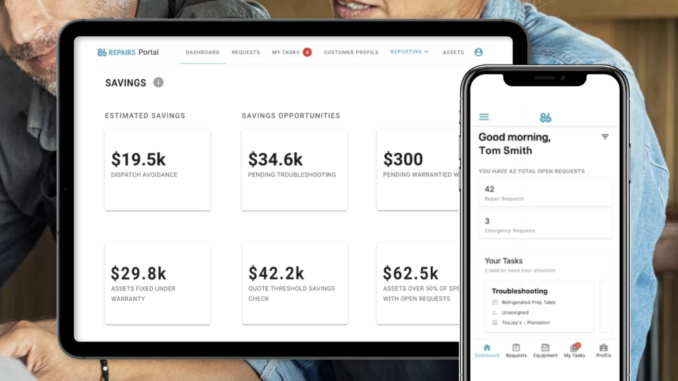
Parts Town and 86 Repairs approach that problem from different sides of the same workflow. Parts Town has built its business around parts availability, manufacturer relationships and fast access to genuine OEM replacement parts. 86 Repairs has focused on the operator side of repairs and maintenance, giving restaurants a way to manage service requests, coordinate vendors, track equipment activity, control repair spend and use data to make better decisions.
Clint Holder, president of Parts Town, framed the acquisition around the connection between parts, service and data. In the company’s announcement, he said bringing 86 Repairs into Parts Town will allow the company to invest further in technology and AI-driven capabilities that reduce friction, improve visibility and help customers get equipment running faster. He also said that connecting parts, service and data more closely can help operators make smarter decisions.
That is the operating issue at the center of the deal. A repair request is not just a work order. It can involve troubleshooting, warranty status, equipment history, vendor selection, technician scheduling, part identification, part availability, approvals, invoices and the decision of whether to repair or replace the asset. When those pieces live in separate systems, operators lose time and equipment stays down longer.
Parts Town brings considerable scale to that process. Founded in 1987 in Addison, Illinois, the company started as a restaurant equipment parts distributor for local service companies. It has grown into one of the largest distributors of genuine OEM foodservice, HVAC and residential appliance parts, with a large e-commerce operation, manufacturer relationships and a broad customer base that includes local, national and international foodservice operators.
The company’s growth has long been tied to modernizing a category that was historically fragmented and phone-driven. Restaurant equipment parts are highly specific, often tied to manufacturer models, serial numbers and configurations. Ordering the wrong part can mean lost time, repeat visits and longer downtime. Parts Town’s catalog, OEM focus, manufacturer relationships and digital tools have helped make parts identification and ordering easier for operators and service providers.
86 Repairs brings a different but complementary history. Founded in 2018 by Daniel Estrada and Joe Gallagher, the company was built around the idea that restaurant repairs and maintenance had remained too manual, expensive and opaque. Its platform helps restaurants troubleshoot issues, manage service requests, coordinate with vendors, track repair activity, monitor costs and use data to make better decisions about equipment performance.
In a 2019 interview, 86 Repairs co-founder Joe Gallagher described the company’s mission as helping restaurant operators save time and money on equipment repairs and maintenance. A year later, 86 Repairs released research on restaurant repairs and maintenance, drawing on repair data across quick-service, fast-casual, casual dining and fine-dining locations. The report highlighted the need for better visibility into repair spend, equipment reliability, service-provider performance and repair-versus-replace decisions.
Those themes have become more important as restaurants operate with tighter margins, higher labor costs and more reliance on equipment that has to perform consistently. Kitchens now include traditional cooking and refrigeration equipment alongside beverage systems, smart ovens, kiosks, digital menu boards, kitchen display systems, delivery technology, ventless platforms and connected devices. The more complex the equipment mix becomes, the more expensive downtime gets.
A broken fryer is a production issue. A failed refrigeration unit is a food safety and inventory issue. A malfunctioning kiosk can affect guest flow. A smart oven that is offline can disrupt consistency, training and throughput. A down ice machine or beverage system can quickly become a guest satisfaction problem. Equipment maintenance has become more closely tied to restaurant performance because the physical operation depends on more systems working together.
The acquisition places Parts Town and 86 Repairs at the intersection of OEM parts distribution, repair management, service-provider coordination, asset data and facilities maintenance. That is an increasingly active part of the restaurant technology market. Companies such as ServiceChannel, Ecotrak, ResQ, OpenWrench, MaintainX, UpKeep, IBM TRIRIGA, Corrigo and FMX address different parts of work-order management, asset tracking, vendor management, preventative maintenance, facilities operations and spend visibility.
The market is not one-size-fits-all. Large enterprise brands often need broad facilities platforms that can manage thousands of locations, dozens of trades and national vendor networks. Mid-market restaurant groups may need hands-on support with repair triage, vendor coordination and cost control. Smaller operators may still rely on local technicians, spreadsheets, texts and manager memory. 86 Repairs has focused on the restaurant-specific layer between those extremes, helping operators manage the repair process while preserving visibility and control.
Parts Town changes the equation by bringing the parts supply chain closer to the repair workflow. A facilities platform can create a work order, dispatch a vendor and track spend, but a repair still depends on the right part being identified and available. Parts Town’s OEM parts business gives the combined company a direct role in reducing the friction between diagnosis and resolution. Adding 86 Repairs gives Parts Town more visibility into the demand side of repairs, including what equipment is failing, where parts are needed, which issues repeat and how operators manage maintenance across locations.
That data can become useful in several ways. Operators can use it for budgeting, preventative maintenance, vendor management and replacement planning. Service providers can use cleaner information to reduce repeat visits and improve first-time fix rates. Manufacturers can gain a clearer picture of parts demand and equipment performance. Parts Town can move closer to the full equipment service lifecycle, not just the moment when a replacement part is ordered.
The acquisition also fits a broader pattern in restaurant technology. Categories that used to sit outside the digital stack are becoming connected. POS, loyalty, labor, inventory, kitchen production and guest engagement have been moving toward more integrated operating systems. Equipment maintenance is now moving in the same direction. Restaurant operations cannot become more intelligent if critical equipment is still managed through disconnected phone calls, invoices, service tickets and institutional memory.
The opportunity is not only faster repairs. It is better equipment intelligence. Operators should be able to see which assets are driving the most service cost, which vendors are performing best, whether preventative maintenance is reducing failures, which equipment is approaching the end of useful life and when repeated repairs are hiding a larger capital planning issue. Those questions have traditionally been difficult to answer because the relevant data was spread across invoices, parts orders, service notes, manager emails and technician reports.
Parts Town and 86 Repairs are coming at the opportunity from a more practical starting point: the repair workflow itself. The request, the part, the vendor, the service history, the cost and the equipment record already exist. The challenge is connecting them. That path may be more accessible for many operators than waiting for every asset in the kitchen to become fully connected.
The companies also have a head start. Parts Town said the two businesses have worked closely together in recent years. Both operate in the Chicago area, with Parts Town headquartered in Addison and 86 Repairs listing Chicago as its primary headquarters. Existing collaboration does not guarantee a smooth integration, but it should reduce some of the uncertainty that can come when two businesses with different operating models are brought together.
The operator benefit will depend on execution. The best version of the combined offering would reduce the number of steps required to get equipment repaired, improve visibility into equipment spend, help operators avoid unnecessary service calls, connect repairs with the right OEM parts and give leadership better data on equipment performance across locations. The test will be whether downtime decreases and repair decisions get easier.
The deal also has implications for service providers. Technicians and service companies often face incomplete information, wrong parts, unclear approvals, repeated trips and inconsistent communication with operators. A more connected parts-and-repair ecosystem could make their work more efficient, provided it supports vendor choice and does not add administrative burden. 86 Repairs has emphasized transparency, vendor choice and operator control, and preserving those principles will matter as it becomes part of Parts Town.
For equipment manufacturers, the acquisition could deepen Parts Town’s role as a partner. OEM parts distribution already depends on manufacturer trust. Better data around failures, parts usage and service patterns could give Parts Town and its manufacturer partners a clearer view of how equipment performs in the field and where support can improve.
The timing is also tied to restaurant margin pressure. Operators are being asked to do more with the equipment, staff and capital they already have. Replacing major equipment is expensive, but running unreliable equipment is expensive too. Poor repair decisions can create a cycle of emergency calls, recurring failures and rising costs. Better repair data can help operators know when to repair, when to replace and where preventative maintenance is worth the investment.
That is especially relevant for multi-unit restaurant groups. A single location may know that a fryer keeps failing. A regional director may not realize the same model is creating repeat failures across several stores. A finance team may see repair spend rising without knowing which assets are responsible. A facilities team may know which vendors are reliable, but lack consistent data to prove it. Connecting parts, service and equipment history can make those patterns visible.
The acquisition also expands Parts Town’s role in back-of-house technology. The company has long been associated with e-commerce, OEM parts availability and service enablement. 86 Repairs adds a software and support layer that speaks directly to restaurant operators’ need for lower costs, faster resolution and better visibility. That could help Parts Town build deeper relationships with restaurant groups beyond the moment they need a replacement part.
The larger market is moving in the same direction. Recent analysis of the 2026 National Restaurant Association Show pointed to a restaurant technology market becoming more operational, connected and focused on execution. POS, payments, digital ordering, loyalty, labor, inventory, kitchen equipment and analytics are being pulled closer together. Parts Town’s acquisition of 86 Repairs brings that same logic to equipment maintenance and service.
The deal does not make repairs and maintenance simple. The category involves service networks, manufacturer relationships, local technician availability, parts logistics, warranty rules, urgent field conditions and tight operator expectations. But the acquisition gives Parts Town a stronger position in a part of restaurant operations where better coordination can produce immediate value.
For restaurant operators, equipment downtime has always been painful. What is changing is the ability to manage that pain with better technology, better data and a more connected service ecosystem. Parts Town and 86 Repairs are betting that the future of restaurant repairs and maintenance will not be defined only by who can ship a part or dispatch a technician fastest after something breaks. It will be defined by who can connect the issue, the part, the service provider and the decision before downtime becomes a larger operating problem.
