
By Dustin Stone, Gavriel Shohet and Lea Mira, RTN staff writers - 6.30.2026
Restaurant discovery and restaurant operations used to be treated as separate parts of the business. A guest found a place to eat, read reviews, looked at photos, checked hours and maybe called to ask a question. From there, the restaurant had to manage the rest through phone calls, reservation books, waitlists, host-stand notes and staff judgment during service.
That separation is becoming harder to maintain. Guests expect fast answers, simple booking, accurate wait times and real-time communication. Operators need to capture demand wherever it appears, whether it comes through search, reviews, social links, phone calls, reservations or walk-ins. Missed calls, abandoned waitlist parties, inaccurate wait times and poorly managed seating flow can all translate into lost revenue.
Yelp for Restaurants sits at the intersection of those challenges. Long known as a consumer discovery platform, Yelp has expanded its restaurant-facing technology into a broader front-of-house suite that helps operators manage reservations, waitlists, seating, guest communication, performance visibility and AI-powered phone interactions. The company’s restaurant strategy reflects a larger shift in the market: discovery, reputation, booking and service execution are increasingly connected.
 That positioning gives Yelp a distinct role in the restaurant technology landscape. Many front-of-house systems begin inside the restaurant, with the reservation book, table map, POS integration or host stand. Yelp begins earlier in the guest journey, at the moment when a diner is deciding where to eat. That starting point matters. A guest who is reading reviews, browsing photos, searching for popular dishes, checking hours or comparing restaurants nearby may already have strong intent. Yelp for Restaurants is designed to help operators convert that intent into reservations, waitlist joins, calls, orders and visits.
Yelp was founded in San Francisco in 2004 by Jeremy Stoppelman and Russel Simmons, both former PayPal colleagues. The company built its early identity around local business reviews, ratings, photos and consumer recommendations, with restaurants becoming one of the platform’s most visible and frequently used categories. Over time, Yelp expanded from a review site into a marketplace that helps consumers discover, connect with and transact with local businesses. As of Dec. 31, 2025, Yelp reported 330 million cumulative reviews, along with 485,000 paying advertising locations on a monthly average basis for the first quarter of 2026.
The company’s deeper move into restaurant operations began more than a decade ago with its acquisition of SeatMe, an online reservation and table management startup. That acquisition helped extend Yelp from discovery into reservations, table management and guest flow. The company continued building on that foundation with Yelp Waitlist and later brought several front-of-house products together under Yelp Guest Manager.
That move signaled that Yelp was not only trying to help restaurants be found. It was also trying to help them manage what happens after demand is created. In a market where guests move quickly from discovery to action, the operational handoff has become more important. A restaurant may appear in a search result, earn a strong review impression and capture a diner’s attention, but the opportunity can still be lost if the guest cannot easily book, call, join a waitlist or receive a reliable answer.
Today, Yelp for Restaurants includes Yelp Guest Manager, Yelp Host, Yelp Ads, reservation and waitlist tools, guest communication features, Yelp Kiosk, integrations and performance visibility tools. The platform is designed for restaurants that want to capture guest demand across multiple digital entry points while giving hosts and managers a clearer view of front-of-house activity.
Yelp Guest Manager remains the core operating layer. The product gives restaurants tools to manage reservations, digital waitlists, floor plans, table assignments, guest status updates and seating flow. Restaurants can accept reservations and waitlist parties from Yelp and other digital channels, then manage those guests through a host-facing system designed for real-time service. For operators, the value lies in reducing manual coordination, improving wait-time accuracy, keeping guests informed and helping managers better understand cover flow throughout the day.
That workflow addresses one of the most familiar bottlenecks in restaurants. The host stand often has to manage people who are physically waiting, guests who joined a waitlist remotely, phone callers asking about availability, reservation changes, special requests, table turns, walk-ins and guests who may or may not arrive when expected. When those activities are handled through disconnected tools, paper lists or staff memory, service can become reactive. Yelp Guest Manager is designed to give restaurants a more structured way to manage those moving parts.
 The importance of that structure is especially clear in high-volume restaurants. A long line outside the door may suggest demand, but it can also create confusion, frustration and lost business if guests do not know how long they will wait or whether they should stay nearby. Digital waitlist tools can make that experience more manageable by allowing guests to join remotely, receive updates and return closer to seating time. For staff, the goal is not simply to reduce the visible crowd at the entrance. It is to create a clearer system for managing flow, communication and table utilization.
Yelp integrations add another layer to that front-of-house picture. When table management and point-of-sale data are connected, restaurants can reduce manual status updates, improve visibility into guest activity and give staff a more complete view of performance. For operators, that kind of connection matters because guest management does not happen in isolation. Seating flow, table turns, order status, guest communication and staff workload all influence one another during service.
Yelp Kiosk extends the waitlist experience into the restaurant itself, allowing guests to check themselves into a digital waitlist when they arrive. Self-service check-in can help restaurants reduce host-stand congestion and free staff to focus on hospitality, seating decisions and exception handling. In restaurants where walk-in demand arrives in waves, kiosks can also give operators a more consistent intake process.
Recent product enhancements have added more depth to the workflow. Yelp’s 2025 Spring Product Release introduced restaurant-focused updates such as Guest Experience Surveys, traffic attribution tools, redesigned party management and additional seating controls. Yelp also maintains a page for new Yelp for Restaurants product features, reflecting continued work around host-stand efficiency, waitlist management, table status, guest feedback and communication.
Guest Experience Surveys add an important feedback layer. Restaurants have long monitored public reviews, but public feedback does not always give operators the full operational picture. A direct survey can surface issues before they become public complaints, while also helping managers identify service patterns, food-quality concerns, staff performance issues or recurring friction in the guest journey. For restaurants trying to improve hospitality while managing tighter labor models, structured feedback can give managers more actionable information than anecdotal comments alone.
Traffic attribution is another practical addition. Restaurants spend time and money across social media, websites, local search, review platforms, ads and other digital channels. Yet many operators still struggle to understand which channels are actually generating reservations, waitlist joins and covers. Yelp’s attribution tools are designed to help restaurants see where guest activity is coming from, including custom booking links for social platforms. That visibility can help operators make more informed decisions about marketing spend, digital promotions and channel strategy.
Yelp Host adds a newer AI layer to the platform. The product is designed as an AI phone assistant for restaurants that can answer incoming calls, respond to guest questions, book reservations, share wait times, block spam and connect with Yelp Guest Manager data. For busy restaurants, phone calls remain one of the most persistent operational pain points. Guests call to ask about availability, change a reservation, check wait times, ask about dietary restrictions, confirm parking details or verify basic information. Those calls often arrive when staff are already seating guests, managing takeout orders or handling a lunch or dinner rush.
That makes phone automation a practical entry point for restaurant AI. Operators may still be cautious about guest-facing AI in areas that require hospitality, nuance and judgment. But many inbound calls are repetitive, time-sensitive and difficult to manage manually during peak periods. A phone that rings unanswered can mean a lost reservation, an abandoned takeout order or a frustrated guest who simply calls another restaurant. Yelp Host is designed to help restaurants capture that demand without pulling staff away from guests already in the dining room.
Recent coverage of Yelp’s AI product expansion highlighted the role of Yelp Host in handling restaurant calls, bookings, wait times and guest inquiries. Broader analysis of voice AI in restaurant reservations has also underscored why the category is gaining attention. Phone-based reservations and guest questions remain common, but they often arrive at the exact moments when restaurant teams are least able to answer them consistently.
Yelp’s advantage is that its AI phone-answering product is not being introduced as a standalone tool disconnected from the rest of the guest journey. Yelp Host sits alongside Yelp Guest Manager and the company’s broader consumer discovery platform. That gives restaurants a way to connect call handling, reservation availability, waitlist management and guest communication in a more coordinated front-of-house workflow.
The integration point matters. A restaurant phone agent that can answer basic questions is useful. A restaurant phone agent that understands wait times, reservation availability and guest management context can become more operationally relevant. The value increases when the AI can support the same front-of-house system that hosts and managers are already using, rather than creating another disconnected channel for staff to monitor.
Yelp Host also reflects a larger restaurant AI trend. Much of the industry’s early AI conversation focused on analytics, personalization, marketing copy and back-office insights. Voice and agentic AI are pushing the conversation closer to real-time operations. Restaurants are asking whether AI can answer phones, manage orders, support drive-thru traffic, resolve guest questions, guide employees and complete tasks inside existing workflows. The technology is no longer only about prediction or content generation. It is increasingly about action.
That broader shift was evident in recent coverage of voice and agentic AI in restaurant ordering, drive-thru automation and guest service. While Yelp’s restaurant AI focus is different from drive-thru ordering or in-vehicle commerce, the underlying market direction is similar. AI is moving from abstract experimentation into operational workflows where speed, consistency and labor leverage can be measured.
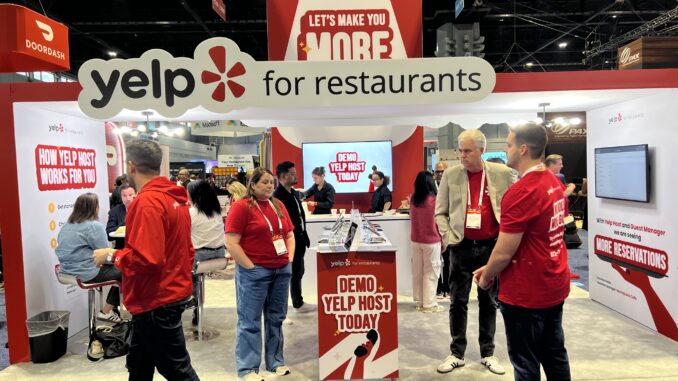
Yelp used the 2026 National Restaurant Association Show to reinforce that front-of-house and AI positioning. The company exhibited as Yelp for Restaurants in Booth 5851, with product categories that included AI, computer software, computerized restaurant management systems, mobile app provider, reservation services and computerized seating systems. For operators walking the aisles at McCormick Place, the message fit a broader theme from the show: guest engagement, reservations, waitlists, loyalty, reviews, digital menus and marketing are no longer separate conversations.
The show-floor relevance was straightforward. Digital ordering, delivery, POS and payments continue to dominate many restaurant technology conversations, but the front of house still has unresolved workflow challenges. Phone calls, waitlists, reservations, seating decisions and guest expectations all remain daily pressure points. A restaurant can have strong digital ordering and modern payment systems and still lose demand because nobody answered the phone or because the host stand could not manage waitlist flow efficiently.
The company’s broader AI roadmap also strengthens the connection between consumer discovery and restaurant execution. Yelp’s 2026 Spring Product Release introduced a broader version of Yelp Assistant designed to help consumers move from search to answers and actions. The release also included an enhanced version of Menu Vision that overlays dish, drink and dessert photos on text-based menus through a phone camera. For restaurants, those consumer-facing features matter because they influence how guests discover where to eat, what to order and whether to take the next step toward booking or visiting.
Yelp Assistant points to a future where discovery becomes more conversational. Instead of typing a generic search, guests may ask for a restaurant that fits a specific occasion, neighborhood, cuisine, dietary need, budget or timing constraint. If that experience connects to reservations, waitlists, menus, ordering and guest communication, restaurant discovery becomes more transactional. Yelp for Restaurants is positioned to benefit from that shift because it connects consumer intent with operator-facing tools.
Menu Vision adds another layer to that discovery experience. Restaurant menus can be difficult for guests to interpret, especially when dishes are unfamiliar or when photos are scattered across review galleries. A tool that helps diners see dish-level photos and review context while looking at a menu may influence ordering decisions and guest confidence. For operators, better menu discovery can support higher satisfaction, reduce uncertainty and potentially improve conversion from browsing to booking or visiting.
The platform aimed not only at independent restaurants but also at high-volume concepts, regional groups and multi-location operators that need better control over guest flow. A brunch restaurant may need to manage long walk-in waits and guest expectations. A seafood chain may need better communication for high-volume waitlists. A multi-location concept may need consistency across different markets. A dinner restaurant using Yelp Host may want to reduce missed calls while preserving staff focus during service. The common thread is not restaurant size or cuisine type. It is the need to capture and manage guest demand more effectively.
Yelp for Restaurants’ competitive strength begins with the scale and intent of the Yelp consumer network. Unlike front-of-house platforms that start inside the restaurant, Yelp sits close to the point of discovery. A diner reading reviews, scanning photos, looking at menu items or searching for a nearby restaurant can move into a reservation, waitlist or call interaction from the same broader environment. For restaurants, that creates a potentially cleaner path from visibility to action.
 The platform also emphasizes accessibility. Yelp Guest Manager and Yelp Host are positioned for restaurants that may not have large IT teams or heavily customized enterprise systems. Digital waitlists, real-time guest updates, table management, diner feedback and AI call answering address everyday workflow problems that independent restaurants and regional groups face as much as national chains. At the same time, Yelp’s advertising products, integrations and multi-location capabilities give larger operators ways to connect guest acquisition, conversion and performance measurement.
The competitive landscape is active. Restaurant guest management includes reservation platforms, waitlist tools, POS-native table management, CRM systems, loyalty platforms, review-management tools and a growing number of AI voice providers. OpenTable, SevenRooms, Resy, Tock, Google, POS vendors and specialized AI call-answering companies all touch parts of the same broader workflow. Some are stronger in reservations. Some are stronger in guest profiles, loyalty or enterprise CRM. Others are focused on voice automation, ordering or call deflection.
Recent market activity shows how valuable dining reservations and guest engagement have become. The proposed American Express acquisition of TheFork, for example, points to the continued convergence of reservations, payments, loyalty, dining discovery and guest data. Yelp operates from a different starting point, but it is moving within the same broad direction: the systems that influence where guests eat are becoming more closely tied to the systems restaurants use to manage those guests.
Yelp’s differentiation comes from combining consumer discovery, reputation, advertising, waitlist, reservations, guest communication and AI call handling under a brand that diners already use to make local dining decisions. That does not make it a replacement for every restaurant technology system. It does, however, give Yelp a meaningful role in the moments when guest intent turns into operational demand. The company’s opportunity is to make that handoff smoother, from search to booking, from phone call to waitlist, from review activity to guest feedback, and from marketing visibility to measurable covers.
Restaurant operators evaluating Yelp for Restaurants will still need to assess how well the tools fit their existing POS, online ordering, loyalty, CRM and reservation systems. They will also need to understand how AI phone interactions reflect the restaurant’s brand voice, how exceptions are handled, how guest data is managed and whether staff trust the system during high-pressure service periods. Front-of-house technology can lose credibility quickly if it creates confusion for guests or adds complexity for staff.
AI call handling raises additional considerations. Restaurants will need to decide which calls should be automated, which should be escalated, how special requests are captured and how the system handles unusual questions, VIP guests, large parties, private events, accessibility needs or service recovery situations. The strongest deployments will likely be the ones that treat AI not as a substitute for hospitality but as a way to absorb routine work that prevents staff from delivering it.
Pricing and packaging will also matter. Restaurants are already managing crowded technology budgets across POS, payments, ordering, delivery, marketing, loyalty, scheduling, accounting and inventory systems. For Yelp Host and Yelp Guest Manager to gain traction, operators will look for measurable impact: fewer missed calls, more captured reservations, better waitlist conversion, shorter host-stand queues, stronger guest communication and clearer attribution of covers back to digital channels.
The need is immediate. Labor pressure has made it harder to dedicate staff to phones and host-stand administration. Margin compression has made every missed call, empty table and lost guest more consequential. Guest expectations have also changed. Diners expect accurate hours, fast answers, simple booking, live updates and less waiting around in crowded entryways. Restaurants are being asked to deliver more responsive service with fewer operational buffers.
Yelp for Restaurants addresses those realities by giving operators tools designed to capture demand, automate routine interactions and improve front-of-house visibility. Its evolution from review platform to restaurant technology provider reflects a broader convergence in the industry. Discovery, reputation, reservations, guest communication and operational execution are no longer separate domains. They increasingly influence one another in real time.
That convergence is where Yelp’s restaurant technology story is strongest. The company is not trying to be the restaurant’s entire technology stack. It is focused on the moments when guest interest becomes restaurant demand, and when that demand needs to be managed quickly, clearly and consistently. For operators under pressure to fill seats, answer guests, reduce friction and make better use of staff time, that front-of-house layer has become more important than ever.
