
By Dustin Stone, Gavriel Shohet and Lea Mira, RTN staff writers - 6.30.2026
Restaurant point-of-sale systems used to be judged mainly by how well they handled orders and payments. A server entered an order, the kitchen received it, the guest paid and the transaction moved into the day’s sales report. That core function still matters, but it no longer captures what operators need from the system that sits at the center of the restaurant.
Today, the POS touches nearly every part of daily operations. It affects tableside service, menu changes, staff permissions, payments, floor plans, kitchen communication, inventory, labor, online ordering, reservations, loyalty, marketing and financial reporting. When those pieces are disconnected, managers spend too much time reconciling information manually. When they work together, the POS becomes less of a transaction tool and more of an operating foundation.
TouchBistro has built its market position around that idea. The company offers an all-in-one POS and restaurant management system designed specifically for restaurants, with tools spanning front of house, back of house and guest engagement. Its platform is aimed at operators that want a restaurant-specific POS, integrated payments and connected tools for controlling costs, improving service, strengthening guest relationships and building more profitable operations.
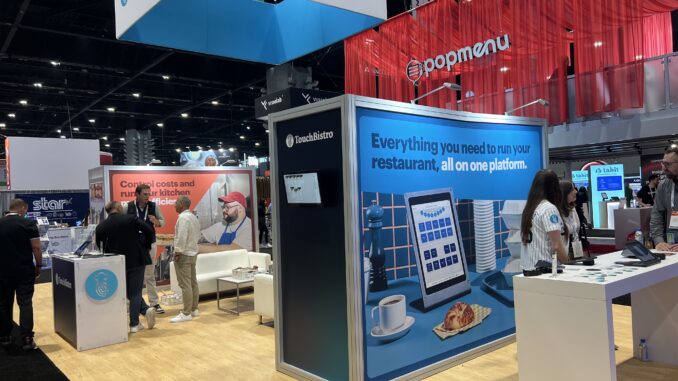
That positioning was evident at the National Restaurant Association Show, where TouchBistro emphasized its ability to help restaurants reduce chaos and deliver stronger service. The company’s booth presence reflected one of the clearest themes across restaurant technology this year: operators want fewer disconnected systems and more connected platforms that bring POS, payments, digital ordering, loyalty, reservations, labor, inventory, kitchen systems and analytics into a more unified operating model.
The need is clear. Restaurants continue to face labor pressure, volatile food costs, margin compression, rising guest expectations and more complicated ordering channels. Managers are being asked to do more with leaner teams while maintaining speed, accuracy and hospitality. In that environment, a POS platform is no longer evaluated only by whether it can process a check. Operators want to know whether it can help them turn tables faster, manage staff more efficiently, keep kitchens organized, reduce waste, support direct ordering and give them clearer insight into profitability.
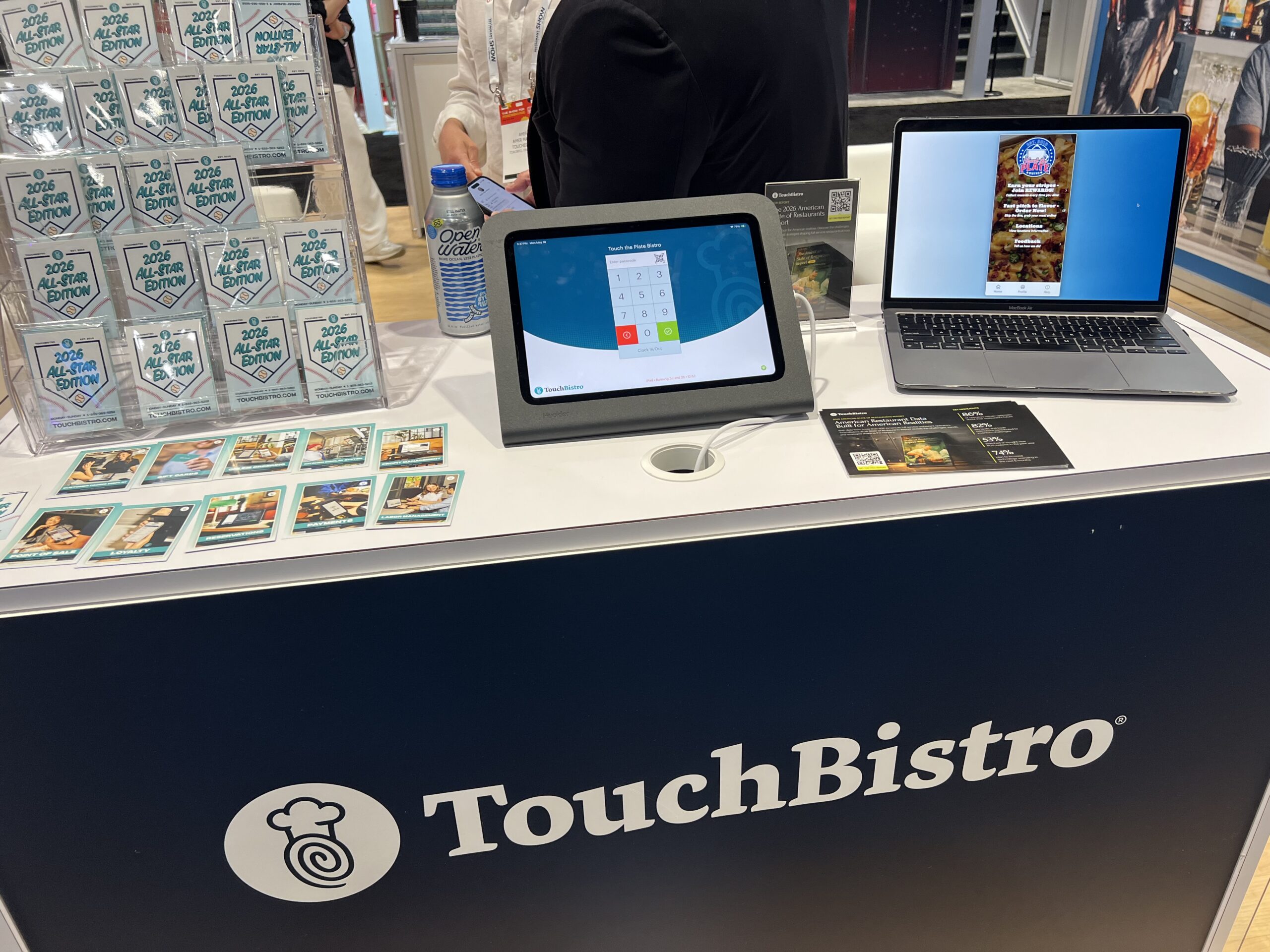 TouchBistro was founded in 2010 with an initial focus on point-of-sale technology for restaurants. The company has since expanded into a broader restaurant management platform that includes payment processing, online ordering, reservations, loyalty, marketing, gift cards, inventory management, labor management, kitchen display technology and profit management. TouchBistro lists Samir Zabaneh as Chairman and CEO, and reports 16,000+ restaurants powered, 64,000+ terminals deployed and more than $14 billion in payments processed annually.
The company’s restaurant-specific roots remain central to its appeal. TouchBistro was built for foodservice rather than adapted from general retail. That shows up in features such as tableside ordering, bill splitting, floor plan management, menu modifiers, kitchen communication, staff permissions and service workflows that fit restaurants with moving parts on both sides of the house. The platform serves a wide range of concepts, including full-service restaurants, fine dining, family-style restaurants, multi-unit groups, quick-service restaurants, fast casual concepts, bars, clubs, breweries and wineries.
At the center of the platform is TouchBistro POS. The system includes menu management, reporting and analytics, staff management, tableside ordering, floor plan and table management, and other core functions designed for restaurant service. In full-service settings, tableside ordering can help servers send orders to the kitchen more quickly, reduce handwritten mistakes and keep guests from waiting for staff to return to a fixed terminal. Floor plan tools help managers see table status, adjust layouts and track service flow in the dining room.
These capabilities are practical, but they matter most during a rush. A busy restaurant has little room for friction. A slow modifier screen, confusing table map, delayed kitchen ticket or payment bottleneck can ripple across the dining room. TouchBistro’s interface is designed to keep common restaurant tasks close to the way staff already work, giving operators a system that can support fast service without adding unnecessary complexity.
Reliability is another important part of the platform’s value. Restaurants cannot pause service because the internet drops during dinner. TouchBistro emphasizes offline mode, allowing restaurants to continue taking and closing orders, sending orders to the kitchen display system and taking offline payments if connectivity is lost. For operators, that kind of resilience protects revenue, staff confidence and the guest experience when conditions are less than ideal.
TouchBistro Payments extends the platform into integrated payment processing. Payments have become part of the service experience, especially as guests expect contactless options, digital wallets, faster checkout and smoother pay-at-the-table interactions. Integrated payments can reduce manual entry, limit errors, speed up closeout and give operators cleaner transaction data. For restaurants trying to turn tables efficiently without making guests feel rushed, payment flow has become part of hospitality.
Payments also affect profitability. Processing costs, hardware reliability, settlement visibility and transaction data all shape the economics of the restaurant. That is why POS and payments decisions are becoming harder to separate. Operators want systems that let staff move quickly while giving owners and managers a cleaner view of revenue, fees, tips and performance.
The kitchen is another area where TouchBistro extends its operational reach. A Kitchen Display System connects front-of-house ordering with back-of-house execution by routing orders to kitchen screens and giving teams better visibility into preparation flow. For high-volume restaurants, kitchen communication is one of the biggest drivers of speed, accuracy and guest satisfaction. A KDS can reduce paper-ticket confusion, make order status easier to track and support better timing across stations, courses and service channels.
That need has grown as restaurants manage more order types. A kitchen may be handling dine-in meals, bar orders, takeout, delivery, online orders and large-party checks at the same time. Without clear routing and visibility, priorities can become unclear. Connected kitchen technology helps operators maintain throughput as demand spreads across more channels.
Back-of-house cost control has become a more prominent part of TouchBistro’s platform. The company now offers Inventory Management, Labor Management and Profit Management. These tools address some of the most persistent financial pressures in restaurants: food waste, ingredient-cost volatility, scheduling inefficiency, labor-cost creep and delayed visibility into margins.
Inventory management is especially relevant in the current market. Food costs can shift quickly, and small changes in ingredient prices can affect profitability. A restaurant may have strong sales but still lose margin if recipes are not costed accurately, purchasing is inconsistent or waste is not visible. TouchBistro’s inventory tools are designed to help restaurants manage stock, recipes and cost visibility more systematically rather than relying on spreadsheets, manual counts and delayed reports.
TouchBistro Profit Management Powered by MarginEdge adds a deeper financial layer. The product is designed to help restaurants process invoices, track food costs, manage inventory, analyze recipes, monitor budgets and understand profitability with more current data. TouchBistro says the system can digitize invoices and handwritten adjustments in less than 48 hours, update inventory prices daily, calculate plate costs, identify profitable and high-volume items, import sales and labor data from the POS nightly and sync information with accounting systems.
That kind of back-office connection can give operators a more current view of what is happening inside the business. Instead of waiting for month-end reporting or manually comparing spreadsheets, managers can work from more timely information about sales, costs, recipes, purchasing and margins. For restaurants where profitability can depend on small changes in labor, menu mix or ingredient costs, that visibility can be especially valuable.
Labor Management addresses the other major cost category. Restaurants need enough staff to deliver service, but overstaffing can quickly erode margins. Understaffing can damage the guest experience, slow service and increase employee stress. TouchBistro Labor Management connects POS data with scheduling, forecasting, staff performance and labor-cost visibility. TouchBistro says sales, guest and shift data flows from TouchBistro POS into Labor Management every 15 minutes, giving managers a more current basis for staffing decisions.
That connection matters because labor decisions are often made with imperfect information. Managers may use historical sales, weather, reservations, local events and intuition to build schedules. A more data-informed process can help restaurants better align labor with expected demand. It can also help managers respond when traffic patterns change, which has become more important as operators deal with uneven dayparts, weather-sensitive patios, event-driven surges and shifting consumer behavior.
Employees can also use TouchBistro Labor Management from their own devices to set availability, request time off, trade shifts and pick up open shifts. That type of employee self-service can reduce manager back-and-forth while giving staff a clearer way to participate in scheduling. The product is also designed to support multi-location teams, shift trades, blocked dates, labor forecasts and digital task tracking.
TouchBistro’s guest engagement products extend the platform beyond operational control and into revenue growth. Online Ordering allows restaurants to accept direct pickup and delivery orders through their own website and other channels. The company also supports a DoorDash Drive integration for restaurants that want delivery fulfillment without sending guests through a third-party ordering marketplace.
Direct ordering remains a priority for many restaurants because it affects both margin and data ownership. Third-party marketplaces can generate demand, but they often carry high commissions and limit the restaurant’s direct guest relationship. A direct online ordering channel gives restaurants more control over pricing, promotions, guest communication and repeat engagement. When online ordering connects to the POS, it can also reduce manual order entry and improve kitchen flow.
TouchBistro Reservations gives restaurants tools to manage bookings, capacity and guest information. For full-service restaurants, reservations are not only a guest convenience. They influence staffing, prep, table turns, kitchen pacing and revenue forecasting. A reservation system that connects with the broader POS environment can help operators plan more effectively and reduce the gap between expected demand and actual service flow.
TouchBistro Loyalty, Marketing and Gift Cards address another operator priority: turning first-time guests into repeat customers. Loyalty and marketing tools help restaurants communicate with guests, create promotions, support rewards and generate repeat visits. Gift cards can provide upfront cash flow, support holiday and special-occasion sales, and bring guests back after the initial purchase.
These tools are most useful when they connect to transaction and guest data. A restaurant does not need another disconnected marketing list. It needs insight into who visits, what they buy, how often they return and which offers may bring them back. TouchBistro’s guest engagement suite is designed to make those activities part of the same restaurant management environment rather than separate systems that operators have to reconcile manually.
The company’s customer references point to practical restaurant operations rather than abstract technology claims. TouchBistro’s current materials highlight restaurants such as El Atlakat, Monica’s and 7 Hills Brewing Co. These examples reinforce the platform’s appeal to operators focused on speed of service, table turns, staff efficiency, front-of-house visibility and daily usability. They also suggest that TouchBistro’s strongest fit remains restaurants that want a purpose-built system with enough breadth to support growth.
TouchBistro’s own research adds useful context. Its 2026 American State of Restaurants Report, based on a survey of more than 600 independent full-service restaurant operators, describes an operating environment shaped by tariffs, rising labor costs and ingredient volatility. The company’s 2026 Canadian State of Restaurants Report similarly focuses on economic volatility, food and labor costs, technology adoption and resilience among full-service operators.
Those findings track closely with what operators are facing in the market. Restaurants are not investing in technology because it is new. They are looking for tools that can reduce manual work, protect margins, improve speed of service, support better forecasting and give managers clearer visibility into the business. A POS platform that connects ordering, labor, inventory, payments and guest engagement can become a central part of that strategy.
The company also appeared in the broader hardware and payments ecosystem at the show. PAX Technology announced that it would demo partner solutions from TouchBistro, On The Fly and OrderCounter while showcasing payment and restaurant hardware. That partner context is useful because restaurant operators increasingly need software, hardware and payments to work together. A POS decision is no longer only a software decision. It also affects terminals, handhelds, kiosks, kitchen screens, payment workflows and service design.
TouchBistro’s strengths begin with its restaurant-specific focus. The platform was built for restaurants from the start, and that specialization shows in features such as tableside ordering, bill splitting, floor plan management, kitchen communication, menu modifiers and offline service continuity. For independent restaurants and regional operators, that focus can be valuable. They need depth in areas where restaurants are operationally complex, but they may not want the deployment burden or customization requirements of larger enterprise systems.
The breadth of the platform is another important advantage. TouchBistro is anchored in POS, but its value expands as restaurants connect payments, kitchen display technology, reservations, online ordering, loyalty, marketing, gift cards, labor, inventory and profit management. That gives operators a path to modernize more areas of the business through a connected restaurant management environment rather than stitching together separate tools one at a time.
Operational accessibility is also part of the appeal. Many restaurant managers do not have time to navigate complex software while running service. They need systems that staff can learn quickly, managers can adjust without heavy technical support and owners can use to understand performance. TouchBistro’s iPad-based roots and restaurant-specific interface give it a usability story that remains relevant as operators look for technology that can simplify daily work.
As with any connected restaurant platform, successful adoption depends on fit, configuration and staff engagement. A single-location cafe may care most about speed and ease of use. A full-service restaurant may prioritize table management, reservations and payments. A growing multi-unit operator may focus more on reporting, standardization, labor forecasting, inventory and centralized controls. TouchBistro’s modular structure gives operators room to align the platform with those different needs.
The value of an all-in-one platform often increases as more modules are connected. A restaurant that uses POS, payments, KDS, online ordering, loyalty, inventory and labor management together may get more operational visibility than one using only the core POS. Each added module still needs thoughtful setup and staff adoption, but the benefit can be a more complete view of the restaurant and fewer disconnected systems to manage.
Back-office tools also work best when paired with strong operating discipline. Inventory, recipe costing, invoice processing and labor forecasting can produce stronger insights when restaurants maintain accurate data and consistent processes. Technology can reduce manual work, improve visibility and support better decisions, while giving managers more time to focus on guests, staff and execution.
That balance is part of TouchBistro’s appeal. The platform is designed to help restaurants simplify operations, improve service flow and better connect revenue with cost control. It does not replace the work of running a restaurant, but it can give operators a stronger foundation for doing that work with more speed, visibility and confidence. The need for that foundation is growing. Labor remains expensive. Food costs remain unpredictable. Guests expect faster service and more convenient ordering. Digital channels have added complexity without always adding profitability. Restaurant managers need tools that help them make decisions earlier, not just review results after the fact.
TouchBistro addresses those pressures with a connected platform anchored in POS but extending into payments, kitchen operations, inventory, labor, profit management, online ordering, reservations, loyalty and marketing. Its evolution mirrors the direction of restaurant technology overall. The POS is no longer just the place where the check closes. It is becoming the place where the restaurant’s operational, financial and guest data come together.
For operators looking to modernize without losing sight of daily service realities, that is TouchBistro’s central appeal. The platform is built around the idea that restaurant technology should reduce chaos, not add another layer of complexity. In a market where every order, labor hour, ingredient cost and guest interaction matters, that kind of connected operating foundation has become harder to ignore.
