GoTab has acquired Fishbowl, adding one of the restaurant industry’s longest-running guest marketing and loyalty platforms to a commerce ecosystem built around POS, ordering, payments, kiosks, mobile ordering, RFID and multi-vendor venue operations. Financial terms of the acquisition were not disclosed.
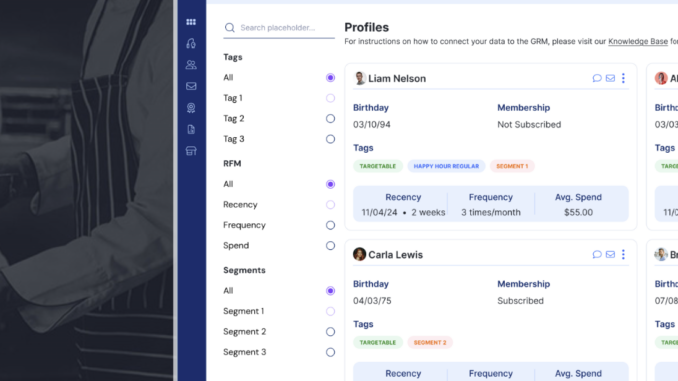
The deal brings Fishbowl’s guest relationship management platform into GoTab’s technology stack, giving operators a more direct way to turn ordering and behavioral data into guest profiles, segmented campaigns, loyalty programs, personalized outreach and repeat revenue. For GoTab, the acquisition extends the company’s reach beyond transaction management and further into guest engagement, a category where operators are under pressure to make better use of the data they already collect.
GoTab’s platform captures behavior across multiple ordering and payment touchpoints, including QR ordering, kiosks, handheld POS, shared tabs, events and multi-vendor environments. Fishbowl adds a marketing and loyalty layer designed to help restaurants organize those signals into audience segments, offers, automated email and SMS campaigns, and measurable retention programs.
The acquisition reflects a restaurant technology market in which POS and ordering platforms are being judged by more than their ability to process transactions. Operators want systems that help them understand who their guests are, how often they return, what they order, which channels they use and what type of outreach is most likely to bring them back. In that environment, the guest record is becoming as valuable as the transaction record.
GoTab has built much of its market position around flexible service models. The company serves restaurants, breweries, food halls, hotels, bars, entertainment venues and other hospitality businesses where traditional table-service assumptions do not always apply. Guests can order through staff, from their own mobile phones, from kiosks or through other service points, while maintaining a shared tab across the experience. The company’s RFID Pass technology extends that model into venues where guests move through multiple stations or vendors, using wristbands or cards to order and pay without repeatedly pulling out a wallet.
That flexibility has made GoTab especially relevant to food halls, breweries, eatertainment concepts, cinemas, festivals, country clubs and other venues where the guest journey is more fluid than in a conventional restaurant. Restaurant Technology News previously profiled GoTab founder and CEO Tim McLaughlin, whose experience as a restaurateur shaped the company’s focus on reducing friction while preserving hospitality. GoTab’s $18 million Series A round also underscored investor interest in platforms built for hybrid service, mobile ordering, payments and operational flexibility.
Fishbowl brings a different but complementary history. Founded in 2000 as an email marketing service for restaurants, the company became one of the industry’s early platforms for digital guest engagement. Its tools have been used by many large and multi-unit restaurant brands, including In-N-Out, Twin Peaks and Lettuce Entertain You Restaurants. GoTab said existing Fishbowl customers will continue to receive uninterrupted service and support.
Fishbowl’s evolution mirrors the changing role of restaurant marketing. The company began in an era when email clubs were often the main digital guest database for restaurants. Over time, the category expanded into CRM, loyalty, SMS, analytics, customer segmentation and omnichannel engagement. Fishbowl was acquired by Symphony Technology Group in 2017, rebranded as Personica in 2020 and returned to the Fishbowl name in 2023 as the company refocused around guest relationship management.
That history gives Fishbowl a recognizable brand in a category where restaurant operators often prefer proven industry-specific tools over generic marketing software. Restaurants now collect data through POS systems, online ordering, reservations, Wi-Fi, loyalty programs, email lists, payment providers, delivery marketplaces, events and in-venue experiences. Much of that data remains fragmented. Fishbowl’s role has been to consolidate guest signals into usable profiles and campaign workflows.
The strategic fit for GoTab is straightforward. When a guest orders through a QR code, uses a kiosk, opens a shared tab, moves across vendors in a food hall or pays with an RFID wristband, the interaction creates useful information. Without a marketing layer, much of that information stays trapped inside operations. With Fishbowl, GoTab can help operators turn that activity into follow-up campaigns, loyalty offers, reactivation messages and more personalized engagement.
That may be especially useful for the kinds of venues GoTab serves. A brewery may want to identify high-frequency guests and promote limited releases. A food hall may want to run destination-wide loyalty across multiple vendors. An eatertainment venue may want to understand how food and beverage spending connects to events, memberships or repeat visits. A hotel or country club may want to connect dining behavior with broader guest preferences. A cinema or entertainment venue may want to target guests based on past visit behavior, ticketing patterns and spending.
Those environments are often more complex than a single restaurant check. A guest may move between stations, vendors, activities and ordering channels during the same visit. GoTab’s commerce platform can capture that behavior. Fishbowl gives operators a way to act on it.
According to GoTab, the combined platform will allow operators to build richer guest profiles based on visit behavior, segment audiences by frequency, spend, preferences and loyalty status, automate personalized email and SMS campaigns, launch destination-wide loyalty programs and measure marketing impact on repeat visits and revenue.
The acquisition also comes as restaurant marketing technology is moving closer to commerce infrastructure. For years, marketing platforms often sat beside the POS. They received data through integrations, file transfers or middleware, then used that data to run campaigns. That model still works, but the market is moving toward tighter links between ordering behavior and outreach. Operators want fewer gaps between a guest action and the marketing response that follows.
That is the value GoTab is trying to create. Its platform already sits close to the transaction. Fishbowl adds tools to manage the relationship after the transaction. Together, the two products give GoTab a stronger story as a restaurant commerce platform that helps operators capture demand, serve guests, collect data and drive repeat business.
GoTab is also keeping its open-platform message intact. The company said operators will still be able to connect GoTab with other marketing platforms. Fishbowl will offer the tightest native integration, but GoTab is not positioning the acquisition as a closed ecosystem mandate. That point is important because many hospitality operators already have established CRM, loyalty, marketing or guest engagement partners. Preserving choice gives GoTab a more flexible path into accounts that are not ready to standardize everything on one vendor.
The competitive landscape is active on both sides of the deal. On the POS and commerce side, GoTab competes with Toast, Square, SpotOn, Clover, Lightspeed, TouchBistro, PAR Technology, Oracle Food and Beverage, Shift4, Heartland and other restaurant platforms. Most are adding or deepening capabilities around payments, loyalty, online ordering, marketing, labor, inventory, analytics and back-office operations.
On the guest engagement and marketing side, Fishbowl sits in a category that includes Paytronix, Thanx, Punchh, Bikky, Ovation, Incentivio, Popmenu, SevenRooms, Lunchbox, BentoBox, Clutch, Olo and broader marketing platforms such as Klaviyo. These companies approach the guest relationship from different angles: loyalty, CRM, guest feedback, direct ordering, reservations, websites, campaign automation, customer data infrastructure or digital revenue.
The lines between these categories are becoming less distinct. POS providers want stronger guest engagement capabilities because order and payment data become more valuable when tied to retention. Marketing platforms want deeper transactional integrations because campaigns perform better when based on actual behavior. Reservation and guest management platforms want to own more of the relationship before and after the visit. Online ordering providers want to help restaurants protect direct digital revenue. Loyalty providers want to connect rewards with first-party data, ordering behavior and personalized messaging.
GoTab’s Fishbowl acquisition fits that convergence. It gives GoTab a mature marketing and loyalty product without having to build the entire category from scratch. It gives Fishbowl a tighter connection to modern ordering and payment flows. It also gives GoTab access to a long-standing Fishbowl customer base while allowing those operators to continue using the service they already know.
The operator benefit will depend on execution. A POS-owned marketing platform can create value if data moves cleanly, segmentation is easy, campaigns are measurable and staff do not have to perform manual work to connect systems. It can create friction if operators feel locked into one vendor or if the marketing product does not keep pace with specialized competitors. GoTab’s open-platform commitment will be central to how the acquisition is received.
The deal also reinforces the growing importance of first-party data. Restaurants have become more aware of the cost of relying on delivery marketplaces, social platforms and paid advertising channels for guest access. Direct ordering, loyalty, email, SMS and guest profiles give operators more control over the relationship. Fishbowl’s long-standing role in restaurant marketing aligns with that shift, while GoTab’s ordering and payment touchpoints create more opportunities to collect data at the moment of engagement.
The combination could be particularly useful for operators with complex service environments. In a food hall, one guest may order from multiple vendors under one umbrella. In an entertainment venue, food and beverage behavior may be tied to event attendance, ticketing, game play or membership. In a brewery, visits may revolve around taproom habits, seasonal releases, private events and repeat local traffic. In those settings, traditional POS data often tells only part of the story. GoTab and Fishbowl can help operators see more of the guest journey and respond with more relevant outreach.
The acquisition also gives GoTab a stronger retention story. Restaurants have spent heavily on acquisition through delivery marketplaces, paid search, social media, influencers and discount-driven campaigns. Margin pressure is pushing operators to think harder about repeat visits and lifetime value. Marketing tied to purchase behavior, visit frequency and preferences can be more profitable than broad promotions aimed at everyone.
Fishbowl’s challenge under GoTab will be to modernize while preserving the reliability that made it familiar to restaurant marketers. The platform has long served operators that need practical tools for email, SMS, segmentation, loyalty and guest engagement. GoTab’s challenge will be to integrate Fishbowl deeply enough to create new value while continuing to support Fishbowl customers that may not use GoTab’s POS or ordering platform.
The transaction is also consistent with GoTab’s recent expansion beyond front-of-house ordering and payments. In 2025, GoTab acquired opsi, an intelligent restaurant management platform focused on kitchen operations, recipe management, inventory, invoice processing and financial tracking. That deal extended GoTab further into back-of-house operations. Fishbowl now expands the company further into marketing and loyalty.
The larger pattern is easy to see. Restaurant platforms are trying to become fuller operating systems. Recent analysis of the 2026 National Restaurant Association Show pointed to the same shift, with POS, payments, digital ordering, loyalty, guest engagement, labor, kitchen production and analytics becoming more connected. GoTab’s acquisition of Fishbowl extends that movement into the guest marketing layer.
The deal does not mean every GoTab customer will adopt Fishbowl, or that every Fishbowl customer will move to GoTab. The stronger signal is that the boundary between restaurant commerce and guest marketing is getting thinner. Ordering platforms are no longer just taking orders. They are trying to help operators understand what happens before and after the order.
For restaurant operators, that is where the acquisition becomes practical. A guest who orders through a kiosk, QR code or RFID wristband should not disappear after the transaction. A loyal local, a first-time visitor, a high-spend guest, an event attendee and an infrequent customer all represent different opportunities. The more accurately a restaurant can recognize those patterns and respond, the more valuable each transaction becomes.
GoTab’s acquisition of Fishbowl adds marketing depth to a commerce platform already built for flexible, high-volume and experience-driven hospitality environments. It also shows where restaurant technology is heading: away from disconnected systems and toward platforms that connect ordering, payments, guest data, loyalty and marketing into a more complete view of the customer and a clearer path to repeat business.
