By Dustin Stone, Gavriel Shohet and Lea Mira, RTN staff writers - 6.29.2026
Restaurant operators have no shortage of data. POS systems capture sales. Scheduling platforms track labor. Inventory tools record stock movement. Accounting systems show financial results. Guest feedback arrives through review sites, surveys and social channels. The problem is that too much of that information still sits in disconnected systems, forcing managers to reconcile reports manually and make daily decisions with incomplete visibility.
Nory is building its restaurant management platform around that gap. The company describes its system as an agentic AI restaurant operating system, designed to help restaurants predict demand, build staffing plans, manage ordering and payroll, and keep P&L performance on track across locations. The focus is not on guest-facing ordering or POS replacement. It is on the operating decisions that determine whether restaurants control labor, cost of goods sold, waste and margin.
That positioning gives Nory a distinct role in the restaurant technology ecosystem. Many restaurant software platforms help operators understand what happened after the fact. Nory is trying to move AI closer to the decisions that happen before and during service: how much demand to expect, how many people to schedule, what to order, where waste is building and whether a location is drifting away from its targets. In that sense, the company’s AI story is less about dashboards and more about operational action.
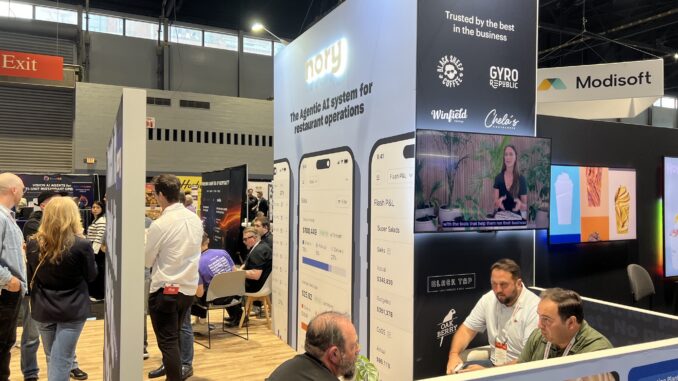
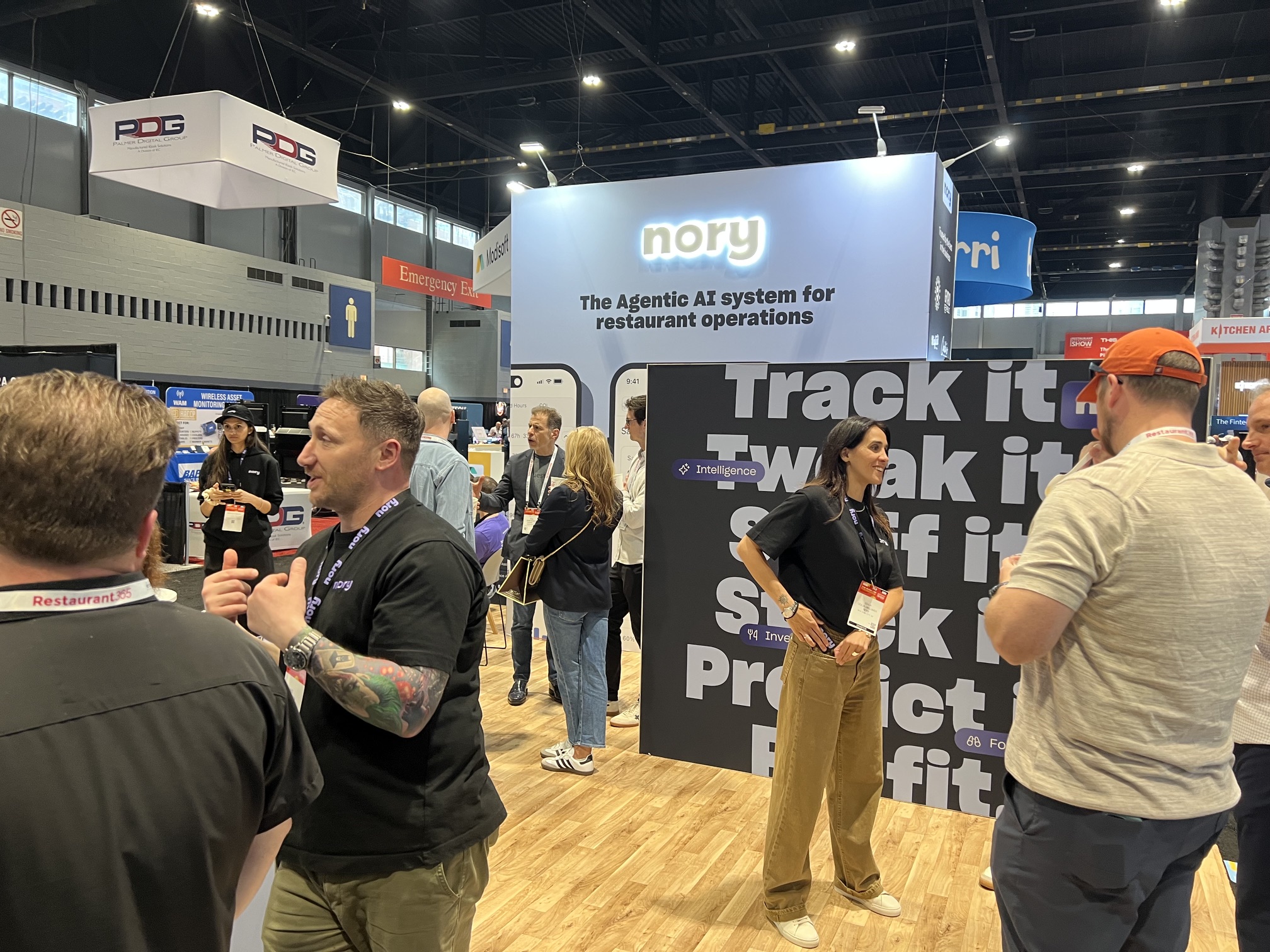
Nory brought that message to this year’s National Restaurant Association Show in Chicago, where the company exhibited in booth 5857. At a show where restaurant operators were evaluating AI, automation, labor tools, inventory systems and profitability platforms, Nory’s message was well aligned with a central industry concern: how to use technology to protect margins in a market where demand is volatile, labor is expensive and cost control requires faster decisions.
The company’s core concept is prime cost control. For restaurants, labor and cost of goods sold are the largest controllable cost categories and the ones managers influence every day. A schedule that is too heavy erodes margin. A schedule that is too lean harms service. Ordering too much creates waste. Ordering too little creates shortages. Nory’s platform is built around connecting those decisions through forecasting and AI-assisted workflows.
The company’s agentic AI positioning is central to the story. Nory frames its platform around a crew of AI assistants working across demand forecasting, scheduling, ordering, payroll, reviews and operational performance. The distinction is important. A traditional analytics tool may surface a trend for a manager to interpret. Nory’s model is designed to turn forecasts and operational data into recommended actions across the business.
Forecasting is the foundation. Nory’s Demand Forecasting Assistant predicts revenue and item sales in 15-minute intervals at each location. Its Business Intelligence product also provides a five-week rolling forecast, built from historical data, weather and other inputs. That forecast is not simply a reporting layer. It becomes the basis for labor planning, ordering, inventory control and performance management.
 That connection between forecast and action is where Nory’s platform differs from systems that treat forecasting as a separate report. In a multi-location restaurant group, even a strong forecast has limited value if managers still have to translate it manually into schedules, purchase orders and labor targets. Nory is designed to make the forecast operational, pushing demand expectations into the workflows that determine how each site prepares for service.
The business intelligence layer gives operators a more current view of financial performance. Nory pulls revenue from POS systems every 15 minutes, calculates theoretical gross profit as orders come in and tracks projected versus actual labor cost hour by hour. The result is a flash P&L that is closer to live operations than a traditional month-end report. For multi-unit operators, that can shorten the gap between a problem appearing in the business and a manager being able to act on it.
That matters because restaurants often identify margin problems too late. A location may spend too much on labor, over-order ingredients or lose margin through waste and variance before the issue is visible in accounting reports. Nory’s group-level and site-level dashboards are designed to show revenue, gross profit, labor, forecasts and flash P&L in one place, giving operators a more immediate view of where performance is on track and where attention is needed.
Labor is one of the most visible use cases. Nory’s Workforce Management product is designed to build compliant schedules from the sales forecast, labor targets and team availability. General managers review and adjust the schedule rather than building it from scratch. The platform also supports time-off requests, shift swaps, time and attendance, team communication, onboarding and labor-cost visibility across sites.
The scheduling workflow is designed around a common restaurant pain point. Managers do not simply need a staff rota. They need a schedule that matches forecasted demand, respects availability, stays within budget, accounts for compliance and supports the guest experience. Nory’s Scheduling Assistant is designed to bring those inputs together so labor planning becomes less reactive and less dependent on manager guesswork.
That approach is particularly relevant for multi-location restaurant brands. A single restaurant manager may be able to rely on instinct and local knowledge, but a growing group needs more consistent operating controls across locations. Nory gives area managers and operators a way to compare planned versus actual labor, monitor labor drift and identify sites that may be over- or under-deployed before the week closes.
Inventory and ordering form the second major side of Nory’s prime-cost story. The company’s Inventory product tracks the COGS side of the business, including supplier management, stock usage, recipe costing, waste logging and real-time gross profit. The platform connects to POS data so stock can deplete as items are sold, allowing restaurants to monitor theoretical usage and gross profit more closely.
Nory’s inventory system is built around three practical levers: demand-based ordering, stock reconciliation and waste logging. Demand-based ordering helps restaurants buy for expected sales rather than static par levels. Stock reconciliation helps operators see where waste and variance are occurring. Waste logging makes waste capture part of the daily workflow, giving teams a clearer view of what is being lost and why.
The Ordering Assistant extends that capability by checking inventory against forecasted demand and creating supplier purchase orders. For operators, that creates a direct link between what a restaurant expects to sell and what it buys. The goal is not simply to digitize inventory counts. It is to reduce the mismatch between demand, purchasing, prep and waste.
That is a meaningful distinction in foodservice operations. Many restaurants know that waste is a problem, but they lack the connected data needed to identify whether waste is coming from over-ordering, prep loss, supplier discrepancies, poor portion control or weak forecasting. Nory’s inventory and BI tools are designed to bring those signals closer together, making waste and variance easier to see while there is still time to correct them.
Payroll adds another layer to the operating system. Nory’s Payroll product connects schedules and timecards to the pay run, with errors flagged before payday and visibility into payslips. Payroll is not the primary story, but it reinforces the company’s broader platform logic. When forecasting, scheduling, timecards and payroll live in the same workflow, restaurants can reduce manual reconciliation and limit errors that often arise when labor data moves across disconnected systems.
The platform also includes integrations with existing restaurant systems. Nory’s product pages reference connections across POS, payroll, accounting and other restaurant systems, allowing operators to bring existing data into the platform rather than replacing every system around it. That integration strategy is important because restaurant technology stacks are rarely simple. Operators often need a layer that can connect operational data from multiple systems and make it useful for daily decision-making.
Nory’s customer examples help illustrate where the platform is being used. Black Sheep Coffee, which operates across the UK and U.S., has used Nory to consolidate forecasting, labor scheduling and inventory management across a 130-location estate. The success story highlights forecast accuracy, 15-minute demand forecasting intervals and tighter labor-cost variance as the company scaled.
Other customer stories emphasize different parts of the platform. Roasting Plant Coffee has been featured around labor and payroll improvements. CUPP has been highlighted for reducing food waste. Tasty African Food has used the platform across multiple locations to control margins and improve operational visibility. Hook & Ladder has been featured for forecasting, waste reduction and margin improvement.
The company’s customer base also includes restaurant and hospitality groups such as Black Sheep Coffee, Jamie Oliver Group and Azzurri. Those references support Nory’s positioning as a platform for growing operators and multi-unit restaurant businesses, not only single-location independents. The strongest fit appears to be brands that need greater consistency across locations and more direct control over the relationship between labor, inventory and profitability.
Nory’s growth story adds another current hook. In 2025, the company raised $37 million in Series B funding led by Kinnevik, with participation from Accel, Base10, Triple Point and Samaipata. The company said the funding would support additional AI development, expansion of its AI assistants and growth in the U.S. market. That timing matters because U.S. restaurant groups are increasingly evaluating AI based on whether it can improve margins rather than simply create novelty.
The competitive landscape includes workforce management platforms, inventory systems, restaurant BI tools, scheduling applications, back-office software, POS-native analytics and enterprise resource planning systems adapted for hospitality. Nory differentiates itself by positioning those functions around one operating model: forecast the business, translate the forecast into labor and ordering decisions, monitor performance in real time and use AI assistants to reduce the manual work required to keep locations on target.
That platform story reflects a broader shift in restaurant technology. Operators are moving from isolated tools toward systems that can connect decisions across the business. Labor planning affects service and profitability. Inventory affects menu availability, waste and gross margin. Payroll affects administrative burden and accuracy. Forecasting affects all of them. When those workflows operate separately, managers spend more time reconciling data and less time acting on it.
Nory’s bet is that AI can be most valuable when it is embedded inside those operating workflows. Rather than treating AI as a chatbot or an analytics layer, the company is applying it to recurring decisions that managers make every week and every day. That includes building schedules, flagging labor drift, forecasting item demand, recommending orders, surfacing waste patterns and keeping performance visible across locations.
The result is a restaurant management platform aimed squarely at profitability. Nory does not need to be the restaurant’s POS system or ordering channel to become operationally important. Its value sits in the connective tissue between revenue forecasts, staffing plans, inventory decisions, payroll and live P&L visibility. For operators trying to widen margins while scaling across locations, that connective layer can be critical.
As restaurants continue to face pressure from labor costs, food-cost volatility and unpredictable demand, the ability to act earlier and more consistently will matter. Nory’s agentic AI operating system gives restaurant groups a way to move from retrospective reporting toward more proactive control. By connecting forecasting, labor, inventory, payroll and business intelligence in one platform, Nory is helping restaurants turn operational data into better decisions and, ultimately, stronger profitability.
