
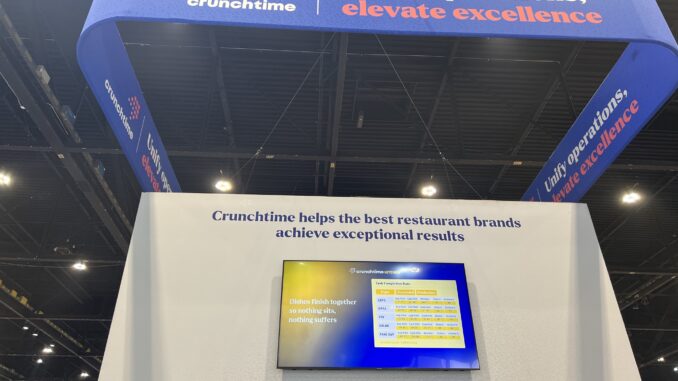
By Dustin Stone and Lea Mira, RTN staff writers - 7.11.2026
Running a multi-unit restaurant brand has always depended on timing. The right food has to be in the building before the rush. The right people have to be scheduled by daypart. Prep has to match expected demand. Kitchens have to move orders without losing accuracy. Brand standards have to hold across locations that may be hundreds or thousands of miles apart.
The challenge is that much of the information needed to manage those decisions has historically lived in separate places. Sales data sits in the POS. Inventory counts sit in the back office. Labor plans live in scheduling tools. Kitchen performance may be visible only during the rush. Store audits, food safety checks, prep routines and training data often move through yet another system. By the time leadership sees a pattern, the opportunity to fix the shift may already be gone.
Crunchtime has spent years addressing that gap for large restaurant operators. The company provides a restaurant operations management suite used to manage inventory, labor and scheduling, operations execution, kitchen management, guest management, learning and operational intelligence. Crunchtime works with more than 850 brands across more than 150,000 locations in more than 100 countries.
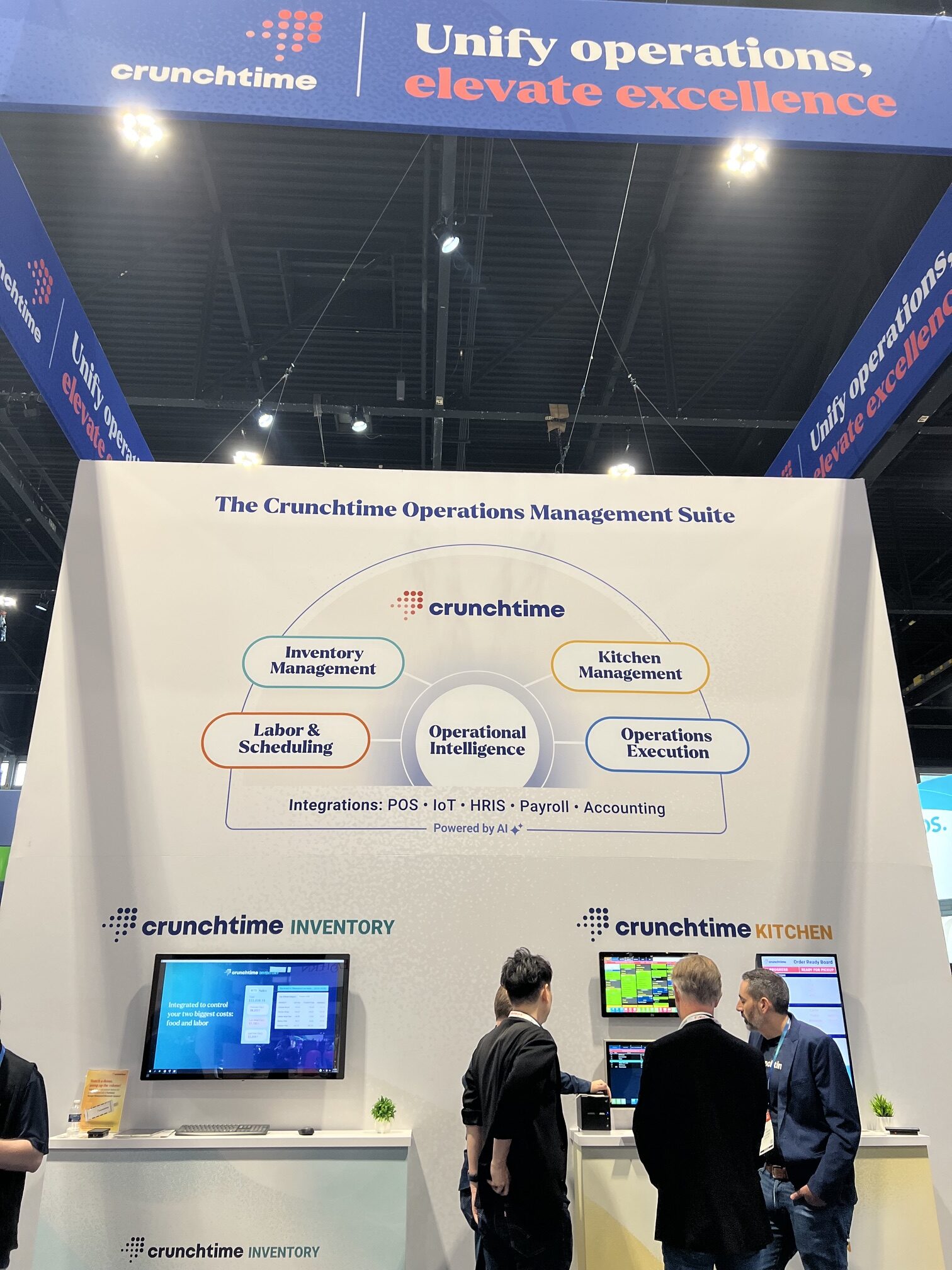 Crunchtime’s presence at the 2026 National Restaurant Association Show reflected the direction of the current product suite. In the weeks leading into the show, Crunchtime introduced new AI capabilities across inventory, operations execution and analytics, reinforcing its focus on giving operators faster ways to understand what is happening in the business and act on it.
The company’s product story has changed quite a bit over the past several years. Crunchtime has long been associated with restaurant back-office operations, especially inventory, food cost and labor management. The 2022 acquisition of Zenput brought store execution, task management, audits and food safety workflows deeper into the portfolio. In February, Zenput was renamed Crunchtime Ops Execution, bringing that product more clearly into the Crunchtime suite.
The next major expansion came after Crunchtime and QSR Automations agreed to merge in 2025. That move added kitchen automation and guest management technology, giving Crunchtime a wider role in the restaurant operating cycle. The combined company framed the deal around the full food lifecycle: ingredient ordering, demand forecasting, prep, kitchen routing, guest flow and order execution. For operators, the logic is easy to understand. Inventory planning and labor planning are only part of the picture if the kitchen and host stand are running on separate information.
Crunchtime’s current suite is organized around that connected operating model. Inventory Management handles counts, ordering, reconciliation, sales forecasting, actual-versus-theoretical food cost and supplier workflows. Labor & Scheduling focuses on staffing, labor cost management, employee scheduling and labor law compliance. Ops Execution handles tasks, audits, temperature monitoring, food prep labeling, corrective actions and store-level standards. Kitchen Management brings kitchen display system functionality into the same environment, while Guest Management supports host stand workflows and front-of-house flow.
A store manager does not experience inventory, labor, food safety, prep and kitchen throughput as separate technology categories. They experience them as one shift. The prep plan depends on the forecast. The forecast affects the schedule. The schedule affects throughput. Throughput affects the guest experience. Food safety checks and operating standards affect consistency. When those workflows are disconnected, managers spend too much time reconciling the business instead of running it.
Inventory Management remains one of Crunchtime’s core strengths. Restaurants can use the platform to manage inventory counts, order guides, purchasing, reconciliation, waste tracking and menu profitability. The product also supports actual-versus-theoretical food cost analysis, helping operators compare what food should have cost based on sales and recipes with what it actually cost based on inventory movement and purchasing.
 A few points of food-cost variance may look small in one restaurant, but across hundreds of locations it can become a major profit leak. Operators need to know whether the problem is pricing, portions, waste, prep, theft, supplier substitution, inaccurate recipes or weak forecasting. Crunchtime gives above-store teams a way to spot those patterns and gives store teams tools to correct them.
Crunchtime’s AI Forecasting builds on that inventory foundation. The forecasting engine uses a custom-built AI algorithm to predict future sales, guests or checks, supporting ordering, prep and labor planning. Crunchtime has reported that some customers have achieved 98% to 99% forecast accuracy using the tool.
Forecasting is one of the more practical uses of AI in restaurant operations because managers already make forecast-based decisions every day. They decide how much product to order, how much prep to assign, how many people to schedule and how to prepare for events, weather, holidays and shifting traffic patterns. Better forecasts do not replace judgment, but they can reduce guesswork and help managers protect both labor and food cost.
In April, Crunchtime introduced four additional AI capabilities: AI Analyst, Voice-Based Inventory, Photo Intelligence and AI Actions. The tools are aimed at daily operating work rather than abstract analytics, placing AI inside the tasks managers and above-store leaders already handle.
AI Analyst lets operators ask questions in natural language and receive answers drawn from operational data. A multi-unit leader might ask which regions had strong checklist scores but rising food waste, or where labor performance and prep execution are moving in opposite directions. The benefit is not simply a faster report. It is the ability to connect information that would otherwise require dashboards, exports and manual analysis.
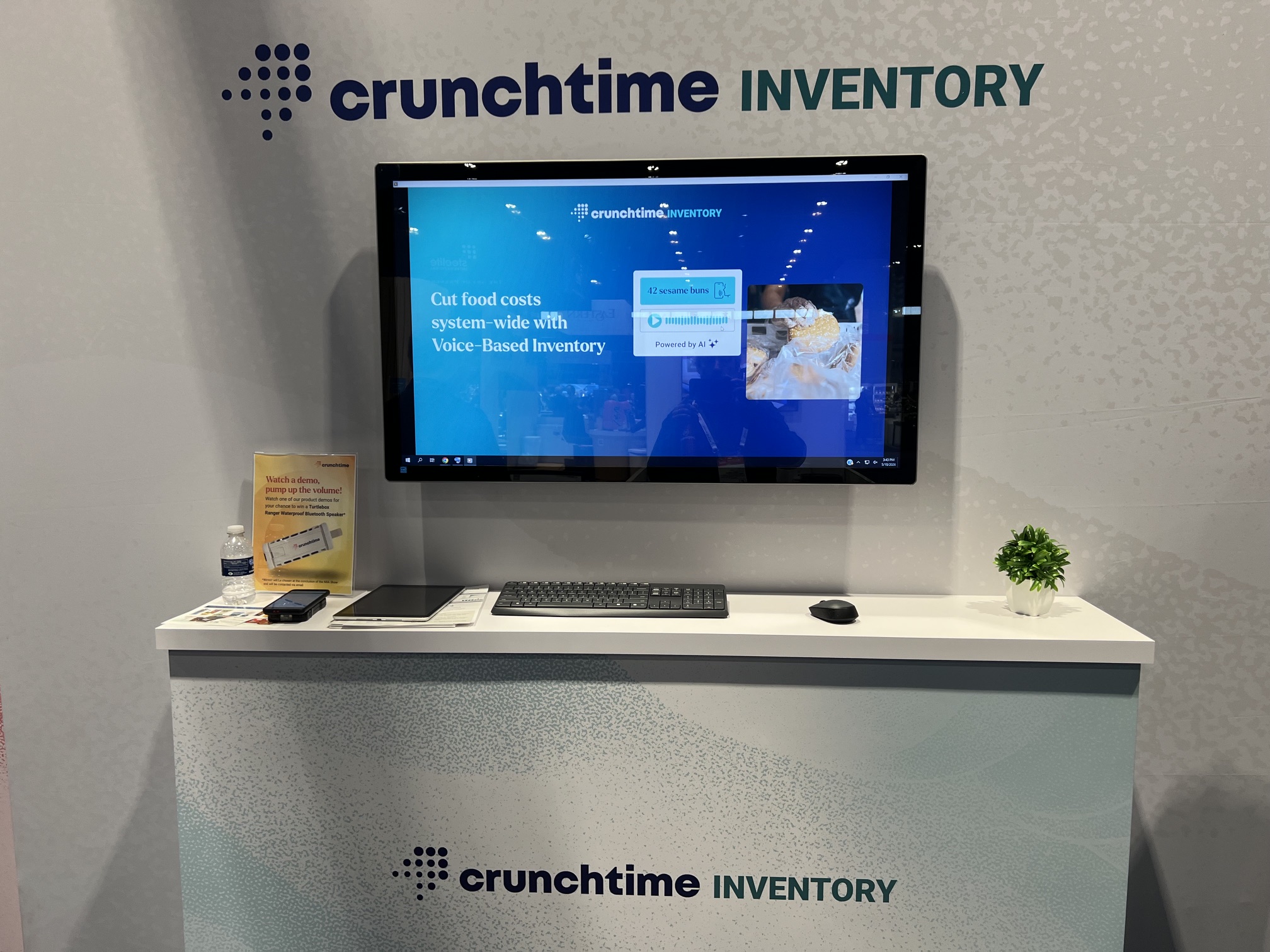
Voice-Based Inventory brings AI into one of the least popular restaurant tasks: counting product. Managers can speak inventory counts into the mobile app rather than stopping to type on a screen or write on a clipboard. Crunchtime has said the feature can make counting three to four times faster. Anyone who has counted shelves, walk-ins or storage rooms during a busy day understands the appeal of a hands-free workflow.
Photo Intelligence applies AI to store execution. Restaurants often ask teams to submit photos of completed tasks, food safety checks, displays, cleaning work or brand-standard execution. Above-store leaders cannot manually review every photo across a large system, so many rely on sampling. Photo Intelligence is designed to review photos at scale, checking content and adherence to standards so leaders can manage by exception.
AI Actions moves from review to follow-up. The tool analyzes completed task submissions, including daily HACCP checks or opening checklists, and identifies where execution is breaking down. Crunchtime says AI Actions can analyze up to 3,000 completed submissions in seconds and generate recommended follow-up actions. A completed checklist has value. A system that can flag patterns, identify suspicious completions and recommend corrective action is far more useful for brands managing consistency across many stores.
The May product updates added more operational detail. Crunchtime highlighted Voice-Based Inventory, new self-service API tokens, enhancements to Inventory Service APIs, Staffing Template Assistant for labor planning, school calendars for minor labor compliance, pre-shift attestation through Teamworx Time Clock, and self-service licensing and deployment for Kitchen and Host software. These are not headline-grabbing changes, but they address the small points of friction that often determine whether restaurant technology is used well.
The Staffing Template Assistant is a good example. Labor planning is difficult because demand moves by hour, daypart, season, weather and local events. Templates can help, but only if they reflect real revenue patterns and store needs. Crunchtime’s assistant is designed to guide the setup of staffing level templates and cross-check them against revenue data. For brands managing labor across many locations, a more structured setup process can improve consistency without forcing every manager to build schedules from scratch.
School calendar integration for minor labor compliance addresses another operational headache. Restaurants that employ minors have to account for school schedules, holidays, vacation days and local labor rules. Handled manually, that work can become error-prone quickly. Bringing school calendar data into scheduling workflows gives operators another way to reduce compliance risk while preserving flexibility during non-school days.
Crunchtime Ops Execution carries the Zenput heritage into the current suite. The product supports daily tasks, opening and closing checklists, line checks, audits, food safety routines, temperature monitoring, prep labeling, alerts and corrective actions. Store teams get a structured way to complete required work, while above-store leaders can see which tasks were done on time, which were missed and where standards are drifting.
Restaurant operations depend on repeatable work. A brand can write detailed standards, but those standards only matter if they are executed every day in every location. Paper checklists and occasional store visits cannot give leadership the same visibility as digital execution data. Crunchtime Ops Execution gives brands a clearer view of whether the work is actually happening.
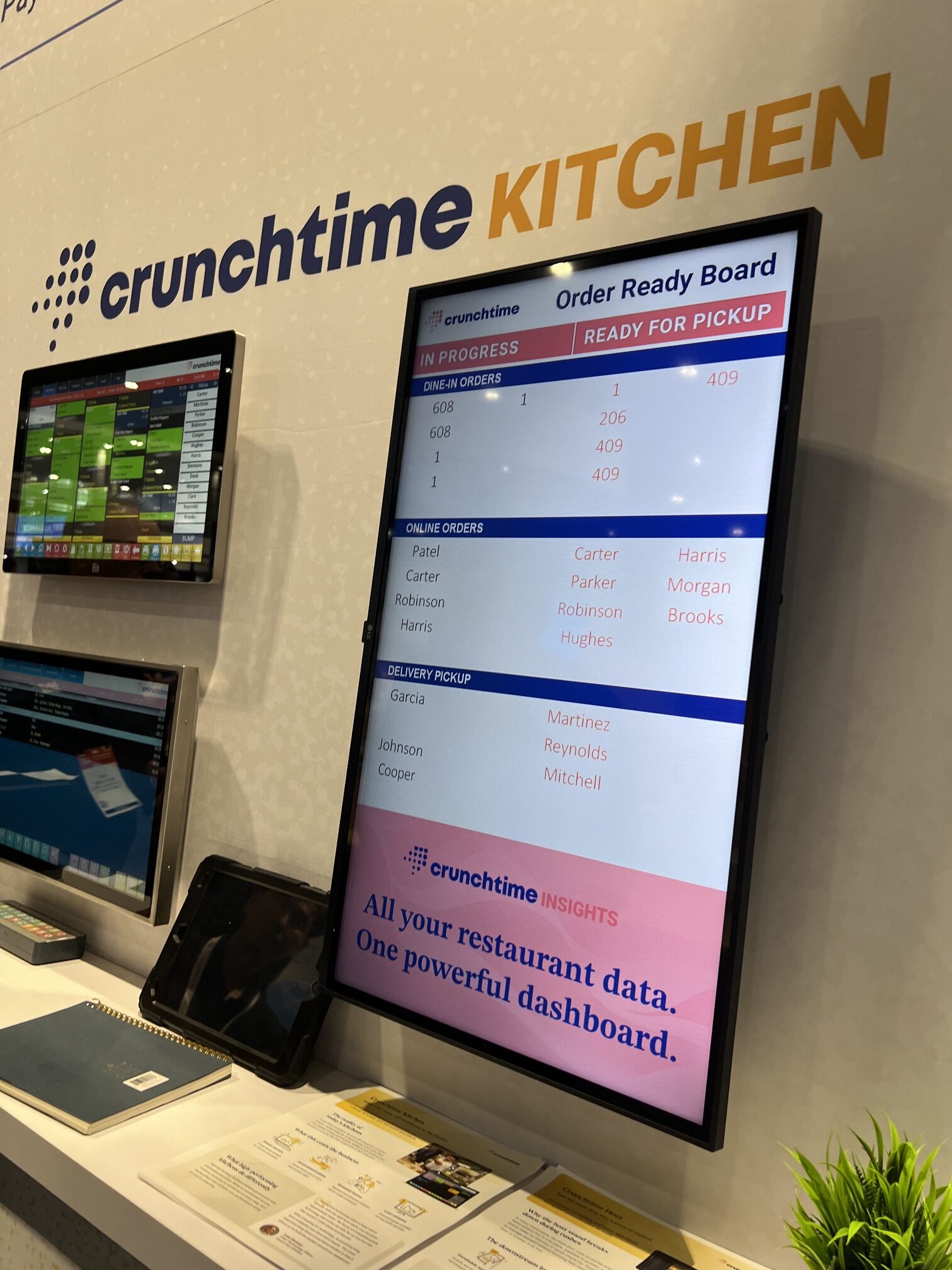 Kitchen Management adds another piece of the operating picture. Crunchtime Kitchen, expanded through the QSR Automations combination, puts the kitchen display system at the center of production. The product is designed to improve order flow, routing, timing and kitchen visibility. For high-volume restaurants, kitchen automation affects speed, order accuracy, waste, labor deployment and guest satisfaction.
The connection between kitchen workflow and inventory is especially important. A kitchen display system can route orders and improve timing, but it becomes more valuable when paired with forecasting, prep planning and food-cost visibility. If operators understand expected demand, prep requirements and live order flow, they have a stronger foundation for managing waste and throughput. The QSR Automations deal gave Crunchtime a better way to connect planning with execution during the rush.
Guest Management extends that connection to the host stand. Waitlists, seating, pacing, quoted wait times and table flow affect the entire restaurant. A kitchen already running at capacity cannot absorb unlimited seating without consequences. A host stand without kitchen visibility can unintentionally create pressure that slows service. Crunchtime Host gives operators another way to connect guest flow with kitchen performance and labor planning.
Learning & Development rounds out the suite. Training is often treated separately from operations, even though it shapes whether standards are followed consistently. Crunchtime includes restaurant courses and learning tools that support onboarding, compliance and skill development. For multi-unit operators, training becomes more useful when tied to execution data. If audits reveal a pattern, training can address it. If stores struggle with prep, safety checks or labor workflows, the issue may be operational, educational or both.
Crunchtime’s integration strategy is central to the product story. The suite connects with POS systems, accounting platforms, HR and payroll systems, vendors and suppliers, and custom business intelligence environments through APIs. The company’s suite overview describes POS integrations for sales, menu mix, time punches and employee data; accounting integrations for accounts payable, accounts receivable, sales, inventory and transfers; HR and payroll integrations; vendor and supplier workflows; and APIs for operational data.
Restaurant groups already operate complicated technology stacks. A brand may use one POS, another HR system, a separate payroll provider, a corporate business intelligence environment and multiple supplier relationships. A restaurant operations platform has to fit into that environment rather than require the brand to rebuild everything around it. Crunchtime is strongest when it becomes the operating layer that connects store activity to finance, labor, purchasing and above-store visibility.
The customer base shows the breadth of the platform. Crunchtime lists brands across quick service, fast casual, casual dining, fine dining, entertainment, foodservice, cruise lines and convenience stores. Customer logos and examples include McDonald’s, Chipotle, Chili’s, Landry’s, HMSHost, Carnival, Love’s, Taco Bell, Dunkin’, Burger King, Domino’s, Sonic, Popeyes, Culver’s, Texas Roadhouse, The Cheesecake Factory, Golden Corral, Five Guys, P.F. Chang’s, Jersey Mike’s, Sweetgreen, Dave & Buster’s, Topgolf, Shake Shack, Panda Express and many others.
The featured customer materials also show how varied the use cases can be. Caffè Nero replaced fragmented supplier portals with Crunchtime Inventory. BJ’s Restaurants uses Crunchtime Kitchen and Host to support high-volume service. Dave’s Hot Chicken relies on Crunchtime Kitchen for ticket times and order accuracy. Jersey Mike’s uses the operations suite while continuing large-scale growth. SIR Corp has used Crunchtime Host across its restaurant brands. Gong cha uses Ops Execution to support standards as it scales. Herschend Family Entertainment applied Crunchtime to food purchasing and menu management across a large entertainment portfolio.
Crunchtime is not a point solution for one department. It is designed for brands where operations, finance, training, food safety, labor, supply chain and kitchen performance all overlap. A small independent restaurant may not need that level of infrastructure. A brand with hundreds or thousands of locations usually does.
Crunchtime now covers a large amount of operational territory. Inventory, labor, kitchen flow, guest management, task execution, food safety, training and analytics all produce data that can inform the next decision. The company’s strategy is to bring those workflows closer together so operators can see what is happening, understand why it is happening and respond before small problems become expensive.
Multi-unit restaurant technology has to function across corporate stores, franchise systems, international markets, different labor laws, different suppliers and different operating models. Crunchtime’s footprint across more than 150,000 locations and more than 100 countries gives it credibility with large operators that need enterprise support, security, integrations and rollout experience.
Restaurant AI often sounds abstract until it is tied to a specific task. Crunchtime is applying it to forecasting, inventory counts, natural-language analysis, photo review and execution follow-up. These are daily management tasks that already consume hours across restaurant systems. The test is whether AI can make them faster, more reliable and easier for managers to use during a real shift.
Crunchtime can connect a large amount of operating work, but restaurant groups still need clean data, well-designed processes and clear rollout plans. Forecasting depends on reliable historical data and store adoption. Inventory tools depend on accurate counts and maintained recipes. Ops Execution depends on thoughtful task design and manager follow-through. Kitchen and host systems depend on careful configuration, staff training and change management.
Operators also need to decide which pieces of the suite to deploy first. A brand focused on food cost may start with inventory and forecasting. A fast-growing franchise system may prioritize Ops Execution to standardize checklists, audits and food safety. A high-volume restaurant group may look first at kitchen automation and guest management. A brand dealing with labor pressure may focus on scheduling and compliance. The value grows when the pieces connect, but the rollout still has to match the operator’s most urgent problems.
Restaurants are under pressure to protect margins, improve labor productivity, reduce waste, maintain brand standards and grow without losing consistency. Operators are also becoming more serious about AI, but they are looking for practical AI tied to measurable operating work. Crunchtime’s recent product updates reflect that shift by embedding AI into counting, forecasting, task review, analysis and follow-up.
For restaurant leaders, the larger question is how quickly the organization can turn data into action. Knowing what happened last month is useful. Knowing what is happening today is better. Knowing which store needs attention, why the issue is occurring and what action should happen next is where the value grows. Crunchtime is building its suite around that progression.
Crunchtime sits at an important point in the restaurant technology market. The company has the back-office depth of a long-standing operations platform, the store-execution capabilities brought in through Zenput, the kitchen and guest-management capabilities added through QSR Automations, and a new generation of AI tools aimed at practical daily work. For multi-unit restaurant brands trying to run every location with more consistency, visibility and control, Crunchtime offers a connected operating system for the work that determines profitability and guest experience.
