

6.6.2026
When Mohaimina (“Mina”) Haque graduated cum laude from the American University Washington College of Law, she could have joined her classmates in climbing the ranks at prestigious law firms. Instead, she forged her own path, ultimately becoming CEO of global casual dining chain Tony Roma’s in June 2023 at a time when the iconic brand was burdened by debt, operational inefficiencies and years of declining momentum. Less than two years later, the turnaround has been remarkable. Under Haque’s leadership, Tony Roma’s eliminated all outstanding debt, implemented rigorous financial controls, reduced operating costs through strategic AI adoption and increased systemwide sales by 18% year over year in 2024, restoring profitability and positioning the brand for growth. The transformation helped earn Tony Roma’s the No. 2 spot in the restaurants and foodservice category of Newsweek’s 2025 Excellence Index, trailing only Starbucks.
A lawyer by training and a technology-driven executive by practice, Haque has placed AI, automation, predictive analytics and data-driven decision-making at the center of the company’s revival. In this Spotlight Interview, she discusses how technology is reshaping franchise operations, site selection, labor management, guest engagement and restaurant economics and why she believes legacy restaurant brands that fail to embrace AI risk being left behind.
You stepped into leadership of a legacy brand with more than 50 years of history. What did you see as the biggest disconnect between Tony Roma’s past success and its recent challenges?
Tony Roma’s built its reputation on a category-defining product and a hospitality experience that anchored families and travelers for decades. The disconnect was not the brand. The disconnect was the operating model that surrounded the brand. The infrastructure had not kept pace with how guests now discover restaurants, how franchisees evaluate unit economics, and how data informs every decision a modern operator makes. The opportunity was to preserve everything that made the guest experience iconic and to rebuild the system underneath it. Once that became the working thesis, the path forward clarified quickly.
As a practicing attorney turned CEO, how has your legal background shaped your approach to franchise operations, governance and risk management?
What legal training gives you is a way of thinking that travels. Lawyers are trained to walk into a room without the operational background everyone else carries and still ask the question that reframes the conversation. That instinct travels across industries. I may not arrive at a meeting with the same restaurant operating muscle memory that a career operator brings, but I will often ask the question that surfaces the assumption no one had thought to challenge. Once that question is on the table, the room starts thinking differently, and the path forward becomes clearer for everyone in it.
What I bring to franchise operations, governance, and risk management is that posture, paired with the discipline to follow each issue to its resolution. Strategy, sequencing, and the willingness to keep asking until the answer holds up. For franchisees, the value of that approach is consistency. Decisions are made deliberately, the system is governed with precision, and the leadership chair is occupied by someone whose judgment is informed by both rigor and perspective.
Tony Roma’s has significantly reduced its U.S. footprint in recent years. What specifically needs to change for the brand to successfully scale domestically again?
Domestic scale requires three coordinated shifts. First, the prototype must match how Americans dine today, which means flexible footprints suited to high-traffic tourist corridors, lifestyle centers, and mixed-use developments. Second, the unit economics must be transparent and defensible, with predictable buildout costs, accelerated ramp curves, and technology that lowers the operating burden on the franchisee. Third, the brand presence must be reactivated through earned media, strategic placements, and cultural relevance. We are executing all three concurrently, and the early results in site selection conversations with developers reflect renewed confidence in what the brand can deliver.
You’ve positioned AI and robotics at the center of the brand’s transformation. What does that actually look like at the unit level today versus six months ago?
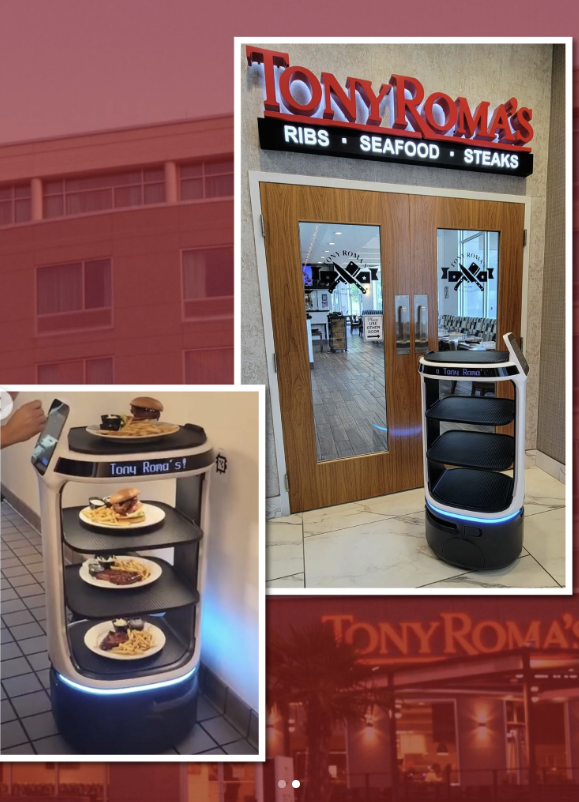 The honest answer is that the most advanced applications of AI inside our system today are running at the corporate level. That is where the transformation has compounded most visibly over the past six months. Memos that used to take two weeks now move in hours. Legal review, vendor coordination, market analysis, financial modeling, and franchise development workflows are all running with AI assistance, which is how a lean corporate team operates with the agility of a much larger one.
New franchisees signing into the system inherit the full benefit of that infrastructure from day one. Existing operators are a different conversation, and we are mindful of it. Legacy operators built their businesses without these tools and are reasonably skeptical of change. Our approach is to demonstrate value before we ask for adoption. As corporate-level results accumulate, the case for unit-level adoption makes itself.
Many restaurant brands talk about AI, but few operationalize it. Where are you already seeing measurable ROI from these investments?
The clearest returns have surfaced at the corporate level, which is precisely where the highest leverage exists for a brand of our footprint. Administrative cycles that historically required multiple weeks now resolve in days or hours. A lean corporate team supports a global franchise system across multiple legal jurisdictions, currencies, and operating environments, and AI is the reason that ratio holds. Legal drafting, market research, financial analysis, and internal communications are all running faster and with greater consistency than was possible even a year ago.
The capital efficiency that produces is meaningful, and it allows us to redirect resources into the parts of the business that matter most to franchisees, including brand development, real estate strategy, and franchisee support. The returns at the unit level will follow as adoption broadens, and the corporate platform we are building now is what will make that next phase efficient when it arrives. Each of these outcomes is auditable, which matters because franchisees and investors do not respond to narrative. They respond to numbers that hold up under scrutiny.
You’ve emphasized predictive analytics across operations. How are you balancing data-driven decision-making with the human element of hospitality?
Data tells you what is likely to happen. Hospitality tells you what to do about it. Predictive analytics is most valuable when it frees the operator and the team from the cognitive load of forecasting, so they can spend their attention on the guest in front of them. The technology is invisible to the diner. What the diner experiences is a server who is not buried in a tablet, a kitchen that is not running out of the dish they came in for, and a manager who has time to walk the floor. That is the design intent.
Smaller footprints are a major shift from Tony Roma’s traditional format. What’s the ideal prototype now, and how does technology enable that transition?
The ideal prototype today is calibrated to the trade area rather than to a fixed square footage. In tourist corridors and high-density urban locations, the format leans toward a streamlined dine-in experience with strong takeout and delivery integration. In suburban and resort markets, the format expands modestly to accommodate family occasions and group dining.
Technology enables this flexibility by allowing a smaller box to operate with the throughput of a legacy footprint. Kitchen display systems, optimized prep flows, and digital ordering channels collapse the operational complexity that historically required a larger physical environment. The franchisee captures comparable revenue with a meaningfully lower capital outlay.
How are AI-driven tools improving back-of-house workflows like inventory management, prep, and labor scheduling in practical terms?
Inventory tools now reconcile against actual sales velocity and surface variance in near real time, which shortens the loop between a problem appearing and a manager addressing it. Prep workflows are being sequenced by predicted ticket volumes rather than by static daily routines, which reduces both over-prep and stockouts. Labor scheduling is increasingly informed by trailing performance data combined with forward demand signals, which protects guest experience during peak periods and protects margin during slower ones. Each of these shifts is incremental in isolation. Together, they redefine what an operator can reasonably expect to control.
Staff turnover continues to challenge the industry. What role does technology realistically play in retention versus just efficiency?
Technology cannot manufacture retention, but it can remove the conditions that drive people to leave. When schedules are fair and predictable, when training is accessible on demand, when the tools a team member uses on shift actually work, retention improves. The industry has historically treated technology as a cost-savings instrument. We treat it as an instrument of dignity for the workforce. People stay where they feel competent and respected. Technology, deployed thoughtfully, contributes to both.
You’ve highlighted personalization at scale. How far can AI go in shaping the guest experience before it risks feeling impersonal?
Personalization fails the moment a guest senses that they are being processed rather than welcomed. The line is held by judgment, not by code. We use AI to understand patterns of preference, frequency, and occasion, and we hand that understanding to the operator and the server in a form they can act on naturally. The guest never sees the algorithm. The guest sees a manager who remembers their anniversary or a server who anticipates a favorite. That is the entire test.
Franchise alignment has historically been a challenge for legacy brands. How are standardized systems and unified data changing the franchisee relationship?
Unified systems change the conversation between franchisor and franchisee from interpretation to alignment. When everyone is reading the same operational data on the same cadence, debates about performance become productive rather than defensive. Franchisees gain visibility into their own business that many never had under legacy reporting structures. The franchisor gains the ability to identify systemic issues early and to direct support where it produces the highest return. The relationship becomes a partnership grounded in shared facts. That is precisely the environment in which a thoughtful franchisee wants to invest.
AI-driven site selection is gaining traction across the industry. How confident are you that these tools can outperform traditional real estate decision-making?
AI-driven site selection is not a replacement for experienced real estate judgment. It is an accelerant for it. The tools surface trade area dynamics, demographic trajectories, and co-tenancy patterns at a depth that a single analyst cannot replicate manually. The judgment of whether a particular street, a particular intersection, or a particular development reflects the brand still belongs to the human operator. Used together, the combination produces faster decisions and better hit rates. Used in isolation, either approach falls short.
Predictive maintenance is often overlooked in restaurant tech conversations. What impact has it had so far on cost control and operational uptime?
Equipment downtime is one of the most underestimated cost centers in the industry. A single hood, walk-in, or fryer failure during a peak service can erase a week of margin. Predictive maintenance moves the conversation from reactive repair to scheduled intervention, which protects both the asset and the guest experience. The savings show up in two places. Emergency service costs decline meaningfully, and revenue is preserved during periods that would otherwise have been disrupted. Operators who have adopted these systems rarely return to the old model.
You’ve said you want Tony Roma’s to become a model others replicate. What would need to be true in the next 24 months for that to happen?
Three conditions must hold. First, the technology stack must demonstrate durable, repeatable economics across diverse markets, not only in flagship locations. Second, the franchisee community must be able to point to peers who have entered the system recently and achieved their projected returns. Third, the brand narrative in the public conversation must reflect what the operating reality already is. The first two are well underway. The third is accelerating through earned media, speaker platforms, and the strategic visibility work we are executing now.
There’s a growing gap between tech-forward brands and those still operating traditionally. Where do you think Tony Roma’s sits on that spectrum today?
Tony Roma’s is firmly on the tech-forward side of that line, and the gap is widening in our favor. What distinguishes our position is that the technology adoption was not bolted onto a comfortable legacy operation. It was rebuilt into the operating system as part of the turnaround. That sequencing matters. Brands that defer this work in favorable conditions tend to discover, in less favorable conditions, that the rebuild is far harder than the upgrade.
What’s the biggest misconception operators have about implementing AI and robotics in a legacy restaurant system?
The most persistent misconception is that meaningful AI deployment requires a transformative technology budget before any progress can be made. It does not. What it requires is clarity about the problem being solved and the discipline to implement solutions that integrate with how the business actually runs. Operators who wait for ideal conditions tend to wait indefinitely. Operators who begin with the tools available to them, prioritize precisely, and measure rigorously will compound their advantage quarter over quarter. The meaningful gains in this industry have consistently gone to those who started before they felt fully ready.
How do you prioritize which technologies to invest in, given the pace of innovation and the risk of overbuilding the tech stack?
Every technology decision is evaluated against three questions. Does it measurably improve the guest experience, the franchisee economics, or the operator workflow? Does it integrate with the systems already in place without creating new dependencies that the system cannot support? Does it produce returns within a defined window, and can those returns be audited? Tools that satisfy all three move forward. Tools that satisfy only one or two are documented and revisited. The risk of overbuilding the stack is real, and the discipline to say no is as important as the willingness to say yes.
Looking ahead, how different will a Tony Roma’s location feel to a guest three years from now compared to today?
To the guest, the difference will feel like ease. The reservation will be more intuitive, the wait will be shorter, the server will be more present, and the meal will arrive faster and more accurately. The guest will not be aware of the systems that produced any of those outcomes. They will simply leave with the impression that this was one of the better dining experiences they have had in a long time. That impression, repeated reliably across a growing footprint, is what defines the next chapter of this brand and what makes the franchise opportunity in front of us as compelling as it is.

