

By Marc Obadia, Founder, Rock Drive Business Capital - 9.22.2026
A restaurant can post a strong sales week and still be moving toward a cash shortage. The reason is timing: sales, payroll, food purchases, delivery-platform receipts, card settlements and supplier payments do not all reach the bank account on the same schedule. The bank balance confirms what has already happened. The systems used to run the restaurant can reveal the pressure earlier.
The most useful warning signals usually already exist inside the point-of-sale system, labor platform, inventory software and payment reports. The challenge is connecting them and reviewing a small set of indicators often enough to act before a temporary mismatch becomes an emergency.
Sales should be separated from cash
POS dashboards make revenue visible in real time, but gross sales are not the same as cash available for operations. A restaurant may record a delivery order today while receiving the net settlement later, after commissions, refunds and other adjustments. Card batches may also settle on different schedules depending on the processor, weekend and holiday timing.
Operators should therefore compare three figures rather than relying on headline sales: sales recorded, net payments expected and cash actually deposited. A widening gap between them deserves investigation. The cause may be harmless, such as a holiday settlement delay, or operational, such as an increase in refunds or a channel mix shifting toward platforms with higher deductions and slower payouts.
Labor data can show pressure before payroll runs
Labor pressure becomes visible while schedules are still being built. A weekly labor dashboard should compare scheduled hours, actual clocked hours and labor dollars with expected sales by daypart. The useful question is not simply whether labor is above a fixed percentage. It is whether labor is rising faster than the sales expected to support it.
Overtime, early clock-ins, late clock-outs and repeated schedule extensions are especially useful leading indicators. If Friday dinner requires more hours for the same sales volume, the issue may involve training, prep flow, menu complexity or staffing mix. Discovering that pattern before payroll closes gives management more options than seeing it later in the profit-and-loss statement.
Inventory systems expose cash tied up on shelves
Food-cost reports explain only part of the inventory story. Operators should also watch purchase volume, usage, waste and days of inventory on hand. Buying ahead can protect against shortages or price increases, but it also moves cash out of the bank before the related menu items are sold.
A useful exception report can flag items whose purchasing increased without a matching increase in sales, ingredients with unusual theoretical-versus-actual usage, and stock that is turning more slowly. Linking recipe costing, inventory counts and POS product mix makes those signals easier to interpret. The goal is not to minimize inventory at any cost; it is to understand when purchasing is consuming more cash than current demand justifies.
Settlement reports belong in the operating dashboard
Payment reconciliation is often treated as an accounting task, but it also belongs in day-to-day operations. A restaurant may be profitable on paper while waiting for funds from card processors, delivery marketplaces, catering clients or event deposits.
A settlement dashboard should show expected deposit date, gross amount, fees, refunds, chargebacks and net amount by channel. It should also highlight missing or delayed deposits. This converts accounts receivable and payment timing from an end-of-month surprise into a visible queue that managers can investigate.
Combine the signals into one weekly view
More software does not automatically create better visibility. A practical dashboard can be built from existing exports or integrations as long as the definitions and timing are consistent. The following measures provide a useful starting point.
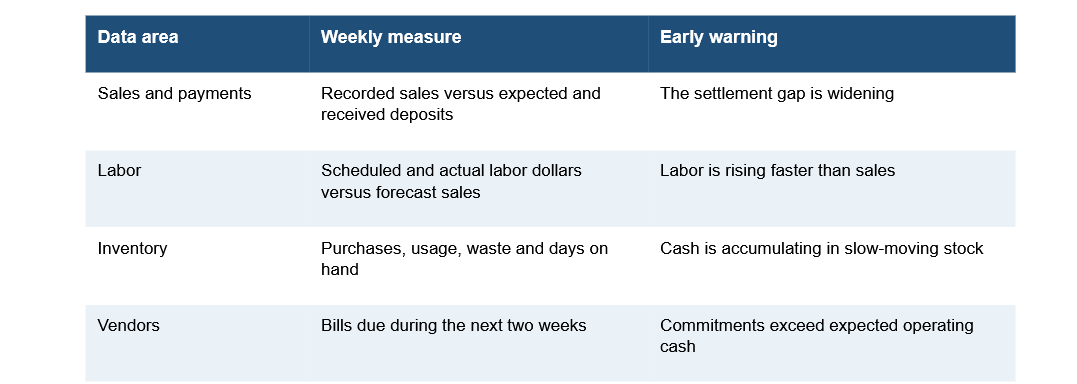
The dashboard should lead to a short rolling forecast. Begin with available cash, then add deposits expected by their realistic settlement dates and subtract payroll, supplier bills, rent, taxes and other obligations by due date. Looking several weeks ahead allows the operator to locate the projected low point rather than relying on today’s balance.
Use alerts carefully
Automated alerts can help, but only when they point to a decision. Examples include labor dollars exceeding the weekly plan, a deposit remaining unmatched after its expected date, a high-value ingredient moving outside its normal usage range or the projected cash balance falling below the restaurant’s operating reserve.
Thresholds should reflect the restaurant’s own seasonality, concept and payment mix. A casual restaurant with daily card volume will have a different normal pattern from a catering operation that invoices corporate clients. Excessively sensitive alerts create noise; thresholds that are too loose merely report problems after they are obvious. Reviewing and adjusting them is part of the process.
The technology should support a management routine
Data becomes useful when ownership is clear. Someone should be responsible for reconciling deposits, someone for reviewing labor exceptions and someone for investigating inventory variance. A weekly 20-minute review can focus on what changed, why it changed and which action is required.
The response may be operational: revise a schedule, reduce an order, follow up on a catering invoice, correct a menu price or query a missing settlement. The important point is that the decision occurs while alternatives remain available. Restaurant technology cannot remove volatility from food costs, staffing or customer demand. But it can make the financial effect of those changes visible sooner.
The bank balance remains essential, but it is a lagging result. Operators gain a more useful view when they treat POS, labor, inventory and settlement systems as parts of one cash-flow warning system.
 Marc Ovadia works with Rock Drive Business Capital, a business financing company focused on helping small-business owners understand and access financing solutions suited to their needs, and writes about business cash flow, working-capital planning and the operational financial challenges facing growing companies.
Are you an industry thought leader with a point of view on restaurant technology that you would like to share with our readers? If so, we invite you to review our editorial guidelines and submit your article for publishing consideration.
