
By Dustin Stone, Gavriel Shohet and Lea Mira, RTN staff writers - 6.22.2026
For years, conversations about restaurant automation focused primarily on labor savings and operational efficiency. While those objectives remain important, a new generation of hospitality technology companies is expanding the conversation. Increasingly, operators are exploring automation not only as a way to reduce repetitive tasks, but also as a means of improving guest experiences, increasing consistency, creating new revenue opportunities and supporting employees in increasingly complex operating environments.
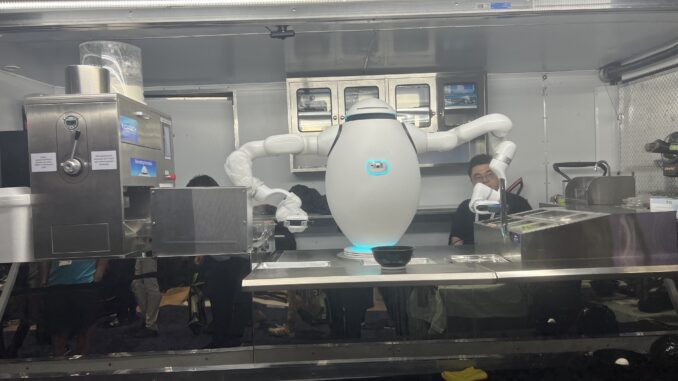
That evolution was on display at this year’s National Restaurant Association Show, where exhibitors showcased technologies designed to transform both front-of-house and back-of-house operations. Among them was RichTech Robotics, which demonstrated its growing portfolio of AI-powered hospitality automation solutions. At the show, the company attracted attention with a live noodle-making demonstration featuring its ADAM robot while also highlighting autonomous service and delivery technologies designed for restaurants, hotels, entertainment venues and other hospitality environments.
The demonstration reflected a broader shift in RichTech’s positioning. While the company initially gained widespread attention for robotic beverage service, its strategy has evolved well beyond a single application. Today, RichTech is building an ecosystem of hospitality automation technologies designed to support food preparation, beverage service, delivery, cleaning and guest engagement across a wide range of operating environments.
That broader vision aligns with changes taking place throughout the hospitality industry. Operators continue facing labor shortages, rising costs, training challenges and growing guest expectations. At the same time, consumers have become increasingly comfortable interacting with technology throughout their daily lives. These forces are creating new opportunities for automation solutions that can support employees, improve consistency and enhance guest experiences without diminishing the human side of hospitality.
At the center of RichTech’s portfolio is ADAM, an AI-powered humanoid service robot capable of performing a variety of food and beverage preparation tasks. While robotic bartending remains one of its most visible applications, the company’s recent demonstrations highlight a broader range of capabilities. At the National Restaurant Association Show, ADAM prepared fresh noodles in front of attendees, illustrating how robotic systems can participate directly in food production while also creating an engaging guest experience.
That combination of functionality and entertainment is one of the more distinctive aspects of RichTech’s approach. Many automation companies focus primarily on efficiency gains that occur behind the scenes. RichTech, by contrast, operates directly in guest-facing environments. Its technologies often become part of the customer experience itself, transforming automation from a purely operational tool into a visible component of hospitality service.
This distinction is increasingly important as operators search for ways to differentiate themselves in highly competitive markets. Restaurants, hotels, casinos, airports and entertainment venues are all looking for experiences that stand out. Technologies that combine operational benefits with guest engagement can create value in multiple ways, supporting efficiency while also generating curiosity, social-media visibility and repeat visits.
RichTech’s broader automation strategy extends beyond ADAM. The company has developed additional hospitality technologies including Matradee Plus, an autonomous delivery robot designed to transport food and beverages within restaurants and hospitality environments. At the National Restaurant Association Show, Matradee Plus worked alongside ADAM as part of the company’s demonstration of integrated hospitality workflows.
The company has also invested in cleaning and service automation platforms designed to support daily operations. Together, these solutions reflect a broader view of hospitality automation, one that focuses on improving workflows across multiple operational areas rather than addressing a single task in isolation.
 What makes this approach particularly relevant today is the changing nature of labor challenges within hospitality. Most operators are not looking to replace entire workforces with robots. Instead, they are searching for technologies that can handle repetitive, labor-intensive or highly standardized tasks while allowing employees to focus on guest interaction, problem-solving and service recovery. RichTech’s technologies are designed to support that objective by augmenting hospitality teams rather than attempting to eliminate them.
The potential business implications extend beyond labor efficiency. Beverage programs, food preparation and service speed all influence revenue generation. Technologies that improve throughput, maintain consistency and support premium experiences can contribute directly to financial performance. In some environments, the automation itself becomes an attraction that helps drive traffic and create memorable guest experiences.
One of the strongest indicators of market interest in this concept has been RichTech’s deployment activity. The company has announced ADAM installations and rollout initiatives in partnership with Ghost Kitchens America, including locations operating within Walmart stores. These deployments demonstrate that hospitality automation is moving beyond pilot programs and experimental installations into real-world operating environments where performance, reliability and guest acceptance matter.
That transition from novelty to operational deployment is an important milestone for the broader robotics industry. Early hospitality robots often generated publicity but struggled to demonstrate sustainable business value. Today’s automation platforms are increasingly being evaluated based on measurable outcomes such as consistency, throughput, guest engagement and operational efficiency.
Another factor working in RichTech’s favor is the growing acceptance of automation among consumers. Self-ordering kiosks, mobile ordering, digital payments and AI-powered customer-service tools have become commonplace. As guests become more comfortable interacting with technology, the barriers to adopting visible automation solutions continue to decline. This creates opportunities for hospitality operators to experiment with new service models that would have seemed unusual only a few years ago.
The company’s strategy also reflects the increasing convergence of robotics and artificial intelligence. Modern hospitality automation is not simply about performing mechanical tasks. It is increasingly about creating systems that can operate autonomously, adapt to changing conditions and participate in broader operational workflows. As AI capabilities continue advancing, the potential applications for service robotics are likely to expand as well.
The competitive landscape includes a growing number of robotics and automation providers targeting hospitality markets. RichTech differentiates itself through its emphasis on guest-facing applications and integrated workflows that combine automation, entertainment and operational utility. Rather than treating robotics as a back-of-house efficiency tool, the company positions automation as a visible and interactive component of the hospitality experience.
Perhaps the most interesting aspect of the RichTech story is what it reveals about the future direction of hospitality technology. The next phase of automation may not be defined by replacing people. Instead, it may be characterized by technologies that support employees, improve consistency and create entirely new forms of guest engagement. Success will depend not only on what automation can do operationally, but also on how effectively it enhances the overall hospitality experience.
That is the opportunity RichTech is pursuing. By combining robotics, artificial intelligence and hospitality-focused design, the company is helping operators explore new ways to serve guests, manage operations and differentiate their brands. As automation continues moving from experimental technology to practical business tool, RichTech is positioning itself at the center of one of the industry’s most closely watched transformations.
