
By Dustin Stone and Lea Mira, RTN staff writers - 7.8.2026
Restaurant and hospitality operators have spent years trying to reduce repetitive physical work without weakening the guest experience. Servers, bussers, runners, banquet teams, housemen and kitchen staff are often stretched across tasks that require constant movement but not always the judgment, warmth or problem-solving that define good hospitality.
Bear Robotics has built its business around that gap. The company develops autonomous mobile robots for restaurants, hotels, senior living communities, entertainment venues, airport lounges, hospitals, ghost kitchens, warehouses and factories. In hospitality settings, its robots are used to move plates, drinks, tubs, supplies and cleaning equipment across spaces where staff already have more valuable work to do.
Bear is best known for the Servi family of service robots, which support food running, table bussing, drink delivery and other front-of-house workflows. The company has since moved into autonomous cleaning, industrial AMRs, facility operations and what it describes as Physical AI, a category focused on robots that apply intelligence to work in physical spaces rather than purely digital environments.
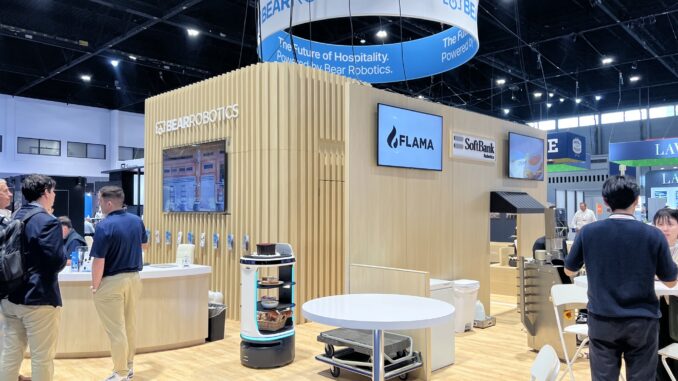
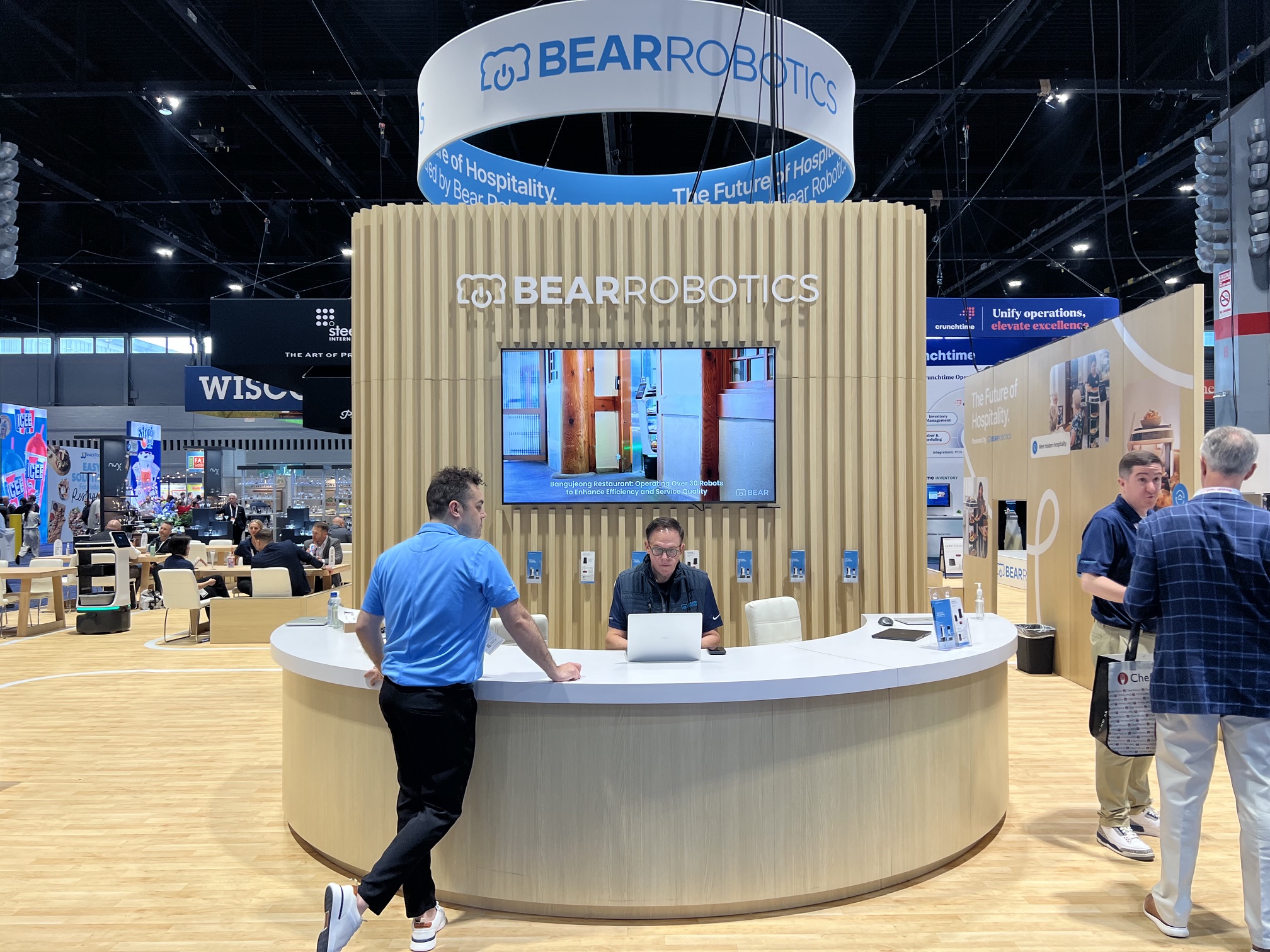
 At the 2026 National Restaurant Association Show, Bear Robotics presented a broader hospitality automation ecosystem. The booth centered on the Servi lineup while also extending into autonomous cleaning and kitchen automation demonstrations with SoftBank Robotics. The message was that Bear is moving beyond robotic food running into a wider set of tools for the physical work of restaurants, hotels and other service environments.
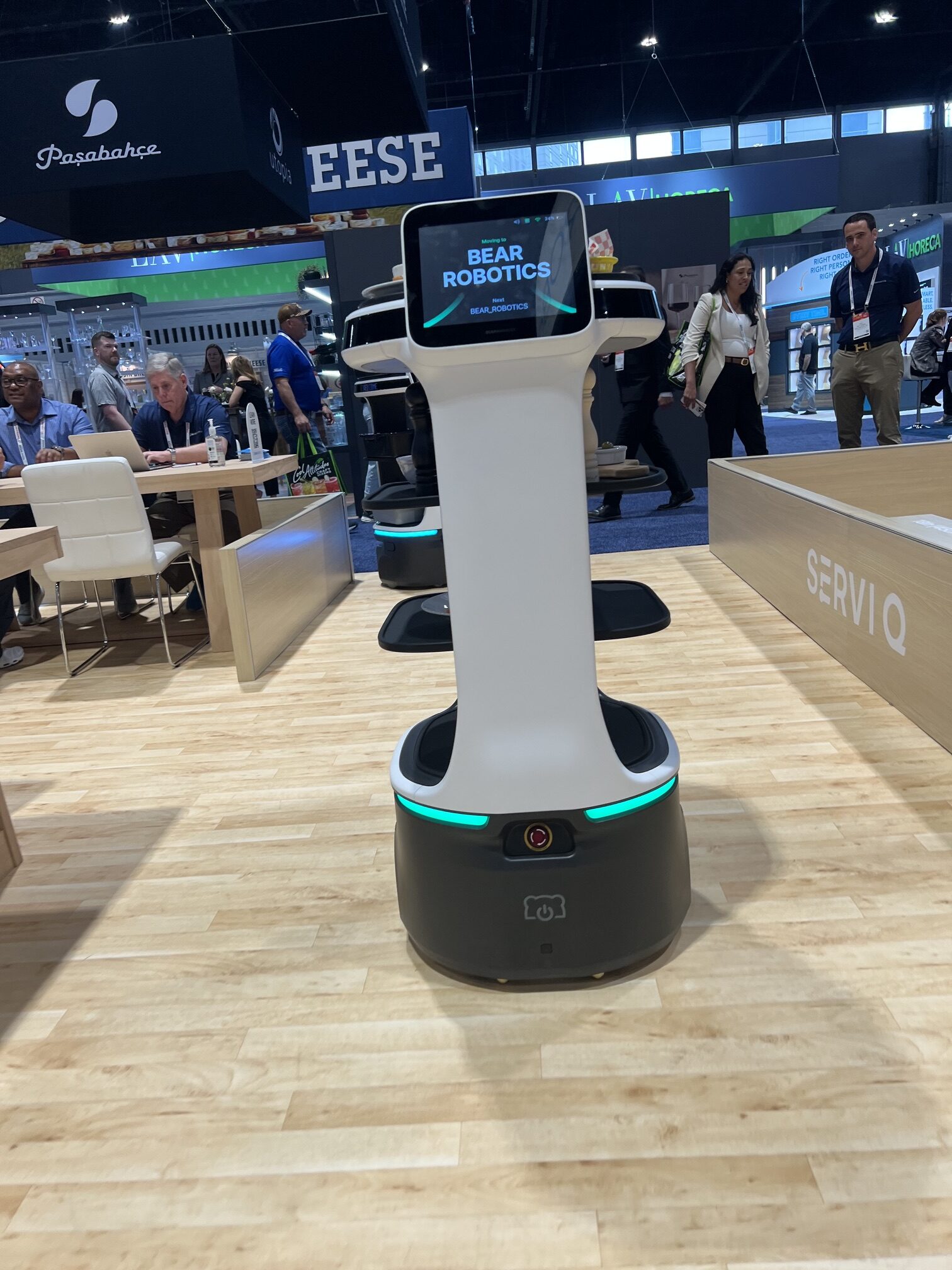
The most notable restaurant-specific product update was Servi Q, a compact service robot built for tighter floor plans. Many restaurants have narrow aisles, crowded bar areas, compact prep corridors and pickup zones that were never designed with robotics in mind. Servi Q addresses those limits with an 18-inch minimum aisle width, backward movement, backward bump detection, stable delivery and flexible tray configurations. Its 18.5-inch built-in display can be used for specials, promotions, branded content or wayfinding information.
Servi Q fills an important space in the lineup because robotics adoption often comes down to the building itself. A robot that works in a hotel ballroom may not work in a narrow dining room. A smaller model that can reverse, stop when it detects contact behind it and operate as part of a mixed fleet gives restaurants more flexibility without forcing them to redesign service areas.
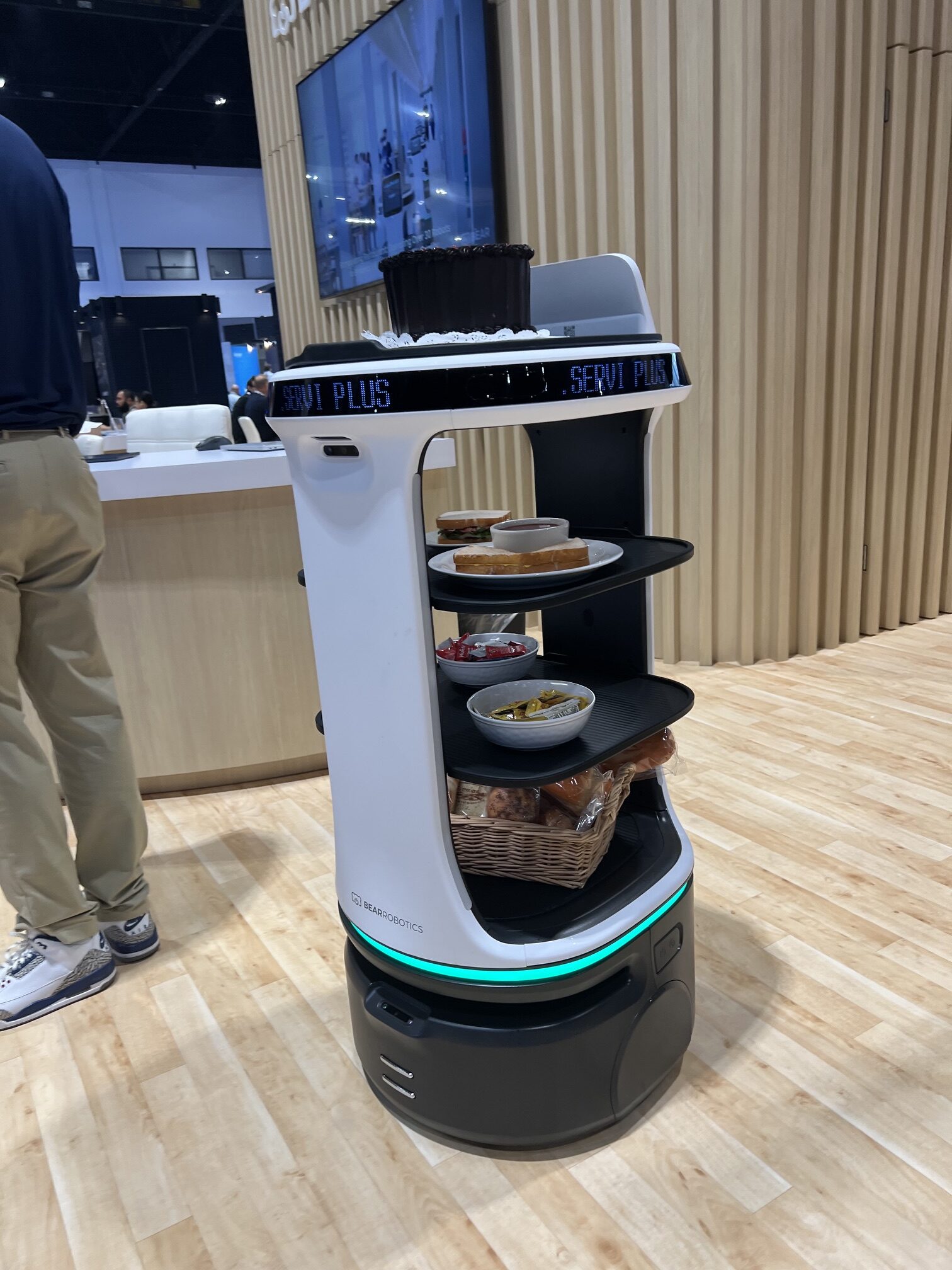
Servi Plus remains the higher-capacity option for heavier food running and bussing. The robot can carry up to 16 entrees or 88 pounds at once and is aimed at high-volume hospitality workflows. Bear’s current materials emphasize expanded payload, tight-space navigation and multi-robot orchestration.
That kind of capacity can matter in full-service restaurants, banquet operations, hotels, senior living dining rooms and entertainment venues. Service is often slowed not by cooking or table interaction, but by the constant relay between the kitchen, dining room, dish area, bar and service stations. A robot that can carry large loads safely and repeatedly can reduce physical strain on staff and keep food, dishes and supplies moving more consistently.
Servi and Servi Mini continue to serve the core restaurant use case. The robots assist with food running and table bussing, using LiDAR navigation to move through active hospitality environments. Bear positions the Servi family as a way to support staff rather than replace servers. The idea is to shift lower-value walking tasks away from people so they can stay on the floor, interact with guests, handle exceptions, sell, explain menus and manage the human side of service.
Robotics in restaurants can easily be framed as a labor-replacement story, but the stronger use case is labor reallocation. Restaurants still need people to greet, host, sell, read the room and solve problems. They also need fewer bottlenecks between the kitchen and table, fewer physically draining trips and more support during peak periods. Bear’s product strategy is built around that division of labor.
The software layer behind the robots is Bear Universe, Bear’s cloud-based fleet management system. The platform lets operators register robots, edit site maps, monitor performance and manage automation from a cloud dashboard. Bear also describes the platform as a way to connect, install and monitor robots in real time without requiring robotics expertise.
Fleet management becomes more valuable once an operator moves beyond a single robot. A lone robot can handle a specific route. A fleet has to share space, avoid congestion and adapt as the restaurant or facility changes. Bear Universe gives operators a way to update maps, review usage, monitor performance and troubleshoot remotely. Bear’s support team can use the platform to evaluate performance metrics, sensor data and navigation behavior.
Bear’s restaurant materials describe service applications that include kitchen-to-table delivery, high-volume drink running, table bussing, dish transport and inter-station supply replenishment. Its robots use LiDAR sensors, cameras, mapping software, custom mapping, point-to-point delivery, auto return, all-floor navigation and Multi-Robot Mode. Those capabilities are meant for changing, guest-facing environments rather than fixed industrial routes.
Hotels and resorts create another natural use case. Food-and-beverage teams may need to move orders through restaurants, lounges, pool decks, banquet spaces and room-service support areas. Housekeeping and facilities teams spend large parts of the day moving through corridors, lobbies, meeting rooms and back-of-house areas. Bear’s move into delivery, cleaning and facility-support robots gives hotel operators a way to apply automation across more than one department.
 The company’s show messaging highlighted that expansion with Servi Clean and Servi Clean Max. Servi Clean is built for sweeping, vacuuming and dust mopping across hard floors and carpets in hospitality, commercial, healthcare and office environments. Servi Clean Max is designed for hard-surface cleaning, including sweeping, scrubbing and mopping, with task scheduling, custom parameters and reporting. Bear also includes the LG B9 vacuum robot in its cleaning lineup, with hotel hallway and lobby use cases among the examples.
Autonomous cleaning can be as relevant to hospitality operators as food running. Cleanliness standards are high, staffing remains uneven and many cleaning routes are repetitive. Hotels, restaurants, senior living communities and entertainment venues all have corridors, lobbies, dining rooms, banquet spaces and back-of-house areas that need regular floor care. Robots do not replace detailed cleaning or human judgment, but they can reduce the routine floor-maintenance burden that consumes staff hours.
Bear Robotics also used the 2026 National Restaurant Association Show to show kitchen automation through live demonstrations with SoftBank Robotics Corp. The demonstrations included STEAMA, a steam-powered automated ramen station, and FLAMA, a stir-frying and cooking robot. These were presented with SoftBank Robotics rather than as core Servi products, but they fit Bear’s wider Physical AI message: automation in hospitality is moving across front-of-house service, back-of-house production and facility maintenance.
Bear’s market position changed significantly in 2025 when LG Electronics moved to secure a controlling stake in the company. LG announced that it had exercised a call option to acquire an additional 30 percent stake after an initial $60 million investment in 2024, giving LG a planned 51 percent controlling stake and incorporating Bear as a subsidiary. LG also said its commercial robot business, centered on LG CLOi Robots, would be integrated with Bear Robotics, while Bear’s management team, including CEO John Ha, would remain in place.
For restaurant and hotel operators, LG’s involvement is relevant because robotics depends on more than software. Hardware quality, manufacturing scale, service support, parts availability, financing and distribution all influence whether robots can move from pilot projects to daily operating tools. Bear’s engineering background, paired with LG’s manufacturing and commercial reach, gives the company a stronger base for scaling robotics across hospitality and adjacent industries.
Bear’s latest corporate update came just last month, when the company announced a definitive agreement to acquire Kinisi Robotics, a Bristol-based humanoid and Physical AI startup behind the KR1 robot. Bear described the deal as adding advanced manipulation intelligence to its production robotics platform. The announcement also stated that Bear had shipped more than 16,000 robots into commercial service across North America, Europe and Asia, spanning restaurants, hotels, hospitals, warehouses and high-rises.
The Kinisi agreement points to a longer-term shift. Bear’s original hospitality robots were built around navigation, delivery and transport. Kinisi adds work in manipulation, including picking, placing, sorting and handling objects. That does not mean restaurant service robots are suddenly becoming humanoid kitchen staff, but it does show where Bear is investing: from autonomous movement through hospitality spaces toward robots that can handle a wider range of physical tasks.
The company’s roots remain restaurant-driven. Bear Robotics was founded in 2017, and its first innovation was Penny. Founder and CEO John Ha had managed his own restaurant and saw firsthand where repetitive movement created drag on service. With a Ph.D. in computer science and experience as a software engineer at Google, he brought a technical background to a problem he had experienced as an operator.
That origin still shows in the product design. Bear’s robots are made for real dining rooms, not controlled demonstrations. They need to move around guests, staff, chairs, carts, thresholds, uneven flooring, changing table layouts and unpredictable congestion. They also need to be usable by teams without robotics expertise. Bear emphasizes quick setup, custom mapping and remote support because hospitality operators cannot rely on systems that require constant specialist attention.
The company has continued to broaden its product line beyond restaurants. Carti 100 is an industrial-grade AMR for warehouses, factories and other industrial spaces, with infrastructure-agnostic material-handling automation and multi-robot orchestration. Bear’s current product menu also includes Carti Low-Profile, a low-clearance AMR for heavy-duty material movement in industrial settings. These products sit outside the daily needs of most restaurant operators, but they reinforce Bear’s move from service robots toward a broader autonomous mobility platform.
That wider platform direction can bring more investment, software development, fleet-management learning and cross-industry experience back into restaurant and hotel products. Hospitality remains a demanding robotics environment because the work is physical, repetitive, guest-facing and highly sensitive to execution quality. Advances from logistics, industrial automation and facility maintenance may improve how robots navigate, coordinate, clean, carry and eventually handle more complex tasks in hospitality settings.
Customer and partner references show where Bear has gained traction. Bear’s current site lists global partnerships and customer logos that include Denny’s, Buffalo Wild Wings, Poppa Rollo’s Pizza, Sergio’s, PENN Entertainment, Marriott, Morrison Living, The Springs Living, CCL Hospitality Group, Sodexo, Aramark, United Airlines, CloudKitchens, Four Seasons and Grand Hyatt. The company also references success stories involving operators such as Bangujeong, where more than 30 robots are described as serving and bussing around the clock.
Customer support is part of the operating model. Bear Robotics says it provides installation support, workflow assessment, process-improvement training, real-time data and analytics, success resources and customer support. Robotics deployments are not simply plug-and-play technology projects. They require floor-plan mapping, staff training, workflow adjustment, path planning, service standards and ongoing measurement.
Operators still need a disciplined rollout. A restaurant or hotel has to choose the right robot for the job, whether that means Servi Q for tight spaces, Servi Plus for high-capacity running and bussing, Servi Clean for floor care, or a mixed fleet managed through Bear Universe. The team also has to define where the robot stops, how staff load and unload it, how it fits into service flow and how success will be measured after launch.
Robots can draw attention, create novelty and support service, but they should not become a distraction or turn hospitality into spectacle. The strongest deployments are likely to be the ones where the robot fades into the operation, reducing physical strain and improving speed while staff remain visible, attentive and empowered.
 Bear’s clearest advantage is the problem it addresses. Restaurants and hotels lose significant staff time to repetitive movement. Bear’s robots take on autonomous transport, bussing, drink running, floor cleaning and fleet coordination. The value is not in removing the human side of hospitality. It is in reducing the physical repetition that keeps staff away from guests and higher-value work.
The product range has also grown. Bear can now address tight restaurant aisles, high-capacity dining rooms, beverage service, bussing, hotel corridors, autonomous floor care, industrial material movement and multi-robot orchestration. That gives operators a way to think beyond a single robot and consider where autonomous mobility fits across the business.
The company also has momentum behind it. LG’s majority-stake move, Bear Universe, Servi Q, Servi Clean, the Kinisi agreement and the broader AMR line all point to a company moving beyond early restaurant robotics. For operators evaluating vendors, that matters. Robotics investments depend on hardware reliability, support, software improvement and a credible path for future capabilities.
The market is also more receptive than it was a few years ago. Labor pressure remains high, service expectations have not relaxed and operators are looking for ways to protect throughput without adding unnecessary complexity. Robotics will not solve every staffing problem, and not every concept or floor plan will be a fit. The category, however, has moved beyond novelty. In many restaurants, hotels and hospitality venues, autonomous robots are becoming practical tools for repetitive physical work.
Bear Robotics is positioned around that shift. Its service robots, cleaning robots, fleet-management software and broader Physical AI work give operators a way to automate parts of the service environment without removing people from hospitality. For restaurants and hotels trying to improve consistency, reduce staff strain and keep teams focused on guests, Bear offers a growing robotics platform built around the physical realities of the business.
