
By Dustin Stone, RTN staff writer - 7.8.2026
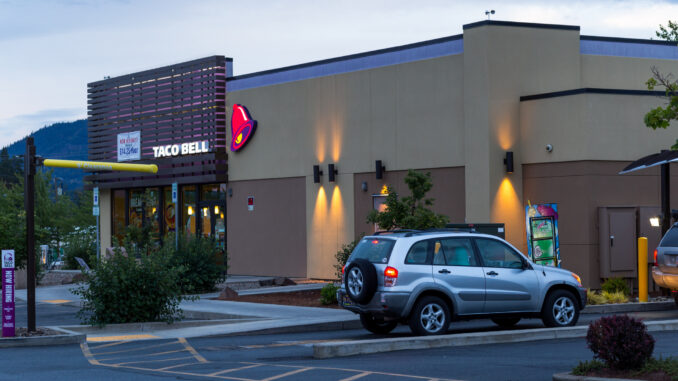
Taco Bell’s expansion of drive-thru voice AI to nearly 900 U.S. restaurants is one of the largest deployments yet of automated order-taking technology in the quick-service restaurant industry. The company’s partnership with Omilia, which began in 2023, now reaches Taco Bell locations across 38 states and gives the brand one of the most visible real-world tests of voice automation at scale.
The technology automates order-taking at the drive-thru speaker while adapting to each restaurant’s menu, real-time stock levels and limited-time offers. For Taco Bell, the expanded deployment fits into a broader digital strategy shaped by parent company Yum Brands and its proprietary restaurant technology platform, Byte by Yum. The company first announced plans in 2024 to expand voice AI to hundreds of Taco Bell drive-thru locations after earlier testing showed improvements in order accuracy, service speed and restaurant economics.
The drive-thru remains one of the most demanding operating environments in quick-service restaurants. For many brands, it accounts for a large share of sales while putting pressure on labor, throughput, accuracy and guest satisfaction. A voice AI system has to recognize speech through traffic noise, regional accents, menu complexity, customer interruptions, order changes and background conversations, then translate that exchange into an accurate order without slowing the line.
Omilia’s platform was built for those conditions, with noise filtering, low latency, real-time menu adaptation and language models tuned for quick-service environments. In Taco Bell’s case, the system handles the order-taking interaction at the speaker while team members focus on food preparation, accuracy, payment, fulfillment and service at the window. Omilia has said transactions using the system are on par with, and in some cases faster than, traditional order-taking methods.
The company has also said Taco Bell locations using voice AI have reported higher employee retention than locations without the technology. That may become as important to operators as speed and accuracy because restaurant automation is increasingly being evaluated as a way to support workers, not simply reduce labor. Taking repetitive, high-volume speaker-box work off employees during busy dayparts can ease pressure on teams while keeping the drive-thru moving.
Taco Bell Global Chief Digital & Technology Officer Dane Mathews has framed the technology in those terms, saying Omilia’s voice AI gives the brand the ability to ease team members’ workloads while giving them more flexibility to engage with customers. That positioning is notable because it treats drive-thru automation less as a novelty and more as part of the restaurant’s day-to-day operating model.
The early phase of restaurant voice AI was mostly judged by whether the system could take an order accurately. The next phase will be judged by how well it works with the rest of the restaurant. A voice assistant that only understands a static menu can answer basic questions, but a system connected to item availability, limited-time offers, POS data, digital menu boards and kitchen operations can become part of a larger restaurant technology infrastructure.
Yum has been moving in that direction through Byte by Yum, which consolidates several of the company’s digital and restaurant technology capabilities under one platform. In the United States, Yum has said Taco Bell uses Byte’s integrated online ordering, point-of-sale and back-of-house technologies. That foundation could make it easier for Taco Bell to connect AI-powered ordering with kitchen timing, menu management, labor planning and digital customer engagement.
The competitive landscape is becoming more active. Presto has positioned itself as a major provider of drive-thru voice automation and has worked with brands and franchise groups including Dairy Queen, Taco John’s and others. SoundHound AI is another major player, with restaurant voice AI deployments spanning drive-thru, phone ordering and other conversational commerce use cases. White Castle previously announced plans to expand SoundHound’s drive-thru voice AI to more than 100 lanes, while other restaurant brands have explored AI phone ordering, kiosks and omnichannel ordering.
Wendy’s has tested drive-thru AI through its FreshAI platform in partnership with Google Cloud, while McDonald’s conducted a high-profile automated order-taking test with IBM before ending that trial in 2024. McDonald’s decision became a cautionary example for the industry, not because it ended interest in voice AI, but because it showed how difficult large-scale execution can be when menu complexity, customer behavior and restaurant operations all have to align. McDonald’s said at the time that it still saw a future for voice-ordering technology, even as it moved away from that particular implementation.
Taco Bell has also had to navigate the technology’s limits. A widely shared incident involving an attempted order for thousands of cups of water showed how vulnerable AI systems can be to edge cases, pranks and unusual customer behavior. The episode did not derail the company’s voice AI strategy, but it did reinforce the need for strong escalation rules, human oversight and careful decisions about where automation is most useful.
Those challenges do not weaken the business case for voice AI as much as they define the conditions required for success. Restaurants with strong digital infrastructure, well-maintained menu data, reliable POS integration and consistent operating processes are likely better candidates for automated order-taking than locations with unusually complex traffic patterns or frequent exceptions. Even then, many deployments will likely work best as hybrid systems that allow employees to step in when an order becomes complicated or when a guest needs a human voice.
That hybrid model may become the industry standard. Rather than replacing drive-thru employees across the board, voice AI can function as a first-line order-taking layer that handles routine transactions and escalates exceptions. For franchise systems, that could improve consistency across locations while preserving local flexibility. For employees, it can remove some of the most repetitive work while freeing them to focus on speed, accuracy and hospitality at the window.
The financial implications are significant. Drive-thru voice AI can potentially improve throughput, reduce order errors, support consistent upselling and help restaurants operate more effectively during labor shortages or peak periods. Even modest improvements in speed, order accuracy and average check can matter at high-volume QSR locations. Franchisees, however, still need to weigh technology costs, integration requirements, training needs, customer acceptance and the system’s performance across different dayparts and traffic patterns.
Taco Bell’s scale gives the Omilia deployment particular significance. Many restaurant technologies perform well in pilots but struggle when exposed to the variation of a large franchise system. A rollout across nearly 900 locations introduces different store layouts, noise conditions, team behaviors, regional accents, menu variations, customer expectations and operating cultures. Continued expansion will test not only the technology’s accuracy, but also its ability to become part of daily restaurant operations without adding complexity for franchisees and team members.
The broader competitive question is whether voice AI becomes a vendor-led category or an integrated feature within larger restaurant technology platforms. Specialist providers such as Omilia, Presto and SoundHound bring deep conversational AI and speech-recognition capabilities. Large restaurant technology platforms, POS providers and cloud partners bring system integration, data infrastructure and scale. Yum’s Byte strategy suggests that major restaurant companies may prefer a hybrid approach, using specialized partners while keeping more control over the operating system that connects those capabilities.
That approach could become more attractive as AI moves beyond order-taking. The same infrastructure that supports a drive-thru voice assistant could eventually connect to personalized menu recommendations, automated make-line timing, labor planning, real-time inventory, customer recovery and loyalty-driven offers. The drive-thru speaker may be the most visible part of the technology, but the longer-term value may come from connecting the guest conversation to the restaurant’s broader data and decision-making environment.
For restaurant operators, Taco Bell’s expansion is a clear sign that voice AI has moved beyond small pilots and futuristic demonstrations. The technology is now being deployed in real operating environments, measured against speed and staffing outcomes, and refined through the practical realities of customer behavior. The category is still early, and the technology still has limits, but the direction is becoming clearer.
Taco Bell’s nearly 900-unit deployment does not mean every drive-thru will soon be run by AI. It does suggest that automated order-taking is becoming a serious operational tool for QSR brands with the scale, infrastructure and patience to keep improving it. The strongest deployments will likely come from brands and vendors that treat voice AI not as a replacement for hospitality, but as a way to make high-volume restaurant operations more consistent, more manageable and more responsive to both customers and employees.
