
By Dustin Stone, Debbie Carson and Lea Mira, RTN staff writers - 6.29.2026
Delivery has become a permanent part of the restaurant business, but profitability remains a major challenge. Third-party marketplaces can generate demand, yet they often come with high commissions, limited guest-data access and less control over the customer experience. For many restaurants, the question is no longer whether to offer delivery. It is how to make delivery work without giving away too much margin, brand ownership and customer loyalty in the process.
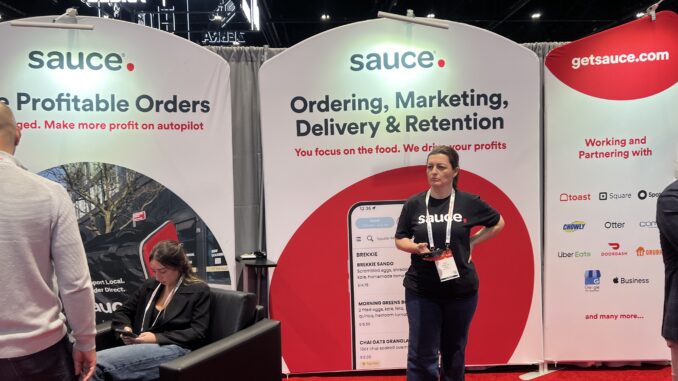
That tension was visible at this year’s National Restaurant Association Show in Chicago, where restaurant technology providers focused heavily on off-premise growth, operational efficiency, digital ordering, AI and margin protection. Among them was Sauce, which exhibited at booth #5845 and positioned its platform around helping restaurants generate more profitable orders with less delivery complexity. The company’s larger story is not simply online ordering. It is helping restaurants shift more demand into branded, first-party channels while managing delivery logistics in a way that protects the guest experience.
Sauce operates in a category that sits between online ordering, delivery management, customer retention and restaurant marketing. The company describes itself as a first-party restaurant ordering and delivery platform that helps restaurants own their customer relationships, grow direct online sales and increase profitability. Unlike a traditional delivery marketplace, Sauce is not trying to insert its own consumer brand between the restaurant and the guest. Its platform is designed to keep the restaurant’s brand at the center of the ordering and delivery experience.
Restaurants still need access to digital demand and reliable delivery fulfillment, but many operators want to reduce their dependence on marketplace channels that charge commissions and control customer relationships. Sauce approaches the problem by combining branded direct ordering, managed delivery, live order support, marketing and retention tools in one platform.
The foundation of the platform is Sauce Direct Online Orders, which allows guests to place pickup and delivery orders directly through a restaurant’s branded website. The product emphasizes commission-free ordering, mobile-first checkout, customer-data ownership, branded ordering pages and a digital experience built around the restaurant rather than a third-party marketplace. For operators, the goal is to make direct ordering feel as seamless and reliable as marketplace ordering while keeping the economics and guest relationship closer to home.
Direct ordering has become a strategic priority for many restaurants because the same guest can be far more valuable when the restaurant owns the relationship. A marketplace order may create short-term revenue, but it often limits the restaurant’s ability to market to the guest, understand ordering behavior or encourage repeat visits through owned channels. A first-party order creates a different opportunity. It can become part of a larger retention strategy that includes reordering, loyalty, email, SMS, feedback and guest engagement.
Sauce’s direct ordering tools are also designed to support conversion. The company highlights mobile-friendly checkout, branded ordering experiences, menu optimization, real-time menu updates and integration with a restaurant’s website, Google Business Profile and other owned digital touchpoints. For restaurants trying to move guests from marketplace discovery into owned ordering channels, every additional step in the checkout flow can create drop-off. Sauce’s value proposition depends on making the direct channel convenient enough for guests to return.
Delivery fulfillment is where Sauce differentiates itself from basic online ordering platforms. Through Sauce Premium Delivery, restaurants can tap into national and local courier networks rather than managing their own drivers or relying on a single provider. The platform uses AI-powered driver selection to route orders to available couriers, with real-time order monitoring and customer tracking designed to reduce delays, missed handoffs and guest uncertainty.
That managed-delivery model addresses one of the most difficult parts of first-party ordering. Restaurants may want to capture more direct demand, but delivery logistics can quickly become burdensome. Coordinating drivers, tracking orders, handling late deliveries, processing refunds and responding to guest issues can consume staff time and create operational stress. Sauce’s platform is built around removing much of that burden from restaurant teams while still keeping the order within the restaurant’s own branded experience.
Live delivery support is another important part of the company’s positioning. Sauce’s Live Order Support product provides real-time monitoring, issue resolution and post-order follow-up. Delivery problems can quickly damage a restaurant’s reputation even when the food was prepared correctly. By monitoring orders, intervening when issues arise and following up with guests, Sauce is positioning support as part of the retention engine rather than a reactive customer-service function.
That service layer reflects a practical reality for operators. When a third-party delivery order goes wrong, the marketplace may own the support process, but the restaurant often absorbs the reputational damage. When a direct delivery order goes wrong, the restaurant has more ownership of the guest relationship but also more responsibility for service recovery. Sauce is trying to give restaurants the benefits of first-party ordering without leaving them alone to manage every delivery exception.
The platform also addresses back-of-house delivery management. Sauce’s delivery management software is designed to automate time-consuming tasks such as tracking orders and drivers, processing refunds, reconciling payments and analyzing performance. For restaurants already managing kitchen execution, dine-in guests, takeout orders and third-party platforms, delivery administration can become a hidden labor cost. Streamlining those workflows helps operators focus staff attention on food preparation, hospitality and fulfillment rather than manual order management.
The operational story becomes stronger when direct orders, delivery logistics and customer retention operate together. Sauce’s model is not simply about saving commission fees on an individual transaction. It is about improving the economics of the entire off-premise channel. A restaurant that converts marketplace customers into direct guests, delivers reliably, captures guest data and re-engages those guests after the order has a better chance of improving margin and repeat business over time.
Sauce also positions profitability as a measurable business issue. Its Savings Calculator gives operators a way to compare commission costs against alternative delivery economics by adjusting order volume, average check and third-party commission assumptions. Tools like this reflect how restaurants increasingly evaluate technology investments. Operators want to understand not only whether a platform adds functionality, but whether it can improve unit economics in a category where margins are often thin.
The company’s profitable delivery platform messaging reinforces that broader value proposition. Sauce frames delivery profitability around reduced commissions, unified channels, reliable driver fulfillment, branded real-time tracking and proactive delivery monitoring. That combination positions delivery not as a necessary but painful add-on, but as a channel that can be managed more strategically.
Customer acquisition is another part of the equation. Direct ordering only works if guests can find and trust the restaurant’s owned channels. Sauce supports that effort through resources such as its Restaurant Local SEO and Google Profile Grader, which is designed to help restaurants assess how easily guests can discover them and whether their Google Business Profile is pushing diners toward direct ordering or third-party apps. For restaurants competing in local search, the ordering link a guest sees at the moment of intent can determine who owns the transaction.
Google visibility has become especially important for delivery and takeout. Many guests do not start with a restaurant website. They search for nearby food, compare options on Maps, scan reviews and click whatever ordering path appears most convenient. If the path points to a marketplace, the restaurant may pay more to serve a guest who was already looking for that restaurant or cuisine. A stronger direct-ordering presence helps operators convert local discovery into first-party demand.
Marketing and retention extend the direct-ordering strategy beyond the initial transaction. Sauce highlights automated email and SMS marketing, loyalty, reordering and guest engagement as part of its platform. For restaurants that rely heavily on takeout and delivery, bringing guests back directly can be more valuable than constantly paying to reacquire the same customer through marketplaces. Retention tools help operators turn delivery from a transactional channel into a recurring guest relationship.
The platform’s fit is strongest for restaurants that already have delivery demand but want better economics and more control. Independent restaurants, regional chains, fast-casual brands, pizza concepts and high-volume takeout businesses often face the same dilemma: delivery volume is important, but marketplace dependence can erode margins and weaken brand relationships. Sauce is built for operators that want to keep participating in off-premise demand while shifting more of that activity into channels they own.
Sauce is also careful to distinguish itself from a POS provider. The company says it is not a POS company and instead integrates with leading systems while the POS remains the restaurant’s system of record. Sauce powers the guest-facing digital ordering, delivery and retention experience around that core infrastructure. That positioning allows the platform to work alongside existing restaurant systems rather than requiring operators to replace foundational technology before improving their off-premise economics.
The competitive landscape includes online ordering providers, restaurant website platforms, delivery marketplaces, POS-adjacent ordering tools, courier networks and restaurant marketing platforms. Sauce differentiates itself by combining first-party ordering, managed delivery logistics, customer support, reporting and retention tools. The company’s strongest argument is that restaurants need more than an ordering widget if they want delivery to become a healthier business channel.
As off-premise dining matures, restaurants are becoming more selective about how they balance reach, control and profitability. Third-party marketplaces can still play a role in discovery and demand generation, but operators increasingly recognize the risks of building too much of their digital business on rented customer relationships. Sauce’s platform gives restaurants a way to use direct ordering and managed delivery to bring more of that business back under their own brand.
For restaurant operators, the broader significance is clear. Delivery profitability depends on more than the commission rate. It depends on where the order originates, how the guest experiences the brand, how the courier is selected, how issues are resolved, how data is captured and whether the guest returns directly. Sauce is building its platform around those connected pieces.
By combining branded direct ordering, premium managed delivery, live order support, delivery operations software, local SEO tools, marketing and retention capabilities, Sauce is helping restaurants take a more strategic approach to off-premise growth. The company’s value proposition is rooted in a simple but increasingly urgent restaurant priority: keep more of the revenue, own more of the guest relationship and make delivery easier to manage.
In a restaurant industry where digital demand continues to grow but margins remain under pressure, the next phase of delivery technology will be defined by control. Sauce is positioning itself as a partner for restaurants that want delivery to support profitability, not just volume.
