
By Gavriel Shohet and Lea Mira, RTN staff writers - 6.21.2026
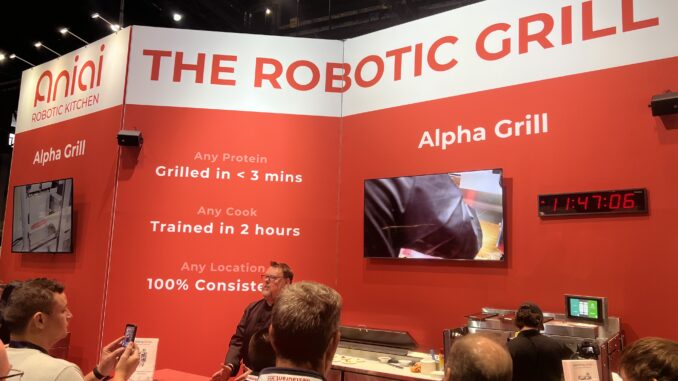
Few stations in a quick-service kitchen are as difficult to standardize as the grill. During peak periods, operators need speed, consistency and food quality simultaneously, often while managing labor shortages, employee turnover and increasing pressure to maintain throughput. Those challenges shaped many of the conversations at the Aniai booth during the 2026 National Restaurant Association Show.
Throughout the show, company representatives repeatedly emphasized that Aniai is not trying to replace kitchen employees. Instead, the company is focused on helping operators create more consistent, higher-throughput grill stations while reducing some of the variability that can affect food quality and operational performance. That distinction is important because it reflects how restaurant operators increasingly evaluate automation—not as a novelty, but as a tool for solving specific operational problems.
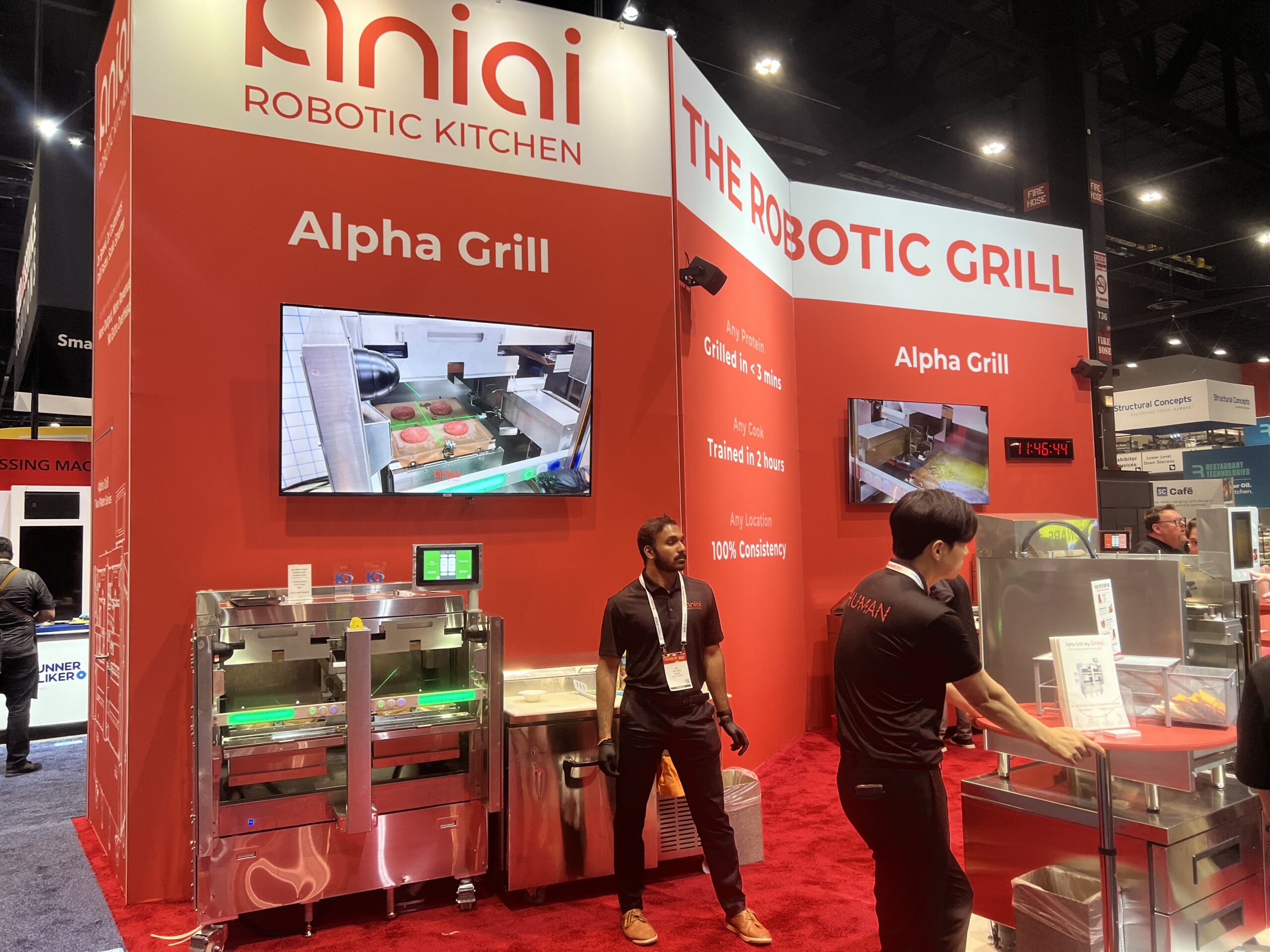
Aniai is a New York-based kitchen technology company whose flagship product, Alpha Grill, combines automated cooking equipment with AI-powered monitoring and cloud-based management tools. While the company initially attracted attention for automating burger production, its current vision is considerably broader. Conversations at the booth consistently focused on the grill station as a whole rather than any single menu category.
That broader positioning was evident in the company’s introduction of the expanded Alpha Grill Series, including both the original two-platen model and the newly introduced Alpha Grill Single Platen. The expansion reflects a practical reality within foodservice: not every operator has the space or volume requirements to support the same type of automation platform.
The Alpha Grill Single Platen is designed specifically for operators interested in automation but constrained by kitchen space. Smaller quick-service restaurants, convenience stores, university dining programs, healthcare facilities, hotel foodservice operations and other compact environments often face the same labor and consistency challenges as larger chains but require equipment that fits within tighter footprints.
Live demonstrations at the NRA Show reinforced another important shift in Aniai’s messaging. While many attendees still associate the platform primarily with hamburgers, representatives showcased a much wider range of menu applications. Demonstrations and discussions included burgers, chicken, steak, eggs, French toast and other grilled products, underscoring the company’s efforts to position Alpha Grill as a flexible cooking platform rather than a single-purpose burger robot.
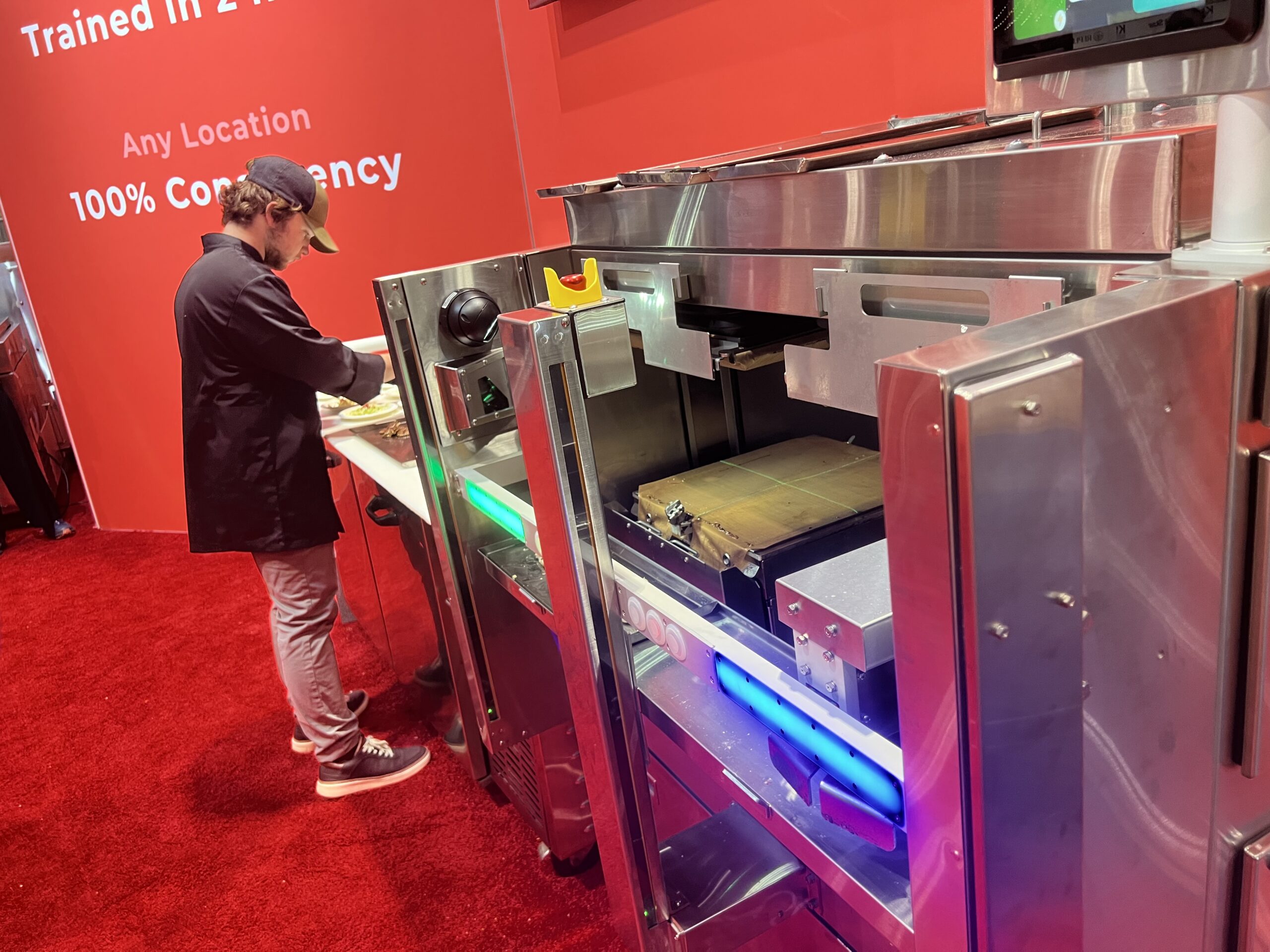
The technology itself is designed around automation of one of the kitchen’s most repetitive and labor-intensive stations. The Alpha Grill platform uses a clamshell cooking configuration with automated loading, cooking and discharge capabilities. According to the company, the system can produce more than 200 burgers per hour while automatically transferring finished products to a holding area and performing cleaning functions between cooking cycles.
For operators, however, the value proposition extends beyond speed. Consistency remains one of the most difficult challenges in foodservice. Grill performance can vary significantly based on employee experience, attention and workload. By automating portions of the cooking process, Aniai aims to reduce variability while maintaining predictable output throughout the day.
Representatives repeatedly framed the platform around consistency and throughput rather than labor elimination. In practical terms, that means helping kitchen teams maintain production levels during busy periods, reducing the amount of training required for grill-station employees and improving the repeatability of cooking outcomes from shift to shift.
The software component may ultimately be one of the company’s most important differentiators. Alpha Cloud adds a connected layer that allows operators to monitor cooking performance and quality across locations. Using cameras, sensors and computer vision technology, the platform evaluates cooking characteristics and provides visibility into grill-station performance.
For multi-unit restaurant organizations, that capability introduces a new level of operational oversight. Historically, grill-station performance has been difficult to monitor without direct observation. Alpha Cloud creates an opportunity to bring data, consistency measurements and quality assurance tools into a part of the kitchen that has traditionally depended heavily on employee judgment and experience.
The cloud platform also reflects a broader industry trend. Restaurant technology conversations increasingly extend beyond POS systems, loyalty platforms and digital ordering. Equipment itself is becoming connected, measurable and manageable. The kitchen is evolving into a data-generating environment, and platforms such as Alpha Cloud illustrate how operators may eventually gain greater visibility into food production itself.
Aniai has also begun establishing a growing base of real-world deployments. According to the company, Alpha Grill systems have now cooked more than 3 million food items across more than 50 installations worldwide. Those figures suggest the platform has moved beyond the pilot stage and is now operating in active production environments.
Among the company’s U.S. deployments are The SSam in New York and The Filling Station, which provide examples of the technology operating under real service conditions. Those deployments are important because automation platforms ultimately succeed or fail based on day-to-day operational performance rather than trade-show demonstrations.
The company has also attracted investor interest. Aniai recently secured additional funding from Korea Development Bank, bringing total funding to approximately $19 million. The capital is being used to support product development, deployment expansion and growth in North America, where restaurant operators continue searching for practical automation solutions.
The market opportunity is substantial. Grill stations remain a common bottleneck in quick-service and fast-casual operations. Labor shortages continue to affect hiring and retention, while guest expectations for speed and consistency remain high. Equipment that can help operators stabilize production without dramatically changing kitchen workflows may have a significant advantage over more disruptive automation concepts.
That practicality may ultimately be one of Aniai’s strongest attributes. Rather than attempting to automate an entire kitchen, the company is focused on a single station where consistency, speed and labor availability have a direct impact on performance. Operators do not need to redesign their entire operation to evaluate the technology. They can address a specific pain point while maintaining existing workflows elsewhere in the kitchen.
The competitive landscape for restaurant robotics remains crowded and not every automation concept has translated successfully from demonstration to deployment. Many systems have struggled with cost, complexity or operational fit. Aniai’s challenge will be continuing to prove that automated grilling can deliver measurable operational value while integrating smoothly into real-world restaurant environments.
Based on conversations at the NRA Show, the company appears keenly aware of that reality. The focus was not on futuristic visions of fully autonomous restaurants. Instead, discussions centered on practical outcomes: maintaining throughput during rush periods, improving consistency, reducing training burdens and giving operators greater visibility into food production. In many ways, that is what makes Aniai interesting. The company is not really selling a robot. It is helping operators build a more consistent, more predictable grill station.
For restaurant owners, operators and technology decision-makers evaluating the next phase of kitchen modernization, Aniai offers a compelling example of how automation is evolving. Rather than replacing people, the latest generation of connected cooking platforms is increasingly focused on supporting teams, improving execution and helping restaurants deliver consistent results at scale.
