
By Gavriel Shohet and Lea Mira, RTN staff writers - 6.21.2026
Walking the floor of this year’s National Restaurant Association Show, it was impossible to miss the industry’s fascination with artificial intelligence, robotics and automation. Yet some of the most practical conversations were happening around a far less complicated question: how can operators increase revenue without adding significant labor, kitchen space or operational complexity?
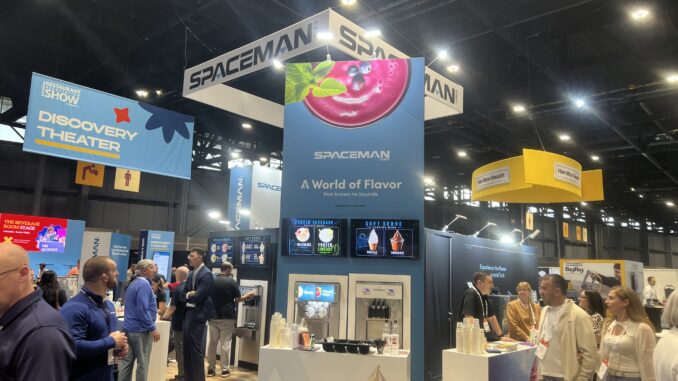
That question was at the heart of discussions at the booth of Spaceman USA, where company representatives focused less on equipment specifications and more on the economics of frozen desserts and beverages. Their argument was straightforward. While restaurant operators continue searching for new revenue opportunities, frozen products remain one of the few categories capable of delivering strong margins, broad consumer appeal and relatively simple execution.
It’s a message that appears to be resonating across multiple segments of foodservice. From quick-service restaurants and cafés to hotels, entertainment venues and convenience stores, operators continue looking for menu additions that can drive incremental sales without requiring significant changes to existing operations. Frozen desserts and specialty beverages fit that profile particularly well.
Founded in 1997, Spaceman manufactures a broad portfolio of soft-serve, frozen yogurt, frozen beverage and shake equipment used throughout the foodservice industry. The company operates its North American headquarters in Loveland, Colorado and supports customers through a growing network of distributors, service providers and training resources.
Today, the company’s equipment can be found in a wide range of environments, from dedicated frozen yogurt concepts and ice cream shops to restaurants, hotels, colleges, family entertainment centers and convenience retailers. That diversity reflects a larger trend within foodservice: frozen products are no longer limited to specialty dessert concepts.
Many operators now view frozen desserts as an extension of their broader menu strategy. Burger concepts use soft serve to increase check averages. Fast-casual restaurants introduce seasonal frozen desserts to create excitement and encourage repeat visits. Hotels add frozen beverages to poolside operations. Entertainment venues leverage frozen treats to boost per-capita spending.
What emerged repeatedly during conversations at the booth was the idea that frozen products are often underutilized profit centers. Representatives pointed to the relatively low ingredient costs associated with soft serve and frozen beverages compared to many other menu categories, particularly when operators use them to support premium toppings, limited-time offerings and specialty presentations.
That opportunity becomes even more attractive when viewed through the lens of labor efficiency. Unlike many food categories that require significant preparation and cooking time, frozen desserts and beverages can often be served quickly with limited labor involvement. In an industry where labor remains one of the largest operating expenses, that simplicity has become increasingly valuable.
Frozen beverages represent one of the most interesting growth areas. Discussions at the booth highlighted growing operator interest in frozen coffees, specialty drinks, frozen cocktails and products such as soft-serve margaritas. These offerings often command premium pricing while creating opportunities for seasonal promotions and daypart expansion.
For hotels and hospitality operators, the category offers additional flexibility. Pool bars, lobby markets, rooftop venues and resort food-and-beverage operations all benefit from products that are easy to serve, visually appealing and capable of generating attractive margins. Frozen beverages and desserts check all of those boxes while requiring relatively modest infrastructure.
Convenience stores are another segment where frozen products continue gaining traction. As retailers increasingly compete with traditional restaurants for foodservice dollars, frozen beverages remain an effective way to drive traffic and differentiate offerings. Many operators view the category as a reliable source of repeat purchases, particularly during warmer months.
While profitability was a recurring theme, so was operational simplicity. Spaceman representatives repeatedly emphasized that long-term success depends on more than equipment performance alone. Cleaning procedures, maintenance requirements, service access and employee training all play critical roles in determining whether a frozen dessert program remains profitable over time.
That perspective helps explain the company’s investment in support infrastructure. Through its Customer Center and related resources, Spaceman provides operators with access to maintenance videos, operator guides, troubleshooting assistance, service documentation, parts support and profitability tools. These resources are designed to help customers manage equipment effectively throughout its lifecycle.
For independent operators and smaller organizations, that support can be particularly important. Many do not have dedicated maintenance teams or technical staff. Equipment that is difficult to clean, difficult to maintain or difficult to service can quickly become a burden regardless of its capabilities. Spaceman’s focus on ease of ownership addresses a challenge that many operators encounter after the initial purchase decision has been made.
The company’s equipment portfolio reflects that philosophy. Models range from compact soft-serve machines suitable for smaller locations to larger floor units designed for higher-volume environments. The company also offers frozen beverage machines, shake equipment and related products designed to support different service styles and throughput requirements.
That flexibility has become increasingly important as foodservice operators experiment with new formats. A quick-service restaurant may use soft serve as a dessert platform. A coffee shop may add frozen beverages to complement its existing menu. A hotel may deploy frozen drink equipment at a seasonal venue. A family entertainment center may create an entirely new revenue stream around frozen treats. In each case, the equipment serves a different purpose, but the business objective remains remarkably similar: generate incremental revenue from a relatively small footprint while maintaining operational simplicity.
The competitive landscape includes several established manufacturers with long histories in frozen dessert equipment. Spaceman’s differentiation appears less about pursuing headline-grabbing innovations and more about helping operators successfully execute frozen menu programs over the long term. Serviceability, support, ease of maintenance and operator education remain central themes throughout the company’s messaging.
That practical orientation may ultimately be one of the company’s greatest strengths. Most operators are not looking for equipment that feels revolutionary. They are looking for equipment that helps them make money consistently. In that context, reliability, support and simplicity often matter more than cutting-edge technology.
Spaceman’s presence at the National Restaurant Association Show served as a useful reminder that not every meaningful innovation in foodservice revolves around automation or artificial intelligence. Sometimes the most valuable opportunity is helping operators execute proven, profitable menu categories more effectively. For restaurant owners, hospitality executives and foodservice operators evaluating new revenue opportunities, frozen desserts and beverages continue to offer a compelling combination of margin, flexibility and guest appeal. Spaceman’s strategy is built around making those opportunities easier to capture.
As operators continue searching for ways to grow revenue without significantly increasing complexity, frozen desserts and beverages remain one of the industry’s most accessible opportunities. Spaceman’s focus on support, simplicity and operational success positions the company as a noteworthy partner for organizations looking to capitalize on that potential.
