
By Dustin Stone and Lea Mira, RTN staff writers - 8.17.2026
Palona AI has launched what it calls a multimodal AI operating layer for physical businesses, beginning with restaurants and positioning the technology as something broader than another voice-ordering system. The launch comes as Palona closes its Series A financing, bringing its total funding to $20 million, including converted SAFE notes, as competition intensifies among technology companies looking to become the AI layer connecting restaurant customers, data and operations.
Investors in the financing include Ardenwood Ventures, CrimsonOx, UpHonest, Turbo, Llama Ventures, Neo, Fusion Fund, Defy and Maynard Webb, along with other institutional, strategic and individual investors. Palona previously announced $10 million in seed funding when it emerged publicly in January 2025, initially with a broader focus on AI sales agents for consumer-facing businesses.
Restaurants have since become a major proving ground for the technology. Palona says its platform is already deployed with operators including Din Tai Fung, Mountain Mike’s Pizza, Giordano’s, Rooted Hospitality Group and Cali BBQ, with products designed to connect customer demand with information about what is happening inside the business and then initiate appropriate actions or workflows.
“Physical businesses need AI that can understand what is happening and act in real time,” Maria Zhang, founder and CEO of Palona AI, said in announcing the launch. “Palona turns demand, operational context and live signals into actions that drive revenue, quality and execution.”
Much of the restaurant industry’s first wave of generative AI adoption has centered on relatively discrete tasks. Voice AI providers have become increasingly effective at answering telephone calls, taking orders, booking reservations and handling routine guest questions, while other AI vendors have concentrated on forecasting, labor, inventory, marketing or business intelligence.
Palona is taking a broader approach. Its goal is to connect several of those functions so information gathered from a customer interaction or physical restaurant environment can be interpreted in context and turned into an action, rather than remaining trapped in another reporting application.
The company’s current product suite is organized around Revenue Expansion, Revenue Intelligence and Operations Excellence. Palona says the platform can capture customer demand from calls, catering requests, private events and large-order inquiries, identify factors such as intent, potential value and urgency, and convert operational signals into workflows that can be acted on by managers or AI agents.
That could be especially useful for catering and other high-value inquiries that restaurants frequently handle through fragmented processes. A restaurant may have technology capable of accepting a $25 takeout order without employee intervention, yet still have no consistent way to identify and follow up with someone who calls during the dinner rush asking about a $2,000 corporate catering order.
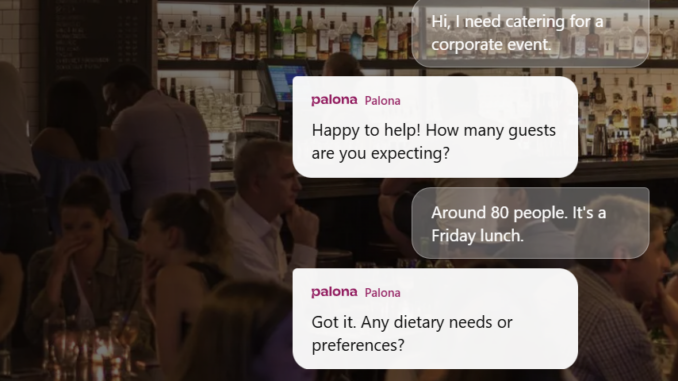
Palona’s Catering Agent is designed to address that gap by handling inquiries across channels and structuring the resulting information for managers. The company says the system can manage catering demand arriving by phone, text, web form and email, creating a more organized process for opportunities that might otherwise end up scattered across voicemail boxes and shared inboxes.
Palona describes the broader process as a continuous cycle of capturing information, understanding it, acting on it and learning from the result. For restaurant operators, the appeal is not another dashboard but the possibility of software that can recognize an opportunity or problem and move the next step forward automatically.
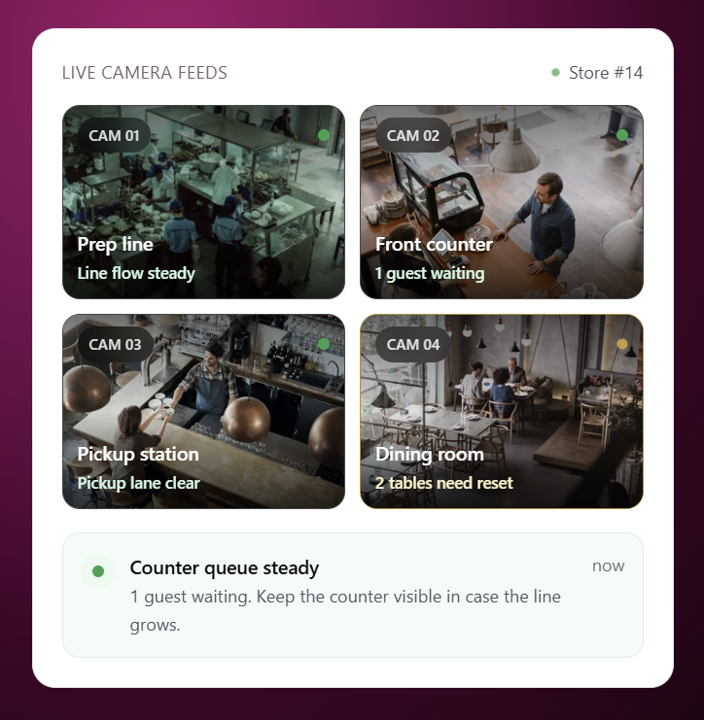
The company is also pursuing a multimodal strategy that extends beyond telephone conversations. Palona says it has developed an “Interaction Model for Physical AI” intended to understand how people, objects, places and processes relate to one another over time, rather than limiting computer vision to object detection or descriptions of individual scenes.
In a restaurant, that could mean the difference between software recognizing that several people are standing near a counter and recognizing that a line is building, customers are waiting longer than expected and a particular workflow may need attention. Palona’s premise is that understanding spatial, temporal and contextual relationships can allow AI to recognize operational situations and determine whether some form of intervention is warranted.
The challenge is that restaurants are difficult environments for computer vision and real-time AI systems. Lighting changes, camera views can be obstructed, customer behavior is unpredictable and workflows can vary substantially from one location or shift to another, all of which raises the bar for reliably interpreting what is actually happening.
Palona also holds U.S. Patent No. 12,481,517, titled “Artificial Intelligence (AI) Agents Orchestration,” which was granted in November 2025 and assigned to Proactive AI Lab, Palona’s corporate entity. The patent covers technology for dynamically orchestrating specialized AI agents and allocating computing resources based on factors associated with incoming requests and system requirements.
 The patent does not cover or validate every element of Palona’s broader physical AI strategy. It does, however, give the company intellectual-property protection around part of the multi-agent orchestration architecture that could become more valuable as restaurant AI moves from individual assistants toward multiple specialized agents working together.
Palona is backing its new positioning with early operating data, although the results have been reported by the company rather than independently audited. A production study spanning Cali BBQ, Rooted Hospitality and Giordano’s recorded 481 orders during 194 location-days and identified 305 large-order and catering inquiries across seven restaurants, according to Palona.
At Cali BBQ, where Palona has been in production for more than a year, the company reported that Father’s Day revenue increased 20 percent year over year and that Palona became the restaurant’s highest average-order-value channel as the deployment expanded to support catering and large orders. Palona has not publicly provided enough detail about the study methodology, control variables or conversion of all identified inquiries to determine how much of the reported performance can be attributed directly to the technology.
“Before Palona, calls we couldn’t answer represented demand we couldn’t capture,” Cali BBQ CEO Shawn Walchef said in the announcement. Walchef said the restaurant is now converting more of those conversations into orders while identifying catering opportunities for which it previously lacked a dedicated process.
The focus on recovered revenue reflects a broader shift in how restaurant AI is being sold. Early automation deployments were often justified primarily by labor savings, while vendors are increasingly emphasizing revenue capture, conversion, upselling and guest retention as operators demand clearer financial returns from AI investments.
Palona is entering a competitive market in which the boundaries between categories are becoming less clear. Slang AI, Kea, ConverseNow, SoundHound AI and Presto all address parts of the restaurant voice and conversational AI market, but several are expanding well beyond the relatively narrow task of answering a call or taking an order.
Slang AI has built a strong position on the guest-communications side, particularly among full-service restaurants. The company says its technology is deployed at more than 2,000 restaurant locations and handles reservations, private dining, catering and common guest questions while qualifying high-value inquiries and connecting with reservation, event and CRM systems.
Slang’s move into higher-value guest interactions brings it increasingly close to Palona in areas such as catering and private dining. The company raised $36 million in Series B financing in February 2026, bringing its total funding to $68 million, and has been positioning its technology as an AI “Superhost” rather than simply an automated telephone answering product.
Kea remains more tightly focused on phone ordering and POS integration. Its platform connects customer calls to restaurant point-of-sale systems so orders, modifiers and payments can be handled without employees manually reentering transactions, making it a closer competitor to Palona’s ordering capabilities than to the full operating-layer vision Palona is now promoting.
ConverseNow also remains a significant restaurant voice AI provider, with products built around restaurant ordering and a stated volume of more than two million conversations per month. Its platform includes configurable upselling, multilingual support, POS integrations and AI-generated insights, placing it squarely in the competition for automated ordering demand.
Presto occupies a somewhat different position, with a strong concentration on drive-thru automation. Its Voice product automates drive-thru order taking and upselling, while the company has also developed computer-vision capabilities for analyzing drive-thru activity, giving it some overlap with Palona’s effort to combine conversational and physical-world signals.
SoundHound AI shows how quickly the market is broadening beyond voice ordering. Along with restaurant ordering across phones, drive-thrus and other interfaces, SoundHound introduced its OASYS agentic AI platform in May 2026 and has demonstrated restaurant applications that include multimodal kiosks, guest-service agents and agents capable of assisting with IT operations and issue resolution.
Palona’s competition will also come from established restaurant technology companies that already control important sources of customer and operational data. If AI agents begin working across restaurant functions, POS, ordering, guest-data, workforce and back-office platforms have a natural opportunity to add intelligence directly to the systems operators already use.
Olo is one example. The restaurant technology provider has been incorporating AI into its guest-data and digital commerce platform, including capabilities designed to analyze restaurant data and surface recommended actions, while its customer data platform already brings together information from multiple restaurant-specific systems.
ClearCOGS approaches the opportunity from the operations side. Rather than focusing on customer conversations, its technology uses restaurant data to forecast demand and translate those forecasts into daily guidance around prep, ordering and labor, another example of restaurant AI moving from simply showing operators data toward telling them what to do with it.
None of these companies offers exactly the same combination of capabilities Palona is describing. What is becoming clear, however, is that restaurant technology categories that once looked separate are beginning to converge around a common objective: turning data into decisions and then turning those decisions into action.
 Palona’s larger opportunity is to establish itself as an intelligence layer that sits above or alongside the restaurant’s existing technology stack. Restaurants commonly rely on separate systems for POS, digital ordering, reservations, catering, loyalty, labor, inventory, payments and guest feedback, creating large volumes of data but often making it difficult to form a unified picture of what is happening across the business.
If Palona can connect enough of those inputs, its value could extend well beyond performing individual tasks. A system that understands a catering inquiry, knows the restaurant’s operating context, recognizes its potential value, routes it appropriately and learns from the outcome is doing something fundamentally different from a voice bot that simply answers the original call.
That ambition also makes integration one of the biggest tests for the platform. The more Palona attempts to coordinate activity across restaurant systems, the more its value will depend on reliable connections with POS, ordering, communications and operational platforms, as well as its ability to reconcile information from systems that were never designed to work together.
Accuracy becomes more consequential as AI moves closer to operational decision-making. A mistaken answer to a routine guest question is inconvenient, but a system that incorrectly interprets an operational event or initiates the wrong workflow can create a much larger problem, which means enterprise operators will want clear controls around confidence levels, escalation and human oversight.
Privacy and governance will also become more prominent if multimodal systems incorporate video and other signals from inside restaurant locations. Operators will need to understand what data is captured, where it is processed and stored, how long it is retained and which automated decisions remain subject to human review.
Restaurants nonetheless provide an attractive proving ground for this kind of technology. They generate large volumes of repetitive customer interactions, operate on thin margins, frequently struggle to capture every inquiry during peak periods and produce measurable transactions that make it relatively straightforward to determine whether technology is generating additional revenue.
They are also unusually complicated physical businesses. Customers, employees, kitchens, dining rooms, phones, delivery drivers, digital orders and payments all intersect in real time, making restaurants a demanding environment for technology that Palona eventually hopes to extend into other brick-and-mortar industries.
Palona says restaurants are its first market rather than the limit of its ambitions. Its research into interaction understanding points toward possible applications in retail stores, kiosks, warehouses, smart buildings and other physical environments where understanding what people and objects are doing over time could trigger useful actions.
For restaurant operators, the immediate question is whether a broader platform produces better economics than purchasing separate AI applications for individual problems. A system that captures more orders, surfaces valuable catering opportunities and helps managers respond to operational issues could be compelling, but only if those functions work reliably enough to justify another layer of integrations, training and change management.
The competitive landscape may ultimately split between operators that prefer best-of-breed tools for voice ordering, forecasting, guest intelligence and other functions and those that favor platforms capable of coordinating several AI functions at once. Palona is clearly betting on the second model.
With $20 million in total funding, a growing group of restaurant customers and a product strategy that stretches from customer conversations into operational intelligence, Palona is trying to push restaurant AI beyond the question of whether a machine can successfully take an order. The bigger opportunity is whether AI can understand enough of what is happening across a restaurant to spot revenue opportunities and operational problems, then take useful action before a manager has to find them first.
