
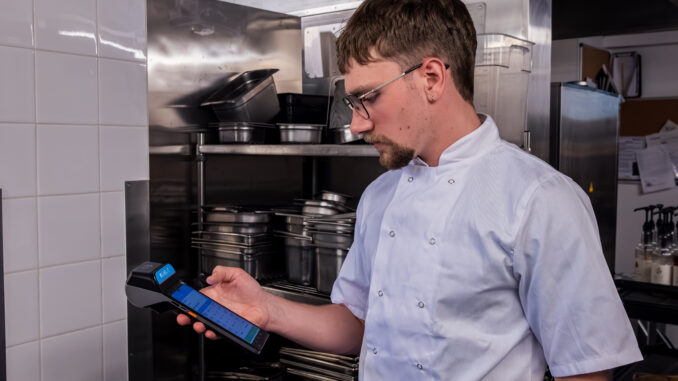
By Kyle Wilks - CEO and Co-Founder of Labl.it - 8.18.2026
Handwritten food labels aren’t failing because they’ve stopped working. They’re failing because commercial kitchens have changed.
Walk into almost any hospitality business today and it’s obvious how much the industry has evolved. Customers book tables online, browse digital menus, pay by phone and expect a seamless experience. Operators have embraced technology because every improvement helps them serve customers more efficiently.
Yet step through the kitchen door and, in many businesses, one of the most important food safety processes still relies on essentially the same method it did 20 years ago: someone picks up a marker and handwrites a food label.
That isn’t a criticism of the people doing the job. It’s simply an observation that the demands placed on commercial kitchens have changed beyond recognition while some of the processes supporting them have barely moved on.
Over the last several years, food preparation demands have increased and allergen management has become more complex, while operators have had to contend with labor shortages, rising costs and growing compliance requirements. Yet many kitchens are still relying on manual systems designed for a much simpler operating environment.
The scale of that challenge becomes clear when you consider the volume of food labeling taking place across the industry. Food labeling is fundamental to day-to-day kitchen operations. Every one of those labels needs to be accurate, legible and able to withstand scrutiny from an Environmental Health Officer.
The conversation around food labeling often focuses on compliance, but I think that misses the bigger picture. The real issue isn’t the labels themselves. It’s that people still have to write them out by hand.
We know chefs are under enormous pressure, working long hours in physically demanding environments where there is always another job waiting. Yet we continue asking skilled employees to spend valuable time on repetitive manual tasks simply because that’s how they’ve always been done.
When operators tell me they’re struggling to recruit, my instinct isn’t simply to ask how quickly they can adopt more technology. It’s to ask whether every task in that kitchen genuinely deserves a person’s time.
That’s an important distinction because automation shouldn’t be about replacing people. It should be about giving people more opportunity to do the work they’re actually employed to do. Most chefs can think of far better uses of their time than handwriting hundreds of labels every week.
Of course, it’s easy to understand why some operators remain cautious. Hospitality has been promised miracle technology before, only to discover systems that create more work than they eliminate.
Back of house also presents challenges that software developers don’t always appreciate. Kitchens are hot, wet and fast-moving environments where equipment has to withstand steam, grease and constant cleaning. A solution that works perfectly in an office can fail quickly in a commercial kitchen.
That may be one reason front-of-house technology has advanced more quickly. COVID accelerated investment in digital ordering, POS and payment systems because operators could immediately see the commercial benefit. Back of house has evolved more slowly, not because kitchens don’t need technology, but because much of the technology available until recently wasn’t designed around the realities of kitchen life.
That is beginning to change. Hardware is becoming more affordable and more robust, while software is becoming simpler rather than more complicated.
As those barriers continue to fall, I suspect we’ll look back at handwritten food labels in much the same way we now think about handwritten restaurant tickets. They weren’t necessarily wrong at the time, but eventually the better alternative became too obvious to ignore.
Whether legislation ultimately forces that change is another question. I don’t believe mandatory digital food labeling is imminent, but food safety regulation has a habit of evolving alongside public expectations. Natasha’s Law is a reminder of how quickly the regulatory landscape can change following a high-profile incident.
Hospitality shouldn’t have to wait for regulation before improving its own processes. The strongest businesses have always been those that look for better ways of operating before they’re told they have to.
If technology can reduce repetitive administration, improve traceability, strengthen compliance and make life easier for kitchen teams at the same time, then the question isn’t whether handwritten labels still work. It’s whether they remain the best use of a skilled chef’s time.
 Kyle Wilks is CEO and Co-Founder of Labl.it, which provides digital food labeling and compliance technology to thousands of commercial kitchens across the UK. Having worked closely with hospitality operators, he regularly shares insights on food safety, operational efficiency and the role of technology in modern commercial kitchens. Since launching, businesses using Labl.it have printed almost 47 million food labels, helping operators improve efficiency, strengthen compliance and reduce manual administration.
Are you an industry thought leader with a point of view on restaurant technology that you would like to share with our readers? If so, we invite you to review our editorial guidelines and submit your article for publishing consideration.
