
By Dustin Stone, Gavriel Shohet and Lea Mira, RTN staff writers - 6.22.2026
Restaurant automation is often associated with futuristic robotics, autonomous kitchens and ambitious visions of fully automated foodservice operations. Yet many of the most impactful innovations emerging today are designed to solve far more specific problems. Rather than replacing entire kitchen workflows, they target individual bottlenecks that limit throughput, constrain menu offerings and increase labor demands.
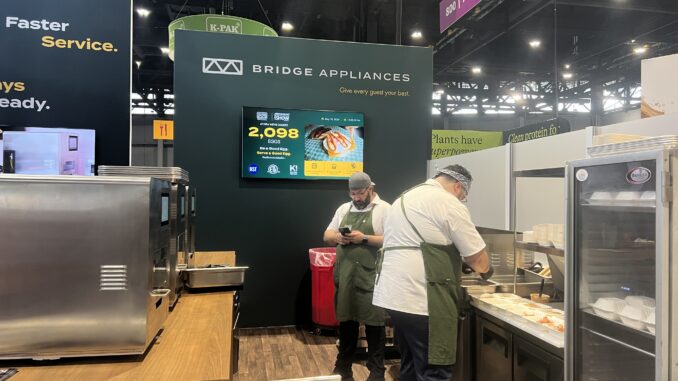
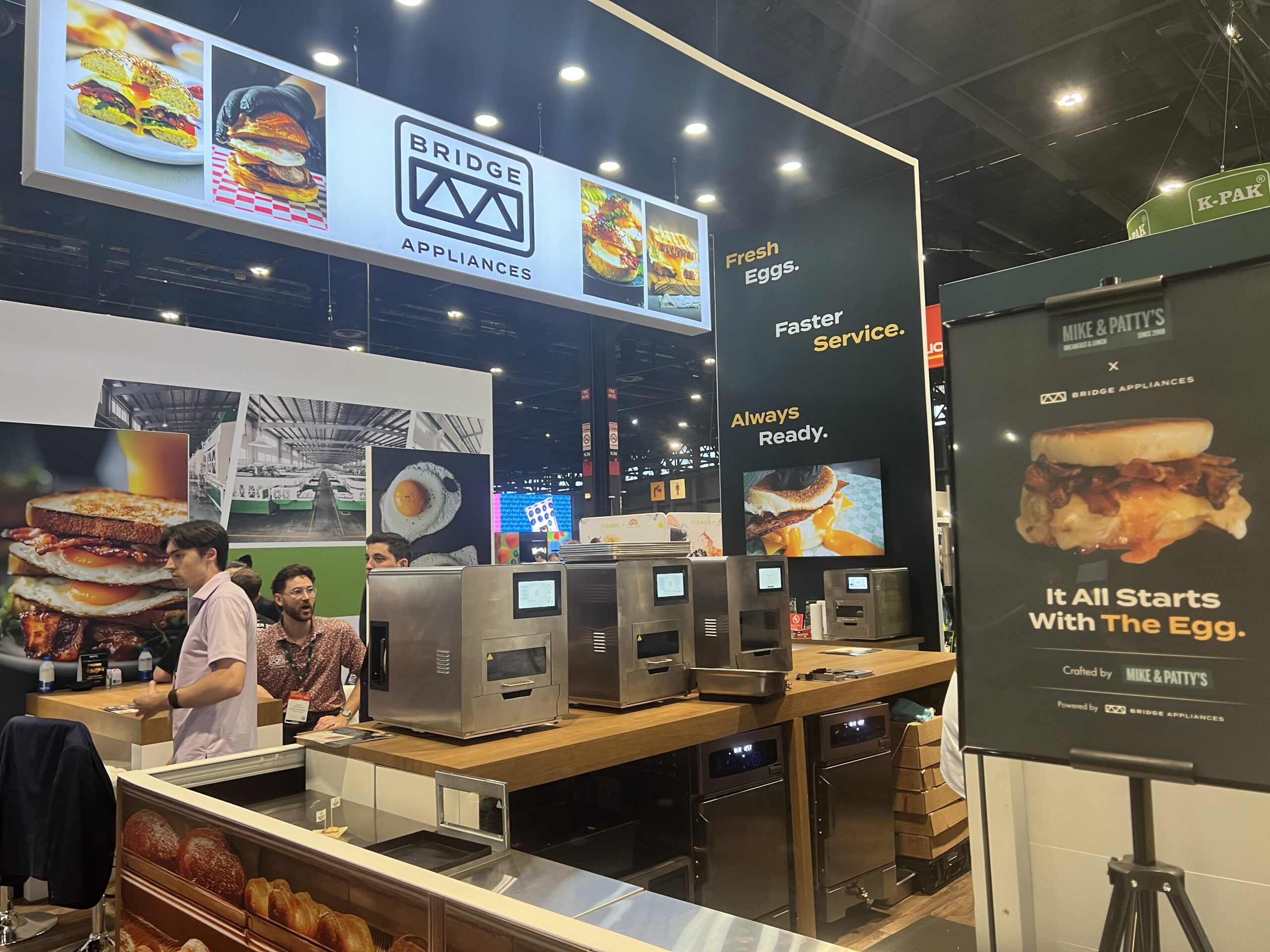
That approach was on display at this year’s National Restaurant Association Show, where exhibitors showcased a variety of technologies aimed at helping operators improve efficiency and consistency. Among them was Bridge Appliances, which demonstrated its flagship OMM automated egg cooker and highlighted a growing category of task-specific kitchen automation designed to address one of foodservice’s most persistent operational challenges: breakfast execution.
Exhibiting in both the cooking equipment and robotics categories, Bridge Appliances used the show to demonstrate how targeted automation can help restaurants increase throughput, improve consistency and expand breakfast offerings without significantly increasing labor requirements. The company’s flagship platform, OMM, also received a 2025 Kitchen Innovations Award, one of the industry’s most respected recognitions for equipment innovation.
At the center of Bridge’s strategy is OMM, which the company describes as the world’s first automated egg cooker. Designed specifically for commercial foodservice environments, OMM automatically cracks and cooks fresh shell eggs while providing operators with consistent output throughout service periods. The compact unit holds up to 40 eggs, supports multiple doneness settings and operates without requiring a traditional ventilation hood, making it suitable for a wide range of restaurant and hospitality environments.
While the technology itself attracts attention, the larger story is the operational challenge OMM is designed to solve. Breakfast remains one of the industry’s most attractive growth opportunities, yet it can also be one of the most operationally demanding dayparts. Fresh egg preparation requires labor, consistency and speed during highly compressed service windows. For many operators, that challenge has limited menu expansion and constrained growth.
Bridge Appliances was founded around the idea that breakfast preparation represents one of the most overlooked opportunities for kitchen automation. Company founder and CEO Lance Lentini has described observing foodservice operations where egg preparation routinely became the limiting factor during busy service periods. While operators wanted to expand breakfast offerings and increase sales, labor-intensive preparation processes often constrained their ability to do so.
That challenge extends across multiple foodservice segments. Specialty coffee operators increasingly seek to add breakfast sandwiches and protein-focused menu items to increase ticket values. Bakeries are expanding into savory offerings. Convenience retailers continue investing in freshly prepared food programs. Hotels are looking for ways to improve breakfast service while managing labor costs. In each case, egg preparation can become a bottleneck that affects both operational efficiency and revenue generation.
Bridge Appliances’ solution is not designed to replace kitchen employees. Instead, it automates a repetitive task that can consume valuable labor during peak periods. By reducing the time and attention required for egg preparation, employees can focus on other aspects of food production, guest service and order fulfillment.
This distinction is important because it reflects how many restaurant operators currently view automation. Rather than seeking wholesale workforce replacement, most are looking for technologies that help existing teams work more efficiently. The goal is often to increase throughput, improve consistency and reduce operational friction rather than eliminate labor entirely.
The business case becomes clearer when examining customer outcomes. According to Bridge Appliances, Beantrust, a specialty coffee operator, reported a 15 percent increase in average ticket value after introducing gourmet breakfast sandwiches supported by OMM. Rather than simply improving kitchen efficiency, the automation enabled the business to expand its menu and capture additional revenue opportunities.
That example highlights a broader trend in restaurant automation. Increasingly, operators are evaluating technology investments based not only on labor savings but also on their ability to unlock new revenue streams. A technology that enables menu expansion or increases order capacity can create meaningful value even if labor reductions are relatively modest.
The hospitality industry presents particularly interesting opportunities for this type of solution. Hotel breakfast programs often face challenges related to staffing, consistency and service speed. Many properties want to offer freshly prepared breakfast items but struggle to justify the labor requirements associated with traditional preparation methods.
A compact, hoodless automated egg-cooking solution can help address those concerns while supporting higher-quality breakfast offerings. For limited-service and select-service hotel brands in particular, technologies that improve breakfast operations without requiring significant kitchen infrastructure investments may become increasingly attractive.
Another factor contributing to Bridge Appliances’ appeal is its relatively accessible approach to automation. Large-scale robotic kitchen systems often require substantial investments, extensive operational changes and significant facility modifications. OMM is designed to fit into existing foodservice environments with far fewer barriers to adoption.
That accessibility reflects a broader trend within restaurant technology. Some of the industry’s most successful innovations solve narrowly defined problems exceptionally well. Operators frequently prefer targeted solutions that address specific operational challenges over technologies that require sweeping organizational changes.
The competitive landscape for kitchen automation continues expanding rapidly. New entrants are developing solutions for beverage preparation, cooking, food assembly and back-of-house operations. Bridge Appliances differentiates itself by focusing on a highly specific and often overlooked production bottleneck.
What makes the company’s story particularly compelling is that it illustrates the next phase of restaurant automation. Rather than pursuing fully autonomous kitchens, many operators are adopting technologies that automate individual tasks and improve workflow efficiency. These solutions are often easier to implement, easier to justify financially and more immediately relevant to day-to-day operations.
The broader implications extend beyond eggs or breakfast service. If specialized automation can successfully eliminate bottlenecks in one area of the kitchen, similar approaches may emerge across many other food-preparation processes. The future of restaurant automation may ultimately be defined not by massive robotic systems, but by a collection of targeted technologies that collectively improve operational performance.
Bridge Appliances sits squarely within that movement. By focusing on a common production challenge and developing a solution that addresses it directly, the company is helping demonstrate how practical automation can create measurable business value.
For restaurant operators, the lesson is straightforward. Some of the most significant opportunities for innovation are not always found in sweeping transformations. Sometimes they are found in solving the small but persistent bottlenecks that affect every shift, every order and every guest experience.
As restaurants continue searching for ways to improve efficiency, expand menu offerings and navigate labor constraints, technologies like OMM may play an increasingly important role. Bridge Appliances is betting that breakfast is just the beginning.
